What is operational risk management? A complete guide
In a world where businesses face unpredictable challenges every day, managing risks is essential to survival and growth. Operational risk management (ORM) is the process that helps companies prepare for, assess, and respond to risks that could harm their operations. Unlike financial risks or market risks, operational risks stem from internal processes, systems, people, or external events.
In this guide, we’ll walk through the basics of operational risk management, why it’s important, and how companies can use tools like CyberArrow GRC to simplify the process.
What is operational risk?
Operational risk refers to potential losses caused by issues in a company’s day-to-day functions. These risks could arise from:
- Human error: mistakes or oversights by employees or managers
- System failures: breakdowns in technology, software, or machinery
- Process issues: inefficient or poorly designed procedures
- External events: natural disasters, regulatory changes, or supply chain disruptions
Operational risks can impact a company’s revenue, reputation, and ability to meet its goals. While every business faces these risks, those that manage them well can maintain stability and growth, even in uncertain times.
What is operational risk management?
Operational risk management (ORM) is the process of identifying, assessing, monitoring, and mitigating operational risks. It involves a structured approach to understand and control risks in ways that protect the company’s resources and reputation. ORM helps businesses minimize the negative impact of potential disruptions on operations, allowing them to continue providing products or services with minimal interruptions.
Why is operational risk management important?
Implementing ORM provides several key benefits:
- Minimizes financial losses: Identifying risks early can help a company avoid costly incidents or issues.
- Protects reputation: A strong ORM framework can prevent risks that could damage customer trust and brand reputation.
- Increases operational efficiency: By managing risks, companies can identify inefficiencies and improve overall performance.
- Ensures compliance: Many industries require companies to have operational risk management practices to comply with regulations.
- Supports decision-making: With a clear understanding of risks, leaders can make informed decisions to protect and grow the business.
Types of operational risks
Operational risks can be classified into several categories:
1. People risks
This involves risks related to employees and their actions, such as human errors, misconduct, or a lack of training. For instance, a single error in data entry could lead to costly mistakes, especially if left undetected.
2. Process risks
These risks arise from poorly designed or inefficient business processes. For example, if a company doesn’t have a proper approval process for spending, it may lead to overspending or fraud.
3. Technology risks
Technology risks include system breakdowns, software failures, or cybersecurity threats. A malfunctioning software system could cause significant downtime, impacting operations and revenue.
4. External risks
External risks are risks outside the company’s control, such as natural disasters, regulatory changes, or supply chain disruptions. These events can harm a company’s operations or make it hard to deliver goods and services.
5. Legal and compliance risks
These risks involve non-compliance with laws, regulations, or industry standards. Failing to follow compliance requirements, for example, could lead to fines and legal issues.
The operational risk management process
ORM is a continuous process that involves four main steps: identification, assessment, mitigation, and monitoring.
1. Risk identification
The first step in ORM is to identify potential risks that could affect the organization’s operations. This involves analyzing various business areas, from employee actions to IT systems and external factors, to pinpoint vulnerabilities.
Common risk identification techniques:
- Risk assessments: Analyze and evaluate possible risks in each department.
- Incident reports: Review past incidents to identify recurring issues or gaps.
- Employee feedback: Involve staff in the risk identification process to gain insights from different perspectives.
2. Risk assessment
Once risks are identified, they need to be assessed to determine their potential impact and likelihood. This step helps prioritize which risks to address first based on their severity.
- Impact assessment: Evaluate the potential damage a risk could cause.
- Probability assessment: Estimate the likelihood of the risk occurring.
- Risk scoring: Assign scores to each risk to prioritize them for action.
3. Risk mitigation
Risk mitigation is the process of taking steps to minimize or eliminate risks. This can involve various strategies, such as implementing controls, enhancing security measures, or redesigning processes to reduce risk exposure.
Common Mitigation Strategies:
- Avoidance: Removing the risk entirely by changing certain practices.
- Reduction: Reducing the impact or likelihood of the risk.
- Transfer: Transferring the risk to a third party, such as purchasing insurance.
- Acceptance: Accepting the risk if its impact and probability are low.
4. Risk Monitoring
ORM is not a one-time process; it requires ongoing monitoring and regular assessments. This ensures that new risks are identified, and mitigation efforts are updated as business needs change.
- Regular audits: Conduct periodic reviews to ensure that risk controls are effective.
- Continuous tracking: Use software tools to monitor risks in real time.
- Reporting: Regularly report risk status to management to keep them informed.
Challenges in operational risk management
Managing operational risks can be complex, and many organizations face challenges in implementing effective ORM practices:
- Lack of resources: Small businesses may lack the resources or expertise needed to implement ORM.
- Data overload: Too much data can make it difficult to identify and track critical risks.
- Resistance to change: Employees may resist new processes or controls if they are not effectively communicated.
- Complexity of regulations: Compliance with multiple regulatory standards can be challenging, especially in global organizations.
Best practices for effective operational risk management
To ensure that ORM is effective, consider these best practices:
- Involve all departments: ORM is not limited to one department; it should involve input from all areas of the business.
- Use technology: Leveraging tools like CyberArrow GRC can streamline risk tracking, monitoring, and reporting.
- Regular training: Train employees to recognize and report risks, and make sure they understand the importance of ORM.
- Set clear risk tolerance levels: Define the acceptable level of risk for your organization and communicate it.
- Review and update regularly: Regularly assess and update your ORM strategy to account for new risks or business changes.
How CyberArrow GRC simplifies operational risk management
CyberArrow GRC is a comprehensive governance, risk, and compliance (GRC) tool designed to help organizations manage operational risks efficiently. With its risk management module, CyberArrow GRC provides everything you need to identify, assess, mitigate, and monitor risks in real time.
Here’s how CyberArrow GRC can benefit your operational risk management:
- Automated risk identification: CyberArrow’s risk management module helps automate the risk identification process, pulling data from various systems to highlight potential risks.
- Centralized risk assessment: Easily assess and prioritize risks based on real-time data and scoring methods.
- Efficient mitigation: CyberArrow GRC allows you to set up risk mitigation plans and monitor progress in a streamlined way.
- Continuous monitoring: Real-time dashboards keep you informed of your risk status, allowing for quick responses to emerging risks.
- Comprehensive reporting: Generate detailed reports on your operational risks and mitigation efforts, making it easier to communicate with stakeholders and meet compliance standards.
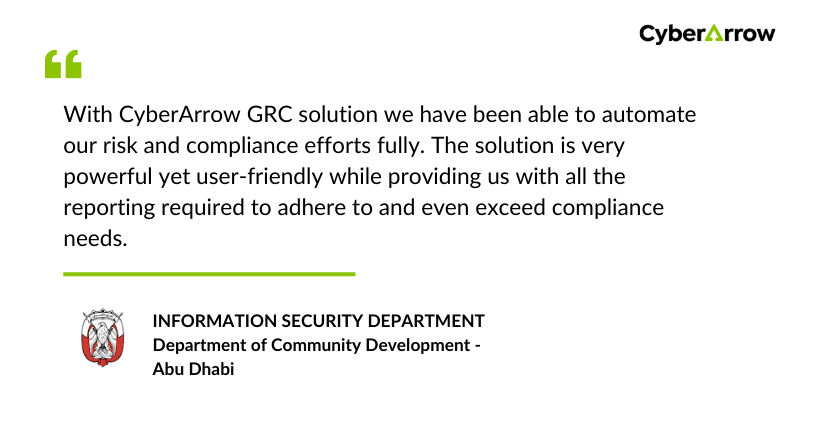
Read how CyberArrow GRC improved risk assessments for DCD – Abu Dhabi.
See what DCD – Abu Dhabi has to say about CyberArrow GRC: