Responsibilities of a Chief Compliance Officer and how CyberArrow GRC is the perfect tool for CCOs
In a world filled with regulations and strict standards, businesses face increasing demands to stay compliant. Leading this charge is the Chief Compliance Officer (CCO)—the executive responsible for guiding organizations through the maze of legal and regulatory obligations. As compliance requirements evolve, the role of a CCO becomes even more critical.
This guide explains the key responsibilities of a Chief Compliance Officer and how tools like CyberArrow GRC can help streamline their work.
By the end, you’ll clearly understand a CCO’s role and how CyberArrow GRC can support a CCO in building a strong, compliant, and risk-aware organization.
What is a Chief Compliance Officer?
A Chief Compliance Officer (CCO) is an executive responsible for ensuring that an organization complies with external regulations, internal policies, and industry standards. The CCO develops, monitors, and enforces compliance programs to avoid fines, legal issues, and reputational damage. This role is especially important in industries like finance, healthcare, and technology, where compliance rules are strict.
Why is the role of a Chief Compliance Officer important?
The CCO is crucial to the success and reputation of a business. Non-compliance can lead to penalties, legal consequences, and loss of customer trust. A strong compliance officer on board minimizes these risks and promotes a culture of responsibility, ethics, and transparency within the company.
Some key reasons why the CCO’s role is essential include:
- Protecting the organization from legal risks: The CCO identifies and addresses risks before they become costly issues.
- Ensuring ethical standards: CCOs build an ethical workplace by enforcing policies that align with corporate values.
- Safeguarding customer data: In sectors with data protection laws, CCOs help maintain customer privacy and data security.
- Improving company reputation: Organizations known for compliance and ethics often attract more customers and partners.
Primary responsibilities of a Chief Compliance Officer
A CCO wears many hats in their role. Let’s explore the core responsibilities that define their work:
1. Developing compliance programs
One of the CCO’s primary tasks is to create compliance programs tailored to the organization’s needs. These programs outline procedures and policies to ensure all employees understand and follow compliance requirements.
- Policies and procedures: Draft guidelines for how the organization should handle various compliance aspects.
- Standard Operating Procedures (SOPs): Develop SOPs that simplify compliance tasks for all departments.
- Internal controls: Implement control measures to detect, prevent, and resolve compliance issues.
2. Risk assessment and management
Compliance is deeply linked to managing risk. The CCO assesses areas where the organization is vulnerable and takes action to mitigate those risks. This includes conducting regular assessments to identify new risks or changing risk levels.
- Risk identification: Identify potential risks associated with compliance in each department.
- Risk analysis: Evaluate the impact and likelihood of risks to prioritize them effectively.
- Monitoring: Continuously monitor risks and adjust strategies as necessary.
3. Conducting compliance audits
Regular audits are essential for spotting compliance issues. A CCO oversees internal audits to verify that policies are followed and correct any violations. These audits also provide insights that help refine compliance programs.
- Internal audits: Conduct audits to detect gaps or violations in compliance processes.
- External audits: Collaborate with external auditors to verify adherence to industry standards.
- Follow-up: Implement corrective actions based on audit findings to prevent future issues.
4. Training and education
Employees need to understand compliance expectations and procedures. The CCO is responsible for designing and implementing training programs that keep the workforce informed about new policies and regulations.
- New employee training: Introduce new hires to the organization’s compliance policies and procedures.
- Ongoing training: Regularly update employees on changes in regulations or internal policies.
- Role-based training: Tailor training sessions to fit specific roles and their compliance responsibilities.
5. Ensuring regulatory compliance
The CCO must stay informed about regulations that apply to their industry. This includes monitoring any changes in these laws and updating company policies accordingly.
- Regulatory updates: Stay current on regulatory changes that affect the organization.
- Policy updates: Revise policies as necessary to align with new regulations.
- Reporting: Provide reports to regulatory bodies as required by law.
6. Reporting to the board of directors
A CCO typically reports to the board on the status of compliance efforts. They offer insights into compliance challenges, achievements, and risk levels.
- Compliance reports: Prepare regular reports that summarize compliance activities.
- Board presentations: Present compliance status updates to the board and senior management.
- Transparency: Ensure that the board understands potential risks and compliance gaps.
7. Handling compliance violations
When a compliance violation occurs, the CCO is responsible for managing it swiftly and efficiently. They investigate the incident, identify the cause, and implement corrective actions.
- Investigation: Look into the cause of the violation to understand what went wrong.
- Corrective actions: Implement measures to prevent similar incidents in the future.
- Documentation: Keep a record of compliance violations and actions taken to resolve them.
Challenges faced by Chief Compliance Officers
The CCO’s role comes with challenges, including:
- Rapid regulatory changes: Keeping up with frequently changing laws can be overwhelming.
- Cross-departmental coordination: Compliance affects all areas of an organization, requiring coordination across departments.
- Complex data protection laws: Data privacy regulations like GDPR add complexity to compliance.
- Resource constraints: Limited budgets and staff can make compliance harder to manage effectively.
How CyberArrow GRC supports Chief Compliance Officers
Compliance can be overwhelming without the right tools. CyberArrow GRC is a governance, risk, and compliance platform designed to make compliance management easier. With CyberArrow GRC, CCOs can automate compliance tasks, monitor risks, and maintain a compliance-first culture.
Key features of CyberArrow GRC for CCOs
- Automated compliance tracking: CyberArrow continuously tracks compliance status, reducing manual effort and improving accuracy.
- Risk assessment and management: CyberArrow’s risk assessment module helps identify, assess, and manage risks, simplifying the CCO’s job.
- Centralized reporting and documentation: Easily generate detailed compliance reports for the board, regulators, and auditors.
- Real-time monitoring: Get real-time alerts on compliance issues, enabling faster responses to potential violations.
- Training modules: CyberArrow offers built-in training tools to help CCOs train employees on compliance policies.
Benefits of using CyberArrow GRC for compliance management
Using CyberArrow GRC offers numerous benefits for Chief Compliance Officers:
- Reduced workload: Automate repetitive compliance tasks, allowing CCOs to focus on higher-priority tasks.
- Enhanced accuracy: Minimize human errors in compliance tracking and reporting.
- Improved risk visibility: Gain insights into compliance risks across the organization.
- Faster audits: Streamline internal audits with CyberArrow’s documentation and reporting features.
- Comprehensive training: Organize and track employee training to ensure compliance understanding.
Empower your role as a Chief Compliance Officer with CyberArrow GRC. Make compliance less stressful and more manageable by leveraging a tool that automates, monitors, and simplifies the entire compliance process.
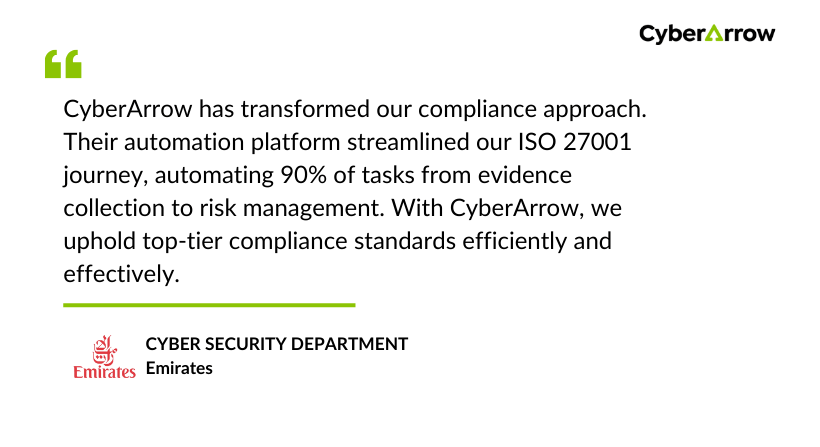
See what Emirates has to say about CyberArrow GRC: