What is a compliance management system?
In today’s world, businesses operate under strict regulations, policies, and industry standards that protect customers, data, and operations. A compliance management system (CMS) helps companies adhere to these rules effectively. By simplifying complex regulations, a CMS assists businesses in meeting their legal, regulatory, and industry requirements, which minimizes the risk of fines, legal issues, and reputational damage.
In this guide, we’ll explore what a compliance management system is, its benefits, and how it functions. Let’s also look at how tools like CyberArrow GRC can automate and streamline compliance management to make your business operations smoother and more secure.
- What is a compliance management system?
- Why is a compliance management system important?
- Key components of a compliance management system
- How does a compliance management system work?
- Benefits of using a compliance management system
- Challenges of implementing a compliance management system
- Best practices for compliance management
- How CyberArrow GRC simplifies compliance management
What is a compliance management system?
A compliance management system (CMS) is a framework that helps an organization manage, monitor, and ensure that it complies with relevant laws, regulations, and policies. It involves a combination of tools, processes, and practices designed to prevent, detect, and resolve issues related to regulatory compliance.
A well-built CMS can help a company:
- Reduce the risk of legal penalties and fines
- Build a strong, trustworthy brand
- Protect customer data and privacy
- Improve overall operational efficiency
Why is a compliance management system important?
Compliance is not optional for most businesses. Companies in finance, healthcare, and data management, for example, are required to follow strict rules to protect customers and maintain fair practices. A CMS makes compliance achievable by creating a structured process for staying informed about and adhering to new regulations.
Some key reasons why a CMS is essential include:
- Avoidance of legal consequences: Non-compliance can lead to severe financial penalties and legal issues.
- Enhanced reputation: Companies that prioritize compliance are seen as trustworthy and reliable, helping attract customers and partners.
- Better operational control: Compliance management systems make it easier to identify and manage risks across different departments.
- Data security and privacy: Compliance with data protection regulations reduces the risk of data breaches and builds trust with customers.
Key components of a compliance management system
An effective CMS includes several essential components that work together to create a comprehensive approach to compliance.
1. Policies and procedures
At the core of a CMS are the policies and procedures that outline the organization’s standards, expectations, and legal requirements. These documents provide a roadmap for employees, ensuring they understand what is expected of them in different situations.
Key policies often covered:
- Data security and privacy policies (e.g., for GDPR or CCPA compliance)
- Financial and accounting standards
- Employee conduct and workplace ethics
- Safety and environmental policies
2. Risk assessment
Risk assessment identifies areas where the organization may be vulnerable to compliance issues. For example, in data management, a risk assessment may reveal potential gaps in data security practices.
Steps in risk assessment:
- Identify potential risks: Highlight areas where non-compliance could occur.
- Analyze impact: Evaluate how severe the impact of each risk might be.
- Prioritize risks: Focus on the most significant risks first.
3. Monitoring and testing
Once policies are in place, continuous monitoring and testing ensure that these guidelines are being followed. This step often involves setting up metrics, running audits, and using software to monitor compliance in real time.
- Compliance audits: Regular audits help detect any non-compliance issues.
- Key Performance Indicators (KPIs): Track metrics that show how well compliance efforts are working.
- Internal reviews: Department heads review compliance on a routine basis.
4. Training and education
Education and training are crucial for ensuring that employees understand and follow compliance policies. Training programs also help reduce the risk of accidental non-compliance by ensuring everyone knows the proper procedures.
- Onboarding: Introduce new employees to compliance requirements from the start.
- Regular updates: Provide ongoing training, especially when laws or internal policies change.
- Role-specific training: Customize training to fit the specific responsibilities of different roles.
5. Issue resolution and corrective action
If a compliance issue does arise, having a clear process for resolving it is crucial. This component ensures quick and efficient handling of non-compliance situations to minimize harm to the organization.
- Incident response plans: Prepare response plans for different types of compliance violations.
- Corrective action: Implement steps to prevent similar issues in the future.
- Documentation: Keep a record of incidents and actions taken to show regulatory authorities, if needed.
6. Reporting and documentation
A CMS requires documentation and reporting to provide a clear trail of compliance actions. This is not only important for internal tracking but also serves as evidence for regulators.
- Compliance reports: Generate regular reports that summarize compliance activities.
- Audit logs: Keep detailed records of all compliance checks and updates.
- Stakeholder updates: Regularly inform stakeholders, including senior management, about compliance status.
How does a compliance management system work?
A CMS generally follows a process cycle designed to ensure ongoing compliance. This cycle includes:
- Identification: Identify the relevant regulations and internal policies that the organization needs to follow.
- Implementation: Develop policies, procedures, and controls to comply with these regulations.
- Monitoring: Continuously monitor processes to ensure adherence to policies.
- Review and improvement: Regularly review and update the CMS to adapt to changing regulations or business processes.
Benefits of using a compliance management system
Using a CMS can offer various benefits for organizations, including:
- Improved efficiency: Streamlined processes save time and resources.
- Reduced risk: A CMS minimizes the likelihood of non-compliance by identifying risks early.
- Enhanced data security: Compliance with data security regulations helps protect sensitive information.
- Better employee awareness: Training programs keep employees informed of compliance standards.
- Transparency for stakeholders: Reporting and documentation provide transparency, building trust with regulators, partners, and customers.
Challenges of implementing a compliance management system
While a CMS offers many advantages, it can also present challenges:
- Cost: Setting up a CMS can require significant investment, especially for small businesses.
- Complexity: Managing multiple regulations across different jurisdictions can be complex.
- Continuous updates: Regulations change frequently, requiring constant updates to policies and practices.
- Resistance to change: Employees may resist new procedures if they view them as burdensome.
Best practices for compliance management
To make the most of a CMS, follow these best practices:
- Start with a risk assessment: Assess risks to identify the areas that require the most attention.
- Use technology: Automate monitoring, reporting, and documentation processes with software.
- Provide regular training: Ensure employees understand compliance requirements.
- Review regularly: Update policies and procedures frequently to stay compliant with changing regulations.
- Create a compliance culture: Foster a workplace culture that values compliance at all levels.
How CyberArrow GRC simplifies compliance management
Compliance management systems can be challenging to implement and maintain, but CyberArrow GRC simplifies this process with automation tools and centralized management features. CyberArrow GRC is an all-in-one governance, risk, and compliance (GRC) platform that streamlines compliance efforts by automating complex tasks and reducing the need for manual intervention.
Key features of CyberArrow GRC for compliance management
- Automated compliance tracking: CyberArrow GRC continuously monitors your organization’s compliance status, reducing the need for manual audits.
- Risk assessment module: Easily assess compliance-related risks with CyberArrow’s risk assessment tools.
- Real-time monitoring: CyberArrow provides real-time tracking and alerts, making it easy to respond quickly to any potential compliance issues.
- Centralized reporting: Generate detailed compliance reports with a few clicks, ensuring transparency and simplifying regulatory submissions.
- Employee training modules: CyberArrow helps companies organize and track compliance training to keep employees up-to-date on policies.
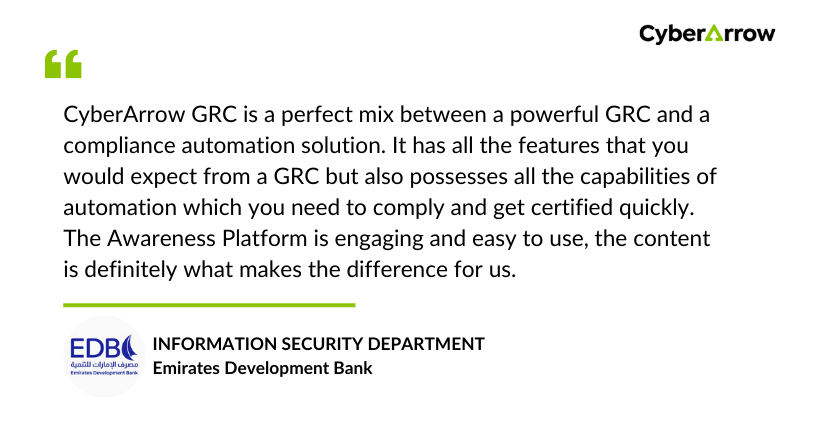
See what EDB has to say about CyberArrow GRC: