DFARS compliance: A comprehensive guide for DoD contractors
If your company works with the Department of Defense (DoD), you’ve probably heard the term DFARS compliance. It’s easy to see it as just another box to tick, but here’s the real question:
What’s the cost of getting it wrong?
In today’s landscape, complying with the Defense Federal Acquisition Regulation Supplement (DFARS) isn’t just about protecting contracts. It’s about securing sensitive data, defending national security, and ensuring your business stays in the game.
From securing critical information to avoiding potential penalties, mastering DFARS compliance is a lot more than paperwork—it’s about future-proofing your operations.
Ready to dive in? Let’s break it down, step by step.
What is DFARS compliance?
DFARS compliance means following rules that the Department of Defense (DoD) has established to protect sensitive information. If your business works with the DoD or handles Controlled Unclassified Information (CUI), you need to follow specific cyber security steps.
These steps come from the NIST SP 800-171 guidelines, which tell you how to keep information safe. They include access control, incident response, data encryption, and more.
If your company doesn’t meet these requirements, it can lose its contracts or face penalties. So, if you’re working with the DoD, ensuring your systems are safe and compliant is crucial to staying in business.
Why is DFARS compliance important?
DFARS compliance is critical for businesses working with the Department of Defense (DoD). It helps ensure the safety of sensitive defense data and maintains your eligibility for government contracts.
Here’s why it matters:
- Risk of non-compliance: Failure to meet DFARS requirements can have serious consequences. Companies may face contract termination, penalties, or even exclusion from future DoD contracts. These risks can damage both your bottom line and your reputation, potentially impacting your ability to work with other government agencies as well.
- Support to national security: DFARS compliance ensures that contractors follow strict security measures to protect defense-related information. By adhering to these standards, you play an important role in securing information vital to national security. Keeping defense data safe from cyberattacks and unauthorized access helps protect the country.
- Safeguard controlled unclassified information (CUI): CUI refers to sensitive information that, while not classified, must be handled with care. This includes data such as defense contracts, design specifications, or operational details. DFARS compliance ensures this information is appropriately secured, reducing the risk of unauthorized access or cyber threats.
What are the DFARS compliance requirements?
To meet DFARS compliance, contractors working with the DoD must adhere to cyber security standards to protect CUI. The key requirements come from the NIST SP 800-171 framework, which outlines the necessary security controls.
Here are the main areas contractors need to focus on:
- Access control: Companies must restrict access to systems and data only to authorized personnel. This includes implementing strong authentication measures and limiting access based on job roles.
- Incident response: A plan must be in place for detecting, reporting, and responding to cyber security incidents. This includes promptly notifying the DoD of any breaches or security threats.
- Data protection: Sensitive information, including CUI, must be protected through encryption and secure storage practices, both when it’s stored and transmitted across networks.
- System and communications security: Contractors must safeguard their communication systems from cyber threats, ensuring that data is transmitted securely and preventing unauthorized access.
- Audit and accountability: Companies must track system activities, monitor user actions, and maintain audit logs to ensure accountability for any misuse or unauthorized actions.
Some other DFARS compliance requirements include awareness and training, physical protection, systems and information integrity, personnel security, and media protection.
Cyber security Maturity Model Certification (CMMC) and its relation to DFARS
The Cyber security Maturity Model Certification (CMMC) is a framework to ensure that contractors working with the DoD meet specific cyber security standards. While DFARS requires compliance with NIST SP 800-171, CMMC takes it further by implementing a tiered system of maturity levels, ranging from basic cyber hygiene (Level 1) to advanced practices (Level 5).
CMMC will eventually be a mandatory requirement for all DoD contractors and subcontractors. Each contract will specify the required level of certification based on the sensitivity of the data being handled. This certification ensures contractors have the appropriate security measures to protect CUI and other critical defense-related data.
Quick link: ISO 27001 for startups
Steps to achieve DFARS compliance
You need to follow several steps to achieve DFARS compliance and ensure your organization meets cyber security standards.
Here’s how you can approach it:
1. Conduct a gap analysis
The first step is to assess your current cyber security practices. Conduct a gap analysis to identify which of the required NIST SP 800-171 security controls are already in place and which are missing. This will give you a clear picture of what needs to be improved to meet DFARS requirements.
2. Implement security controls (based on NIST SP 800-171)
Once you’ve identified gaps, the next step is to implement the necessary security controls based on the NIST SP 800-171 guidelines. These controls cover everything from access management to encryption and incident response. Each control ensures that sensitive defense information, such as CUI, is adequately protected.
Depending on your business size and operations, you may need to invest in new technologies or update your current systems.
3. Continuous monitoring and reporting
DFARS compliance isn’t a one-time effort—it requires continuous monitoring of your systems and practices to ensure ongoing security. Implement tools that help you monitor network activity, detect vulnerabilities, and respond to potential threats. Additionally, you’ll need to maintain accurate records and be prepared to report any incidents to the DoD on time. Regular audits and reviews are also essential for ensuring long-term compliance.
4. Train employees on DFARS requirements
Your employees play a crucial role in maintaining DFARS compliance. Make sure they are trained on the specific security protocols and best practices outlined by NIST SP 800-171. This includes training on recognizing potential cyber security threats, handling sensitive information properly, and following the necessary incident response procedures.
Regular training helps keep everyone informed and reduces the risk of accidental security breaches.
Quick link: The role of cryptography in compliance
Simplify your path to DFARS compliance with CyberArrow
Navigating DFARS compliance doesn’t have to be overwhelming. With CyberArrow, you can transform how you approach compliance, making the process manageable and efficient.
Here’s how CyberArrow can be your trusted partner in achieving DFARS compliance:
- Automate your compliance journey: CyberArrow automates the entire DFARS compliance workflow, from conducting gap analyses to implementing necessary compliance controls. Our tool simplifies the certification process, allowing you to focus on what matters most—growing your defense business.
- Continuous monitoring made easy: CyberArrow takes the stress out of compliance with ongoing monitoring. Forget tedious spreadsheets and the hassle of tracking security controls across multiple systems. With over 50 integrations, CyberArrow automatically gathers evidence and maintains your compliance posture.
- Real-time security KPI monitoring: Our platform integrates seamlessly with your existing technologies, providing automated assessments and reports on key security performance indicators (KPIs). This allows you to allocate your time and resources effectively while keeping your organization secure.
- Streamlined risk management: CyberArrow automates the risk management process. With over 300 pre-mapped risks and mitigations specific to DFARS and other standards, you can upload your existing manual spreadsheets and leverage powerful reporting dashboards, making risk management straightforward and efficient.
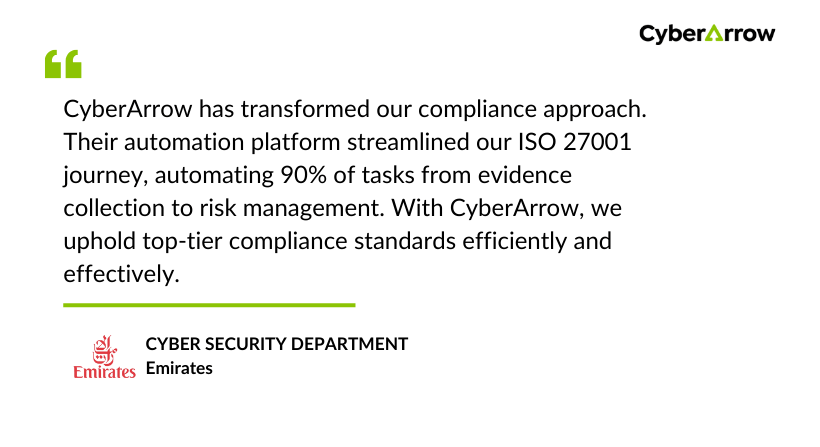
See what Emirates have to say about CyberArrow GRC: