


5 common compliance standards enterprises should know about
Understanding enterprise compliance can sometimes feel like juggling too many balls at once. When you think you’ve got a handle on one set of regulations, the rules change, or new ones pop up.
Are you wondering which compliance standard is the right fit for your company?
Many organizations face multiple standards, especially when answering customer questions or meeting various regulatory requirements across different regions and industries.
This article lists five common compliance standards every enterprise should know about.
Let’s dive in!
- 5 common compliance standards you should know
- Overcome compliance standards challenges with CyberArrow
5 common compliance standards you should know
Here are five common compliance standards you should know:
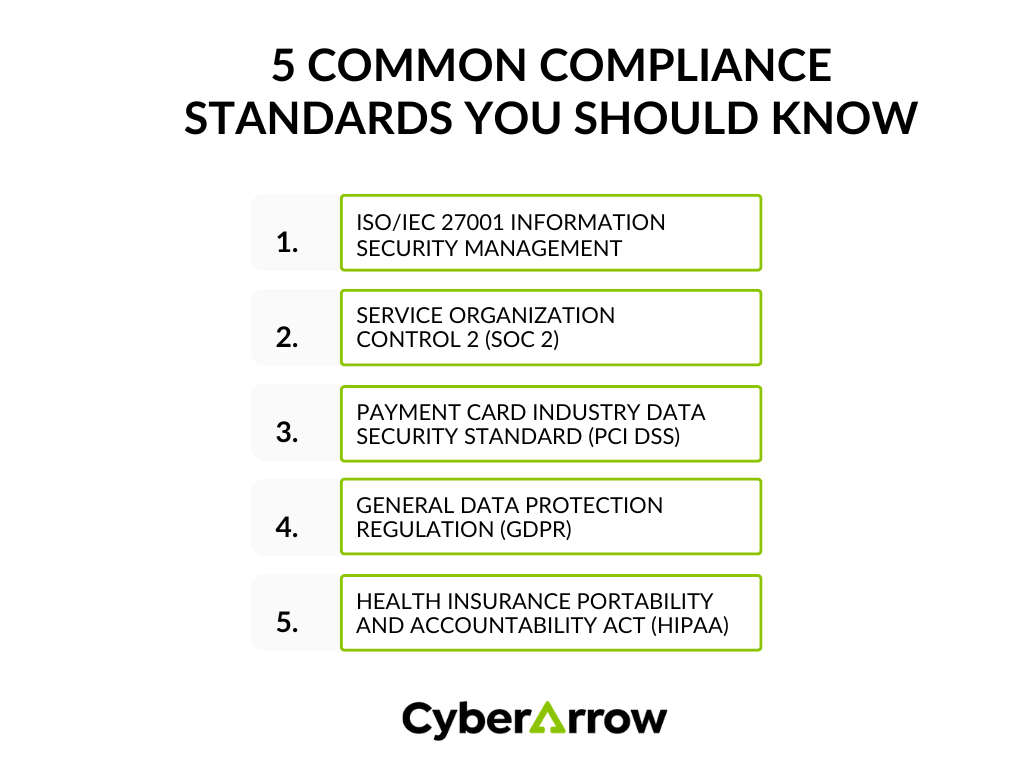
1. ISO/IEC 27001 Information Security Management
ISO 27001 is an international standard that manages and protects sensitive information. It sets out the criteria for an information security management system (ISMS) to ensure that data remains secure.
Organizations use this standard to create, implement, maintain, and continuously improve their information security management systems. Its goal is to protect data from threats and ensure its confidentiality, integrity, and availability.
Key requirements
- Risk assessment and treatment: Identify potential risks to information security and take appropriate measures to manage and mitigate these risks.
- Information security policies and controls: Develop and enforce policies and controls to safeguard information. This includes everything from physical security to cyber threats.
Organizations that comply with ISO 27001 can significantly improve their security measures. Moreover, ISO 27001 certification demonstrates a commitment to protecting sensitive information, which can boost confidence among clients and partners.
However, setting up an ISMS can be complex and time-consuming, requiring substantial resources and expertise. It may involve regular audits and updates to policies and controls, which can be resource-intensive.
2. Service Organization Control 2 (SOC 2)
SOC 2 is a framework to manage and secure customer data. It’s specifically designed for service organizations that handle sensitive customer data. SOC 2 certification provides customers with confidence that their data is handled securely. Moreover, SOC 2 compliance can distinguish a company from competitors who may not have the same level of security.
SOC 2 is based on five trust service criteria (TSC):
- Security: To protect data against unauthorized access.
- Availability: To ensure systems are available and operational when needed.
- Processing integrity: To guarantee that data processing is accurate and complete.
- Confidentiality: To safeguard sensitive information from unauthorized disclosure.
- Privacy: Managing personal information according to privacy policies.
Types of SOC 2 reports
There are two types of SOC 2 reports:
- Type I: Evaluates the design of controls at a specific point in time.
- Type II: Assesses the operational effectiveness of controls over a period of time.
3. Payment Card Industry Data Security Standard (PCI DSS)
PCI DSS is a set of security standards to protect payment card information. It applies to any organization that handles payment card data. Any business that processes, stores, or transmits payment card information must comply with PCI DSS.
Compliance with PCI DSS helps lower the risk of payment card data breaches and fraud. It also helps avoid costly fines and legal consequences associated with data breaches.
Key requirements
- Protect cardholder data: Store and encrypt payment card information to prevent unauthorized access.
- Maintain a secure network: Implement robust network security measures to protect against breaches.
Common challenges
- Compliance with evolving standards: PCI DSS standards are regularly updated, requiring businesses to stay informed and adapt.
- Implementation costs and resources: Meeting PCI DSS requirements can be expensive and resource-intensive, particularly for smaller businesses.
4. General Data Protection Regulation (GDPR)
GDPR is a regulation that governs data protection and privacy for individuals within the European Union (EU). It sets guidelines for the collection and processing of personal data.
GDPR applies to any organization that handles the personal data of EU residents, regardless of where the organization is based.
Key requirements
- Data protection principles: Personal data should be collected and processed fairly, transparently, and only for specified purposes.
- Rights of individuals: Provide individuals with rights such as accessing their data and requesting its deletion.
GDPR helps organizations enhance their data protection practices, leading to better security. Compliance with GDPR can improve customer trust by demonstrating a commitment to data privacy.
However, understanding and implementing GDPR requirements across different jurisdictions can be complex. Moreover, GRPR compliance with data subject rights requires robust systems and processes.
5. Health Insurance Portability and Accountability Act (HIPAA)
HIPAA is a US law that protects the privacy and security of health information. It applies to healthcare providers, insurers, and their business associates. Any organization handling protected health information (PHI) must comply with HIPAA.
Key requirements
- Protect patient health information: Implement safeguards to protect the confidentiality and security of patient health data.
- Administrative, physical, and technical safeguards: Establish policies and procedures, physical access controls, and technical measures to protect PHI.
HIPAA compliance helps secure sensitive health information and maintain privacy. It also helps avoid the significant fines and legal issues that can arise from violations.
However, keeping up with technological changes and ensuring that security measures remain effective can be challenging. Also, ensuring data is secure while still accessible to authorized personnel is a delicate balance.
Overcome compliance standards challenges with CyberArrow
Compliance standards like ISO 27001, SOC 2, PCI DSS, GDPR, and HIPAA are essential to secure sensitive data, ensure operational integrity, and build customer trust. However, complying with these standards can be complex and time-consuming, especially as regulations evolve and become more strict.
Organizations often struggle to stay up-to-date, manage documentation, and ensure continuous compliance while maintaining focus on their core business operations.
Here, compliance automation tools like CyberArrow can help. CyberArrow simplifies and automates the entire compliance process. With features like automated evidence collection, real-time monitoring, and comprehensive risk assessments, CyberArrow takes the guesswork out of compliance.
Whether you’re aiming to meet a specific standard or maintain ongoing compliance, CyberArrow provides the tools and support needed to achieve and sustain compliance with confidence.
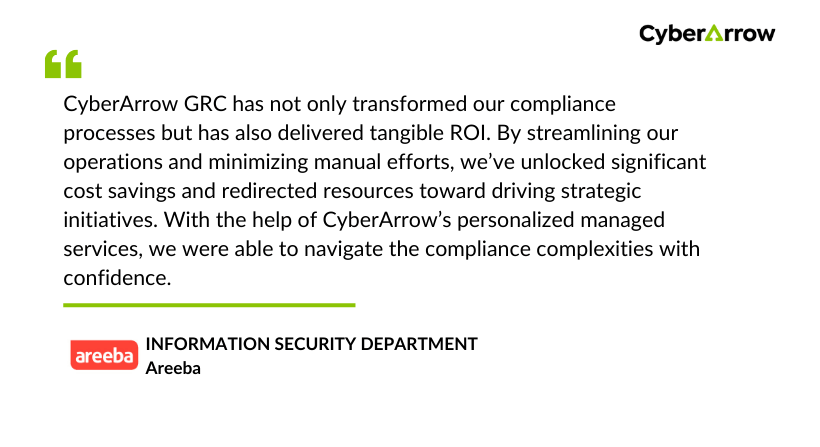
Don’t take our word for it; see what big companies say about CyberArrow:
Ready to simplify compliance?
