GRC analyst: Career, roles & salary guide
In the fast-paced world of compliance and risk management, organizations need skilled professionals who can ensure that they stay compliant with regulations while managing risks. One essential role that meets this need is the GRC analyst. A GRC (Governance, Risk, and Compliance) analyst helps organizations develop and implement strategies that keep them compliant, manage risks, and create a safe and ethical workplace.
This guide covers everything you need to know about a career as a GRC analyst—what the role involves, key responsibilities, and the average salary.
By the end, you’ll understand what it takes to succeed as a GRC analyst and why this career is crucial for today’s businesses.
- What is a GRC analyst?
- Why choose a career as a GRC analyst?
- Key responsibilities of a GRC analyst
- Skills required to become a GRC analyst
- Salary expectations for GRC analysts
- Factors affecting GRC analyst salaries
- Career path and growth opportunities for GRC analysts
- How to become a GRC analyst
- How CyberArrow GRC supports GRC analysts
- Conclusion: Make GRC management easier with CyberArrow GRC
What is a GRC analyst?
A GRC analyst is a professional responsible for managing governance, risk, and compliance within an organization. This role involves developing policies, assessing risks, ensuring regulatory compliance, and implementing control measures. GRC analysts work closely with different departments to monitor compliance and manage any risks that may arise.
In fields like finance, healthcare, and tech, regulatory and security requirements are strict. A GRC analyst helps ensure that organizations meet these standards, protecting both the company and its customers from legal and financial risks.
Why choose a career as a GRC analyst?
Working as a GRC analyst can be rewarding for those interested in risk management, compliance, and organizational security. As more companies adopt digital tools, the demand for GRC professionals is rising. The role offers job stability, good earning potential, and growth opportunities.
Here are a few reasons why a career as a GRC analyst is a smart choice:
- High demand: Compliance and risk management are critical for any organization. This role is highly sought after in industries like banking, insurance, and tech.
- Competitive salary: GRC analysts often earn good salaries, with compensation increasing as they gain experience.
- Career growth: A GRC analyst role can lead to higher positions, such as GRC Manager, Chief Compliance Officer, or Chief Risk Officer.
- Impactful work: GRC analysts play a key role in protecting their company from legal and reputational risks, making the work both impactful and fulfilling.
Key responsibilities of a GRC analyst
A GRC analyst performs various tasks focused on compliance, risk, and governance. Here’s a closer look at their primary responsibilities:
1. Conducting risk assessments
Risk assessment is a core responsibility of a GRC analyst. They evaluate potential risks within the organization and assess how these risks could impact operations and reputation.
- Risk identification: Identify potential risks related to compliance, cyber security, and data protection.
- Risk evaluation: Analyze the likelihood and impact of each risk to prioritize them.
- Risk mitigation: Develop strategies to reduce or eliminate risks.
2. Monitoring compliance programs
GRC analysts are responsible for ensuring that the organization complies with laws and industry standards. They monitor compliance programs and update them as regulations change.
- Policy development: Create and update policies to reflect current laws and regulations.
- Compliance checks: Regularly check that all departments are following compliance procedures.
- Audit preparation: Prepare for internal and external audits by ensuring that all compliance documentation is in order.
3. Implementing internal controls
GRC analysts implement internal controls to prevent fraud, data breaches, and other risks. These controls help secure sensitive information and protect the organization’s assets.
- Control design: Design control measures that detect and prevent compliance violations.
- Control testing: Regularly test controls to make sure they’re effective.
- Control documentation: Maintain documentation for all controls to make audits easier.
4. Conducting training and awareness programs
Employees must be aware of compliance requirements, especially those related to data privacy and security. GRC analysts organize training sessions to ensure that all staff understand the organization’s policies.
- Employee onboarding: Provide compliance training for new employees.
- Ongoing training: Schedule regular training sessions to keep employees updated on policy changes.
- Role-based training: Customize training programs based on different roles and their compliance needs.
5. Reporting to management
GRC analysts prepare reports that provide insights into the organization’s compliance status and risk levels. They present these reports to upper management, offering recommendations for improvement.
- Regular reporting: Share updates with management on compliance and risk status.
- Incident reporting: Report any compliance violations or security incidents immediately.
- Strategic recommendations: Advise on improvements based on risk assessments and audit findings.
Skills required to become a GRC analyst
To succeed as a GRC analyst, specific skills and knowledge are necessary. Here are some essential skills for this role:
- Analytical skills: GRC analysts must analyze large amounts of data to identify trends, risks, and compliance gaps.
- Attention to detail: Precision is key, especially when reviewing policies and audit findings.
- Communication skills: They must be able to explain complex compliance issues clearly to employees and management.
- Technical knowledge: Familiarity with compliance tools, risk management software, and data security is essential.
- Knowledge of regulatory standards: Understanding standards like ISO 27001, PCI DSS, HIPAA, and SOC 2 is crucial for the job.
Quick link: SOC analyst: Career, roles, and salary guide
Salary expectations for GRC analysts
GRC analysts generally receive competitive salaries, reflecting the high demand and specialized nature of the role. Salaries vary depending on factors like experience, location, and industry.
- Entry-level: GRC analysts at entry-level positions can earn between $60,000 and $80,000 annually.
- Mid-level: With a few years of experience, salaries typically range from $80,000 to $100,000.
- Senior-level: Senior GRC analysts or those with certifications can earn upwards of $120,000.
Factors affecting GRC analyst salaries
- Location: Cities with higher living costs often offer higher salaries.
- Experience: Experienced GRC analysts or those with certifications tend to earn more.
- Industry: Industries like finance and healthcare generally pay higher salaries for GRC analysts due to stricter compliance requirements.
Career path and growth opportunities for GRC analysts
A GRC analyst role opens doors to various growth opportunities in compliance and risk management.
Here are some positions that GRC analysts can move into as they gain experience:
- Senior GRC analyst: This role involves more complex responsibilities and often includes managing a team of junior analysts.
- GRC manager: The GRC manager oversees all compliance and risk activities within an organization.
- Chief Compliance Officer (CCO): A top-level role, the CCO is responsible for the entire compliance department.
- Chief Risk Officer (CRO): The CRO focuses on assessing and managing risks at the executive level.
How to become a GRC analyst
If you’re interested in becoming a GRC analyst, here are the steps to get started:
- Education: A bachelor’s degree in business, finance, IT, or a related field is usually required.
- Certifications: Certifications like Certified in Risk and Information Systems Control (CRISC), Certified Information Systems Auditor (CISA), or Certified Compliance and Ethics Professional (CCEP) can boost your qualifications.
- Entry-level experience: Start in a related role, such as risk analyst, compliance associate, or IT auditor, to gain relevant experience.
- Develop key skills: Focus on building analytical, technical, and communication skills.
- Stay updated: The compliance landscape is constantly evolving. Regularly update your knowledge of compliance laws and standards.
How CyberArrow GRC supports GRC analysts
GRC analysts handle multiple responsibilities, from compliance checks to risk assessments, and having the right tool can make all the difference. CyberArrow GRC is a powerful governance, risk, and compliance platform that helps GRC analysts simplify their workload and improve accuracy.
Benefits of using CyberArrow GRC for GRC analysts
- Automated compliance tracking: CyberArrow GRC automated compliance monitoring, reducing manual work and improving accuracy.
- Risk assessment tools: Conduct risk assessments efficiently with CyberArrow’s built-in risk assessment features.
- Centralized reporting: CyberArrow allows GRC analysts to generate detailed compliance reports in seconds, making it easier to prepare for audits.
- Internal control management: Manage and monitor internal controls effortlessly, ensuring compliance with company policies.
- Training modules: CyberArrow GRC includes training tools to help GRC analysts educate employees on compliance requirements.
Conclusion: Make GRC management easier with CyberArrow GRC
A career as a GRC analyst is both challenging and rewarding, offering a critical role in managing compliance and reducing risks within an organization. GRC analysts ensure that companies stay compliant, build internal controls, and minimize risks effectively.
With CyberArrow GRC, GRC analysts can take their compliance efforts to the next level. Here’s how CyberArrow GRC can support GRC analysts:
- Automated compliance tracking for efficient, real-time monitoring
- Risk assessment tools to streamline the risk management process
- Centralized reporting for fast and easy audits
- Internal control management to improve compliance effectiveness
- Employee training modules for comprehensive compliance education
Read How Emirates enhanced Information Security by automating ISO 27001 with CyberArrow.
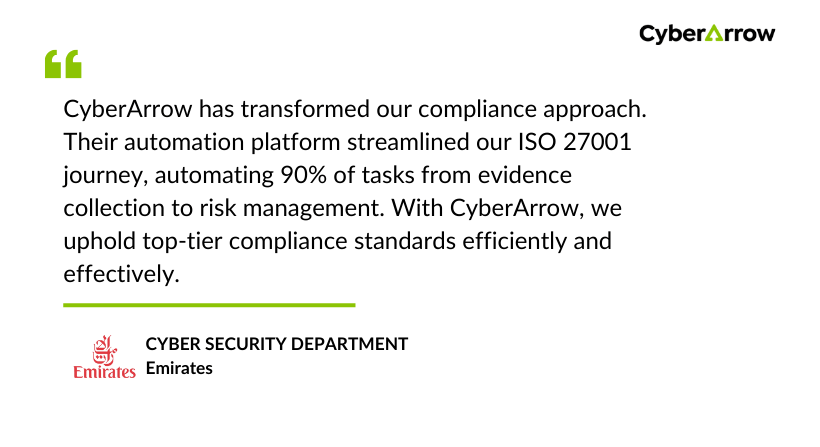
See what Emirates has to say about CyberArrow GRC: