What is IT governance? How to implement it
In today’s digital world, companies rely on technology for almost every part of their business. But with technology comes responsibility. Businesses need a clear strategy to manage and control their IT resources effectively and that’s where IT governance comes in.
IT governance helps companies make better technology decisions, ensure data security, and meet industry standards.
This guide will explain what IT governance is, why it’s essential, and how you can implement it in your organization.
What is IT governance?
IT governance is a framework that helps companies align their IT strategies with business goals. It involves setting policies, roles, and responsibilities for IT management. The goal of IT governance is to ensure that IT supports business goals, minimizes risks, and provides value.
In simpler terms, IT governance is about making sure that a company’s technology is used effectively, securely, and responsibly. This approach helps companies avoid unnecessary IT expenses, protect data, and comply with industry standards.
Why is IT governance important?
Without proper IT governance, companies risk mismanaging their technology, which can lead to:
- Security issues: Poor governance can leave systems vulnerable to cyberattacks.
- Data privacy violations: Companies could accidentally mishandle customer data, leading to costly penalties.
- Financial losses: Misaligned IT spending can waste company resources and cut into profits.
- Operational delays: Without clear policies, IT projects may face delays and miscommunication.
In short, IT governance helps companies maximize their technology investments, safeguard sensitive data, and stay compliant with regulatory standards. This is especially important in fields like finance, healthcare, and tech, where data protection and regulatory compliance are critical.
Key components of IT governance
A successful IT governance framework has several components that help align IT with business goals. Here are the main ones:
- Alignment with business goals: IT should support the overall goals of the company. This means that every IT project or purchase needs to add value to the business.
- Risk management: Identifying and managing IT risks is a key part of IT governance. This includes risks like cyber security threats, data breaches, and system downtime.
- Performance measurement: IT governance frameworks often include metrics to measure how well IT supports business objectives. These metrics help companies track progress and identify areas for improvement.
- Resource management: Companies need to use their IT resources effectively. This includes budgeting for software, hardware, and personnel, as well as making sure these resources are used efficiently.
- Accountability: IT governance involves clear roles and responsibilities to ensure that everyone knows their part in managing IT.
Common IT governance frameworks
There are several popular IT governance frameworks that organizations use to manage their IT processes. These frameworks provide guidelines and best practices for implementing IT governance. Here are a few of the most widely used ones:
1. COBIT (Control Objectives for Information and Related Technologies)
COBIT is a popular IT governance framework developed by ISACA. It focuses on aligning IT with business goals while managing risks and ensuring data security. COBIT provides guidelines for IT management and is widely used in industries with strict regulatory standards, like finance and healthcare.
2. ITIL (Information Technology Infrastructure Library)
ITIL is another widely used framework that provides best practices for IT service management. It focuses on delivering high-quality IT services, managing risks, and ensuring customer satisfaction. ITIL is especially helpful for companies that want to improve their IT service delivery and efficiency.
3. ISO/IEC 38500
ISO/IEC 38500 is an international standard for IT governance. It offers guidelines for directors and executives to manage IT effectively. This framework focuses on accountability, performance, and risk management. ISO/IEC 38500 is a good choice for companies that want to implement a globally recognized IT governance standard.
4. CMMI (Capability Maturity Model Integration)
CMMI is a framework that helps organizations improve their processes. In the context of IT governance, CMMI can help companies assess their IT processes and make improvements. CMMI is particularly useful for companies looking to enhance their performance and optimize their IT resources.
5. FAIR (Factor Analysis of Information Risk)
FAIR is a risk management framework that focuses on quantifying IT risks. It provides a structured approach to identifying and analyzing risks, making it easier for companies to make informed decisions about their IT investments.
Each of these frameworks has unique strengths, and organizations may choose one based on their specific needs, industry, and business goals.
How to implement IT governance in your organization
Implementing IT governance requires planning, resources, and a clear strategy. Here’s a step-by-step guide to get you started:
Step 1: Define your IT governance objectives
First, determine why your organization needs IT governance. Some common objectives include:
- Aligning IT with business goals
- Enhancing cyber security and data privacy
- Reducing IT-related risks
- Improving resource management
Having clear goals will guide the entire implementation process and help you measure success.
Step 2: Choose an IT governance framework
Next, select a framework that fits your organization’s needs. For example:
- If you need a comprehensive governance model, COBIT may be ideal.
- If service quality is a priority, consider ITIL.
- For risk-focused governance, FAIR could be a good fit.
Selecting a framework gives your team guidelines and standards to follow, ensuring consistency across your IT processes.
Step 3: Establish roles and responsibilities
Define clear roles for IT governance. This includes identifying who will be responsible for decision-making, policy enforcement, and performance tracking. Key stakeholders may include:
- Chief Information Officer (CIO)
- IT managers
- Compliance officers
- Risk management teams
Having a well-defined structure ensures accountability and helps avoid confusion.
Step 4: Develop policies and procedures
Create policies that guide IT management. These policies should cover areas like:
- Data security: Procedures for handling and protecting sensitive information.
- Software usage: Rules for using and maintaining software applications.
- Risk management: Guidelines for identifying, analyzing, and mitigating risks.
Clear policies provide a roadmap for IT staff and ensure that everyone understands their responsibilities.
Step 5: Implement control measures
Implement control measures to monitor and enforce compliance with IT governance policies. Examples of controls include:
- Access controls: Limit access to sensitive data and systems.
- Audit trails: Keep records of all system activities for accountability.
- Risk assessments: Regularly evaluate risks to ensure they’re under control.
These controls help ensure that IT practices align with governance policies.
Step 6: Monitor and measure performance
Regularly track your IT governance efforts to ensure they’re achieving the desired results. Key performance indicators (KPIs) might include:
- Risk reduction: Measuring the decrease in IT risks.
- Compliance rate: Tracking adherence to policies and procedures.
- Resource efficiency: Assessing how well resources are managed.
Performance measurement helps you identify areas for improvement and ensures that IT governance remains aligned with business goals.
Step 7: Review and improve
IT governance is an ongoing process. Regularly review your governance framework and make adjustments as needed. This may involve updating policies, introducing new controls, or adopting new technologies to improve efficiency.
Challenges in implementing IT governance
While IT governance provides many benefits, it also comes with challenges, such as:
- Resistance to change: Employees may resist new policies or practices.
- Resource constraints: Implementing IT governance requires time and budget.
- Complex regulations: Companies must keep up with changing industry standards and laws.
By being aware of these challenges, organizations can prepare and develop strategies to overcome them, making IT governance smoother and more effective.
How CyberArrow GRC supports IT governance
Implementing and managing IT governance can be challenging, especially as organizations grow and technology becomes more complex. That’s where CyberArrow GRC helps organizations. CyberArrow GRC is a powerful governance, risk, and compliance tool designed to simplify IT governance and help organizations meet their goals.
Benefits of CyberArrow GRC for IT governance
- Centralized policy management: CyberArrow GRC allows you to manage all IT policies in one place, making it easy to update, monitor, and enforce policies across departments.
- Automated risk assessment: CyberArrow GRC’s risk management features allow you to assess risks automatically, saving time and ensuring accuracy.
- Compliance tracking: CyberArrow GRC tracks compliance with industry standards like ISO/IEC 38500, ISO 27001, ISO 22301, ISO 20000, GDPR, PCI DSS, and COBIT, ensuring that your organization stays compliant.
- Reporting and monitoring: Generate comprehensive reports to monitor IT governance performance and identify areas for improvement.
- User training tools: CyberArrow GRC includes tools for employee training, helping staff understand IT governance policies and best practices.
Conclusion: Simplify IT governance with CyberArrow GRC
In a world where technology is essential for business success, IT governance is more important than ever. A strong IT governance framework helps companies manage technology, protect data, and meet industry standards. However, implementing and maintaining IT governance can be challenging.
With CyberArrow GRC, you can make IT governance easier and more effective.
Here’s how CyberArrow GRC supports your IT governance needs:
- Centralized policy management for easy policy updates and enforcement
- Automated risk assessment to quickly identify and address risks
- Compliance tracking to ensure your organization meets industry standards
- Comprehensive reporting for performance measurement
- Employee training tools for better understanding of governance policies
Read How Emirates enhanced Information Security by automating ISO 27001 with CyberArrow.
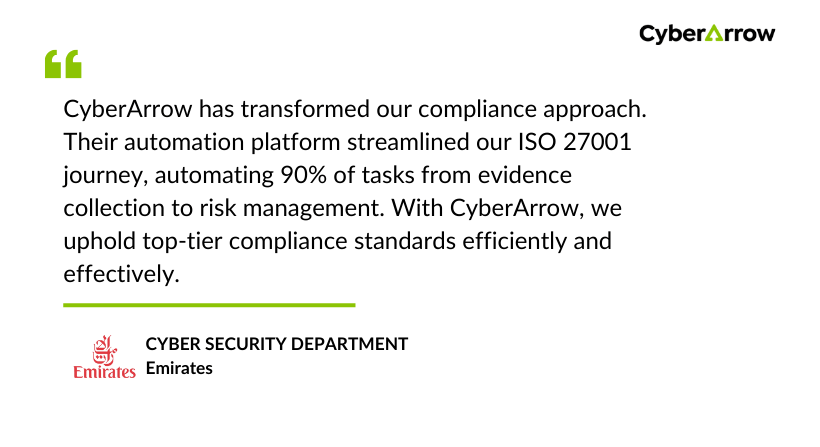
See what Emirates has to say about CyberArrow GRC: