Types of cyber security: Explained
Cyber security is one of the most important aspects of protecting digital information and systems in today’s world. With cyber attacks becoming more frequent and sophisticated, businesses and individuals need to understand the different types of cyber security to safeguard their data.
In this blog, we will break down the various types of cyber security and why each one plays a critical role in keeping your systems safe.
What is cyber security?
Cyber security refers to the practices, tools, and technologies designed to protect computer systems, networks, and data from unauthorized access, damage, or theft. Cyber security aims to defend against both external and internal threats that can compromise the integrity, confidentiality, and availability of your information.
Cyber security is essential for organizations, governments, and individuals to protect against cyber attacks, which can lead to financial losses, data breaches, and reputational damage. Several types of cyber security work together to ensure comprehensive protection.
Why cyber security is important
In a digital age where everything from personal data to business operations is online, the risk of cyber attacks is higher than ever. Hackers and malicious software can infiltrate systems, causing serious damage, from data theft to complete shutdowns of critical services.
The increasing reliance on technology means that cyber attacks can have devastating consequences. Businesses may face downtime, financial penalties, or loss of customer trust, while individuals may deal with identity theft or loss of sensitive data. Therefore, understanding and implementing different types of cyber security measures is crucial for keeping systems safe.
Types of cyber security
There are several types of cyber security, each designed to address different types of threats and vulnerabilities. Let’s explore the most common types:
1. Network security
Network security focuses on protecting the integrity and usability of a network and its data. This type of cyber security involves using tools and techniques to prevent unauthorized access, misuse, or attacks on the network. Common methods include firewalls, intrusion detection systems, and antivirus software.
By implementing network security measures, organizations can detect and block suspicious traffic, ensuring that only authorized users can access the network.
Common tools for network security:
- Firewalls
- Intrusion Detection Systems (IDS)
- Virtual Private Networks (VPNs)
- Network encryption
2. Information security
Information security, also known as data security, protects the integrity and privacy of data during storage and transmission. It involves safeguarding both digital and physical data from unauthorized access or breaches.
To protect sensitive information, organizations may use encryption, access controls, and regular audits to ensure that data is secure both in transit and at rest.
Common tools for information security:
- Encryption
- Access controls
- Data masking
- Backup and recovery systems
3. Application security
Application security focuses on securing software applications to prevent cyber attacks. Vulnerabilities within applications can be exploited by hackers to gain unauthorized access to sensitive data. Application security measures help identify and fix these vulnerabilities before they can be exploited.
This type of cyber security includes things like secure coding practices, regular software updates, and vulnerability testing to make sure that applications are safe from threats.
Common tools for application security:
- Web Application Firewalls (WAFs)
- Secure code reviews
- Software updates and patching
- Penetration testing
4. Cloud security
As more businesses move their data and services to the cloud, cloud security has become increasingly important. Cloud security involves securing cloud-based systems, services, and data to ensure that they are protected from cyber threats.
Cloud security focuses on protecting cloud infrastructure, monitoring access to cloud resources, and ensuring data privacy and compliance.
Common tools for cloud security:
- Multi-factor authentication (MFA)
- Cloud access security brokers (CASBs)
- Data encryption in the cloud
- Identity and Access Management (IAM)
5. Endpoint security
Endpoint security refers to the protection of individual devices that are connected to a network. This includes laptops, smartphones, tablets, and other devices that access the network. Since these devices are often the weakest points in a system, they can be easy targets for cyber attacks.
By using endpoint security measures such as antivirus software, mobile device management, and endpoint encryption, organizations can ensure that all devices accessing the network are secure.
Common tools for endpoint security:
- Antivirus and antimalware software
- Mobile Device Management (MDM)
- Endpoint encryption
- Device monitoring tools
Quick link: Find out how secure your business is
6. Identity and Access Management (IAM)
IAM focuses on managing who has access to what within an organization’s systems. It ensures that only authorized users can access certain data or systems and that they have the right level of permissions based on their role.
By managing user identities and access levels, IAM systems help prevent unauthorized access to critical systems and data.
Common tools for IAM:
- Single sign-on (SSO)
- Multi-factor authentication (MFA)
- Role-based access control (RBAC)
- User Behavior Analytics (UBA)
7. Disaster recovery and business continuity
Disaster recovery and business continuity planning are essential for ensuring that an organization can quickly recover from a cyber attack or other disaster. This type of cyber security focuses on creating plans, backups, and strategies to minimize the impact of incidents and restore operations quickly.
By having a disaster recovery plan in place, organizations can minimize downtime, protect critical data, and continue operations even after a cyber attack.
Common tools for disaster recovery:
- Regular data backups
- Incident response plans
- Data recovery solutions
- Redundant systems
Emerging trends in cyber security
As cyber threats evolve, so do cyber security strategies. Here are some emerging trends in the field of cyber security:
- Artificial Intelligence (AI) and Machine Learning (ML): AI and ML are being used to improve threat detection and response times. By analyzing patterns and behaviors, these technologies can identify potential threats in real time and take action to neutralize them.
- Zero trust security: Zero trust is a security model that requires verification for every user or device attempting to access a network, regardless of whether they are inside or outside the network perimeter.
- Automated security systems: Automated systems are becoming increasingly popular for monitoring and managing security tasks. These systems can automatically detect, analyze, and respond to cyber threats, reducing the workload on IT teams.
Quick link: CyberArrow in the press!
Automate cyber security with CyberArrow GRC
With the increasing complexity of cyber security threats, organizations need a comprehensive approach to protect their data, networks, and systems. One way to achieve this is through the automation of governance, risk, and compliance (GRC) processes.
CyberArrow GRC offers a solution that helps organizations automate their GRC processes, making it easier to manage risk, ensure compliance, and respond to security incidents. With CyberArrow GRC, businesses can:
- Automate risk assessments: Identify and manage risks across your organization with real-time insights.
- Streamline compliance: Ensure compliance with industry standards and regulations through automated monitoring and reporting.
- Proactive security alerts: Receive instant notifications when compliance thresholds are at risk.
- Generate reports automatically: Save time and resources by generating compliance and security reports with just a few clicks.
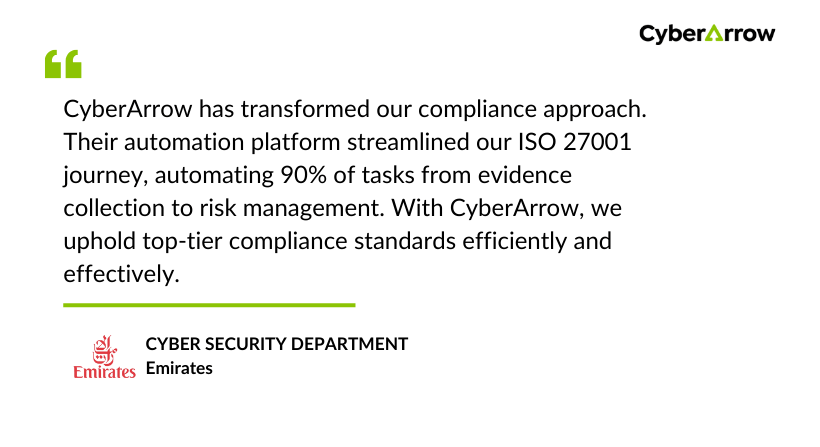
See what Emirates has to say about CyberArrow GRC: