A guide to international cyber security standards and frameworks
Cyber threats are increasing every year, putting all types of organizations at risk. Many businesses struggle to pick the right cyber security standards and frameworks to protect their data and stay compliant. Choosing the wrong one can leave them vulnerable and facing compliance problems.
How can you ensure your organization is protected against evolving threats? Have you implemented the right framework to protect your operations?
In this guide, you will explore the various cyber security standards and frameworks, helping you find the best fit for your needs and how tools like CyberArrow can help in this regard.
- Understanding cyber security standards and frameworks
- 1. ISO/IEC 27001
- 2. NIST Cyber security Framework
- 3. General Data Protection Regulation (GDPR)
- 4. Payment Card Industry Data Security Standard (PCI DSS)
- 5. Health Insurance Portability and Accountability Act (HIPAA)
- 6. CIS Controls (Center for Internet Security Controls)
- 7. SOC 2 (System and Organization Controls 2)
- 8. SAMA CSF (Saudi Arabian Monetary Authority Cyber Security Framework)
- 9. NCA ECC (National Cyber security Authority Essential Cyber Security Controls)
- 10. UAE IA (United Arab Emirates Information Assurance Framework)
- How to choose the right framework for your organization?
- Case study: How IFHC implemented UAE IA and ISO 27001 with CyberArrow
- Automate cyber security standards implementation with CyberArrow
Understanding cyber security standards and frameworks
Cyber security standards and frameworks help organizations set up policies and procedures to meet regulatory requirements. They offer structured ways to manage cyber risks, protect sensitive information, and strengthen defenses against cyber threats.
Below is a list of some popular cyber security standards and frameworks:
1. ISO/IEC 27001
ISO/IEC 27001 sets out the requirements for creating, implementing, maintaining, and improving an information security management system (ISMS).
- Who is it for: Organizations of all sizes and sectors looking to safeguard their information assets and demonstrate commitment to information security.
- Why choose this standard: Provides a systematic framework for managing and protecting sensitive company information, enhancing stakeholder credibility and trust.
2. NIST Cyber security Framework
NIST CSF was developed by the National Institute of Standards and Technology (NIST) developed the NIST CSF, which offers a flexible approach to managing and reducing cyber risks.
- Who is it for: Widely adopted by organizations across industries, especially in the United States, seeking to improve their cyber security posture.
- Why choose this framework: Helps organizations prioritize and manage cyber security resources effectively, communicate risk management goals, and measure progress towards achieving them.
3. General Data Protection Regulation (GDPR)
GDPR is a regulation in EU law on data protection and privacy for all individuals within the European Union and the European Economic Area.
- Who is it for: Applicable to organizations worldwide that handle the personal data of EU citizens, regardless of their location.
- Why choose this regulation: Ensures robust personal data protection, promotes transparency and accountability in data processing practices, and enhances trust with customers and partners.
4. Payment Card Industry Data Security Standard (PCI DSS)
PCI DSS is a set of security standards designed to ensure all companies that accept, process, store, or transmit credit card information maintain a secure environment.
- Who is it for: Organizations involved in payment card processing, including merchants, payment processors, and financial institutions.
- Why choose this standard: Helps prevent credit card fraud, protects cardholder data, and ensures secure transaction processing environments.
5. Health Insurance Portability and Accountability Act (HIPAA)
HIPAA establishes national standards for the protection of ePHI, ensuring confidentiality, integrity, and availability.
- Who is it for: Healthcare providers, health plans, and healthcare clearinghouses that handle protected health information (PHI).
- Why choose this standard: Ensures compliance with legal requirements, protects patient confidentiality, and enhances data security practices in the healthcare sector.
6. CIS Controls (Center for Internet Security Controls)
CIS Controls are best practices designed to help organizations defend against cyber attacks.
- Who is it for: Organizations of all sizes and sectors seeking actionable security guidance.
- Why choose this framework: Provides prioritized, actionable guidance to mitigate the most common cyber threats, enhancing overall security posture.
7. SOC 2 (System and Organization Controls 2)
SOC 2 reports are based on the AICPA’s Trust Services Criteria and assure the controls at a service organization relevant to security, availability, processing integrity, confidentiality, and privacy.
- Who is it for: Service organizations that provide services like SaaS, managed IT services, and data hosting.
- Why choose this standard: Demonstrates commitment to data security and privacy, providing customers with assurance about the effectiveness of controls.
8. SAMA CSF (Saudi Arabian Monetary Authority Cyber Security Framework)
SAMA CSF provides guidelines and requirements for financial institutions in Saudi Arabia to establish and maintain effective cyber security measures.
- Who is it for: Financial institutions regulated by the Saudi Arabian Monetary Authority (SAMA).
- Why choose this framework: Ensures robust cyber security practices, protects financial institutions and customers from cyber threats, and complies with regulatory requirements.
9. NCA ECC (National Cyber security Authority Essential Cyber Security Controls)
NCA ECC is Saudi Arabia’s standard, providing essential cyber security controls and guidelines to enhance cyber resilience.
- Who is it for: Organizations in Saudi Arabia aiming to strengthen their cyber security posture and comply with local regulations.
- Why choose this standard: Offers structured guidance on implementing essential cyber security controls, ensuring resilience against cyber threats and compliance with Saudi Arabian cyber security requirements.
10. UAE IA (United Arab Emirates Information Assurance Framework)
UAE IA framework aims to enhance information security governance and management practices across government entities in the United Arab Emirates.
- Who is it for: Government entities and organizations in the UAE seeking to improve information security capabilities.
- Why choose this framework: Provides standardized guidelines for implementing information security controls, ensures compliance with UAE regulatory requirements, and strengthens cyber resilience.
How to choose the right framework for your organization?
Choosing the right cyber security framework helps organizations enhance their defenses and ensure regulatory compliance.
Here’s a guide to help you select the most suitable standard/framework based on your specific needs and goals:
- Assess your requirements: Evaluate your organization’s size, industry regulations, and data sensitivity. Consider whether you must comply with specific standards like GDPR or PCI DSS or if a broader framework like ISO/IEC 27001 or NIST CSF better aligns with your goals.
- Understand framework capabilities: Explore each framework’s requirements and capabilities. Assess how well they address your security challenges, support your business objectives, and integrate with your existing IT infrastructure.
- Evaluate resource allocation: Consider the resources required for implementation, including time, budget, and expertise. Some frameworks may demand more intensive implementation processes or ongoing maintenance.
- Seek expert guidance: Engage with cyber security professionals or consultants who specialize in implementing these frameworks. Their insights can streamline your decision-making process and ensure alignment with industry best practices.
- Plan for long-term sustainability: Choose a framework that not only meets your current needs but also scales with your organization’s growth. Look for flexible and adaptable frameworks to evolving cyber threats and regulatory changes.
Case study: How IFHC implemented UAE IA and ISO 27001 with CyberArrow
IFHC, an Abu Dhabi government entity, faced challenges in achieving compliance with UAE Information Assurance (IA) and ISO 27001 standards due to busy schedules and resource limitations. These challenges included a lack of visibility into cyber security posture, gaps in threat awareness and regulation updates, and manual efforts to align multiple standards.
To address these issues, IFHC opted for CyberArrow’s automation solution, which streamlined compliance processes and enhanced cyber security maturity.
The result?
- Strengthened cyber security defenses through regular security evaluations and automated risk assessments.
- Enhanced access control management to prevent unauthorized access and protect sensitive data.
- Improved monitoring of security Key Performance Indicators (KPIs) for continuous security posture assessment.
- Streamlined compliance with UAE IA and ISO 27001 standards, reducing manual effort and ensuring adherence to regulatory requirements.
Read the full case study here.
Automate cyber security standards implementation with CyberArrow
Manually complying with cyber security standards is time-consuming and error-prone, requiring constant updates to keep up with evolving threats.
With CyberArrow, organizations can simplify and streamline this process. CyberArrow’s expertise helps reduce implementation time and costs while ensuring strong protection against cyber threats.
It offers:
- GRC automation: Automate your GRC processes, including evidence collection, ERM, third-party risk management, and reporting and documentation.
- Implementation expertise: Leverage our team’s deep expertise in cyber security standards to streamline implementation and achieve certification.
- Continuous support: Benefit from ongoing support and updates to ensure your framework remains robust against emerging threats.
- Customized solutions: Tailor our platform to fit your organization’s unique needs, whether you’re a startup needing foundational security measures or an enterprise aiming for global compliance.
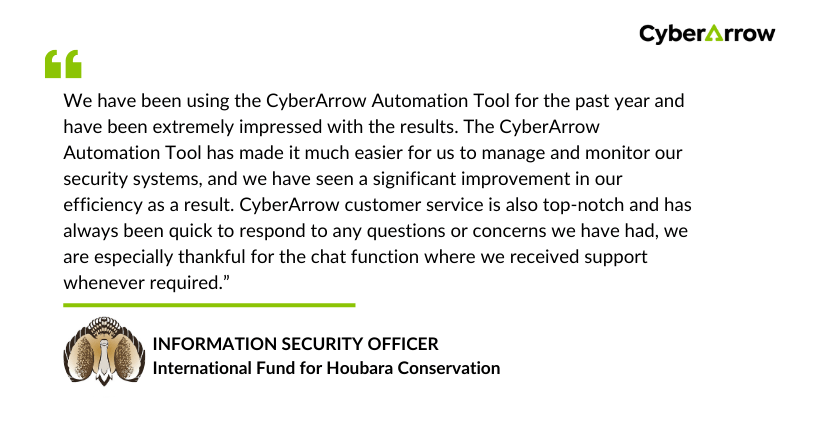
See what our clients are saying about CyberArrow: