What is corporate compliance? How to achieve it?
Compliance with laws, regulations, and industry standards is critical for any business. That’s where corporate compliance comes in. But what exactly is corporate compliance, and how can your company achieve it?
In this blog, we will break down the basics of corporate compliance, why it’s important, and the steps you can take to ensure your business stays compliant.
By the end of this blog, you’ll not only understand corporate compliance, but you’ll also know how tools like CyberArrow GRC can help streamline your compliance efforts.
What is corporate compliance?
Corporate compliance refers to a company’s adherence to laws, regulations, industry standards, and internal policies. These rules can cover various areas such as legal compliance, regulatory compliance, and cyber security compliance. Corporate compliance ensures that your business operates within the boundaries set by the law and maintains ethical standards.
In simpler terms, corporate compliance is about making sure your company follows the rules. Failure to meet compliance requirements can result in legal penalties, loss of trust, and significant financial damage.
Why is corporate compliance important?
- Avoid legal penalties: One of the most obvious reasons for following corporate compliance is to avoid fines and legal consequences. Ignoring regulations can lead to lawsuits, hefty fines, and even criminal charges in some cases.
- Build trust and reputation: Companies that follow compliance rules build trust with customers, partners, and investors. A strong compliance program shows that your business operates with integrity and transparency.
- Protect against cyber threats: In today’s digital world, cyber security compliance is a critical component of corporate compliance. Following cyber security regulations protects your business from data breaches and other online threats.
- Improve business efficiency: Compliance programs help create structured processes and guidelines that improve overall business efficiency. By setting clear rules and responsibilities, companies can streamline their operations and avoid unnecessary risks.
Types of compliance
There are different forms of compliance that businesses must follow, depending on the industry and jurisdiction. Below are some key types of compliance that companies must consider:
1. Legal compliance
Legal compliance refers to the company’s duty to follow the laws and regulations applicable to its business. This can include labor laws, contract laws, tax laws, and more. Legal compliance ensures that a company operates within the law, avoiding any legal trouble or penalties.
2. Regulatory compliance
Regulatory compliance focuses on industry-specific rules set by government bodies or industry organizations. For instance, healthcare organizations must comply with HIPAA regulations, while financial institutions need to follow regulations like the Sarbanes-Oxley Act. Regulatory compliance ensures that companies meet these industry-specific rules.
3. Cyber security compliance
With the rise of cyber threats, cyber security compliance has become crucial for all businesses. This type of compliance refers to the company’s ability to protect its data and systems from cyberattacks by following the relevant security regulations. Many industries, such as finance and healthcare, have specific cyber security regulations that businesses must follow.
Quick link: What is MSP (Managed Service Provider)?
Steps to achieve corporate compliance
Now that you understand the importance and types of compliance, let’s look at the steps involved in achieving corporate compliance.
1. Conduct a compliance audit
The first step toward achieving compliance is to assess your current standing. Conduct a compliance audit to identify areas where your business may not be meeting legal or regulatory requirements. This audit should cover all aspects of your business, from data security to employee contracts.
2. Develop a compliance program
A corporate compliance program is a formal set of guidelines that outline how your company will meet compliance requirements. This program should include:
- Policies and procedures for each area of compliance (legal, regulatory, cyber security).
- Designation of compliance officers or teams responsible for ensuring that rules are followed.
- Training programs for employees to educate them on compliance requirements.
3. Train employees
Compliance is not just the responsibility of top management or a designated compliance officer. All employees need to be aware of the compliance rules and procedures that apply to their roles. Regular training sessions ensure that your staff understands the importance of compliance and knows how to act accordingly.
4. Implement monitoring and reporting systems
Once your compliance program is in place, it’s essential to monitor your company’s adherence to the program. This can be done through:
- Regular internal audits.
- Automated monitoring systems that track compliance across the organization.
- Reporting mechanisms that allow employees to report any breaches or concerns related to compliance.
5. Automate compliance with technology
In today’s digital age, manual compliance processes can be time-consuming and prone to error. That’s why many companies are turning to compliance automation tools. These tools help businesses track and manage compliance requirements in real time, ensuring that no steps are missed.
Automation tools can be particularly useful for managing cyber security compliance, where the regulations and threats are constantly evolving. By using technology to automate tasks like data security checks and regulatory reporting, you can reduce human errors and ensure that your business stays compliant.
6. Stay updated with regulations
Regulations change frequently, and businesses need to stay updated on these changes to remain compliant. Subscribe to industry newsletters, attend compliance seminars, and keep in contact with regulatory bodies to ensure you’re aware of any new requirements.
Quick link: What is FISMA compliance?
How CyberArrow GRC can help achieve corporate compliance
Managing corporate compliance, especially for businesses that operate in multiple industries or regions, can be a complex task. This is where CyberArrow GRC (Governance, Risk, and Compliance) software can make a significant difference.
CyberArrow GRC is designed to help businesses automate their compliance processes, making it easier to achieve and maintain compliance in areas like regulatory compliance, cyber security compliance, and more.
Here’s how CyberArrow GRC can assist your business:
- Compliance-Automation-as-a-Service: Automate end-to-end compliance processes, reduce manual tasks, and minimize human error. This ensures that your business meets compliance requirements without having to dedicate unnecessary time and resources.
- Certification automation: CyberArrow helps businesses achieve compliance certifications quickly by automating the necessary steps. Whether it’s ISO 27001, GDPR, or other certifications, CyberArrow streamlines the process and helps businesses obtain their certifications without the hassle of traditional audits.
- Real-time compliance monitoring: CyberArrow provides real-time compliance monitoring that helps you track your compliance status at all times. This helps identify potential issues early and ensures that your business stays compliant year-round.
- Stay compliant with 50+ cyber security standards: With CyberArrow, businesses can stay compliant with more than 50 cyber security standards, keeping them protected against cyber threats while ensuring data security.
Use cases for CyberArrow GRC
- Cyber security compliance: A healthcare company needs to comply with HIPAA and other cyber security regulations. With CyberArrow GRC, they automated their compliance process and successfully obtained the necessary certifications, avoiding costly fines and penalties.
- Regulatory compliance: A financial institution used CyberArrow GRC to track and manage its compliance with evolving regulations like the Sarbanes-Oxley Act, ensuring they met regulatory standards without sacrificing operational efficiency.
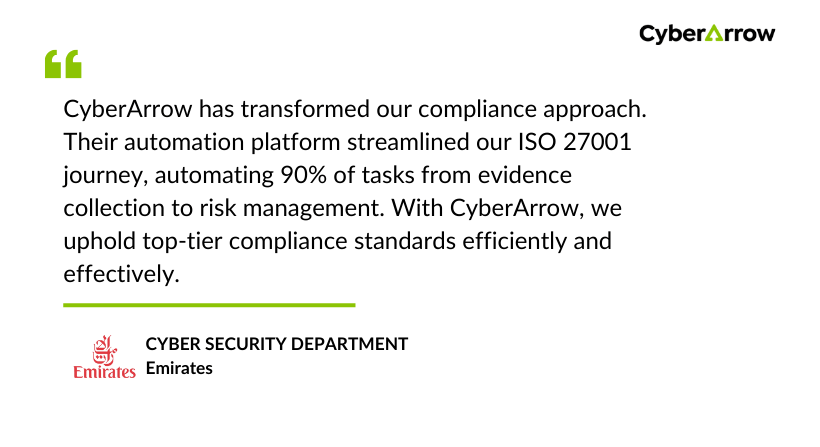
See what Emirates has to say about CyberArrow GRC: