What is ISO compliance? A complete guide
Ready to protect your business from cyber threats and ensure robust digital security? ISO compliance standards, like ISO 27001, ISO 22301, and ISO 20000, are powerful frameworks designed to keep your organization’s data safe and resilient against modern cyber risks.
In this guide, we’ll explore what ISO compliance in cybersecurity means, why it’s critical, and how it empowers businesses to strengthen their digital defenses. We’ll break down key standards and share how each applies to building a secure, resilient, and trusted organization. Plus, discover a tool that makes achieving and maintaining ISO cybersecurity compliance easier than ever.
Let’s dive in and learn how ISO standards can elevate your cybersecurity approach.
What is ISO compliance in cybersecurity?
ISO (International Organization for Standardization) standards serve as global benchmarks for various areas, including cybersecurity. When an organization is ISO-compliant in cybersecurity, it means it follows a specific set of procedures and controls that meet international security standards, strengthening its defenses against cyber threats and enhancing overall resilience.
ISO standards help organizations establish consistent, secure processes, reducing risks and improving data protection.
Key ISO cybersecurity standards for a stronger security framework
Here’s a closer look at the top ISO standards relevant to cybersecurity:
1. ISO/IEC 27001: Information Security Management
Overview:
ISO 27001 is one of the most widely adopted cybersecurity standards, focused on establishing an effective Information Security Management System (ISMS). An ISMS includes the policies, processes, and controls necessary to manage and protect an organization’s information assets.
Key benefits:
- Establishes a formal security framework for managing data security
- Protects against data breaches, ensuring customer trust and regulatory compliance
- Provides a risk-based approach to identifying, mitigating, and managing risks
Implementation steps:
- Assess current risks and vulnerabilities.
- Define security policies and controls.
- Continuously monitor, audit, and improve the ISMS.
2. ISO 22301: Business Continuity Management System (BCMS)
Overview:
ISO 22301 provides a framework for Business Continuity Management (BCM), helping organizations stay resilient and responsive during disruptions. This standard ensures that an organization can maintain essential functions and quickly recover from cyber incidents.
Key benefits:
- Prepares organizations for effective response to cyber incidents.
- Reduces downtime and operational losses during disruptions.
- Enhances customer and stakeholder trust by ensuring continuity.
Implementation steps:
- Identify critical assets and potential disruptions.
- Establish business continuity procedures and response plans.
- Train employees and conduct regular recovery drills.
Quick link: What is corporate compliance?
3. ISO/IEC 20000-1: IT Service Management (ITSM)
Overview:
ISO 20000-1 is designed for IT Service Management, ensuring that IT services align with the organization’s cybersecurity objectives and enhance service delivery. This standard is beneficial for companies with IT-dependent processes, helping integrate cybersecurity within IT service management.
Key benefits:
- Promotes alignment of IT services with security needs.
- Enhances service reliability and reduces risk of cyber incidents in IT operations.
- Encourages continuous improvement in IT service and cybersecurity processes.
Implementation steps:
- Map IT services and identify related cybersecurity needs.
- Establish ITSM policies and controls.
- Continuously monitor and improve service quality and security.
Download your free ISO 20000 checklist!
4. ISO/IEC 27002: Code of practice for information security controls
Overview:
ISO 27002 offers guidance on selecting and implementing information security controls. This standard is a companion to ISO 27001, detailing specific security practices that help organizations strengthen their cybersecurity measures.
Key benefits:
- Provides a comprehensive list of security controls for diverse scenarios.
- Complements ISO 27001 by offering actionable guidance on control implementation.
- Helps in customizing security practices to fit organizational needs.
Implementation steps:
- Identify specific security control requirements.
- Implement tailored controls based on risk assessment.
- Regularly update controls to address evolving threats.
5. ISO/IEC 27017: Cloud security
Overview:
ISO 27017 is focused on cloud security, guiding organizations on securing cloud-based environments. With more businesses relying on cloud solutions, this standard helps establish safe cloud practices and minimizes risks associated with cloud data storage and processing.
Key benefits:
- Provides clear cloud security guidelines to reduce vulnerabilities.
- Enhances data protection within cloud infrastructure.
- Helps organizations comply with both cloud and data privacy regulations.
Implementation steps:
- Review cloud infrastructure for vulnerabilities.
- Establish cloud-specific security policies and controls.
- Continuously monitor cloud environments for new risks.
Quick link: What is an audit trail?
Why ISO cybersecurity compliance is essential for modern businesses
Achieving ISO compliance in cybersecurity goes beyond meeting regulatory requirements—it builds a culture of security within the organization, improving stakeholder confidence and operational resilience.
Here’s why it’s crucial:
- Reduces cyber risks: ISO standards require ongoing risk assessment, helping organizations proactively identify and mitigate vulnerabilities.
- Enhances reputation: ISO compliance signals a commitment to high security standards, boosting credibility and trust among customers and partners.
- Strengthens incident response: Standards like ISO 22301 prepare companies to handle disruptions effectively, ensuring quick recovery and reduced impact on operations.
Implementing and managing ISO compliance with CyberArrow GRC
Maintaining ISO compliance involves continuous monitoring, regular audits, and staying updated on cybersecurity threats. For many organizations, this process can be complex and time-consuming.
That’s where automated tools like CyberArrow GRC come in.
CyberArrow GRC is designed to make ISO compliance easier for businesses by automating much of the process, from risk assessments to audit management. With over 60 integrations, CyberArrow GRC simplifies the tasks required to maintain ISO compliance, allowing your team to focus on critical security objectives.
CyberArrow GRC benefits:
- Streamlines compliance management with automated workflows.
- Reduces audit preparation time through continuous tracking of controls.
- Improves risk management by centralizing threat data and response processes.
Read How Emirates enhanced Information Security by automating ISO 27001 with CyberArrow.
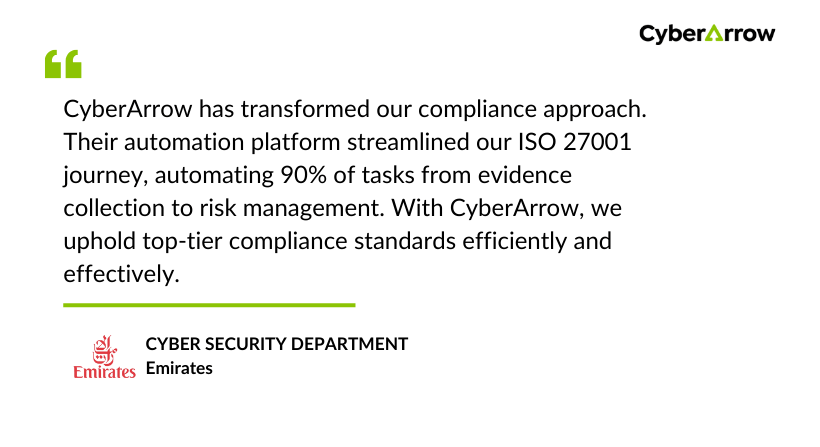
See what Emirates has to say about CyberArrow GRC: