What is cloud web security? A brief guide
As businesses are shifting to cloud solutions for better flexibility, cost savings, and scalability. However, with these benefits come new security risks that can put critical data and operations at risk. Here’s where cloud web security steps in, providing a set of practices and tools to protect data, applications, and overall web activities from unauthorized access and cyber threats.
Let’s break down what cloud web security is, why it matters, and how you can leverage it to keep your business safe.
What is cloud web security?
Cloud web security refers to a range of tools and practices used to secure web-based services and data hosted in the cloud. It ensures the safety of data transferred, stored, and processed on cloud platforms, protecting against unauthorized access, data breaches, malware, and other online threats.
In simple terms, cloud web security acts as a barrier, ensuring only legitimate access and usage of data and applications in the cloud environment. The technology focuses on safeguarding online content, monitoring data access, and preventing unauthorized actions that could lead to data loss or compromise.
Key Components of Cloud Web Security
Data protection
- Data is constantly moving to and from cloud platforms, making it essential to protect it at every stage.
- Encryption is a common method used, securing data both in transit and at rest, making it unreadable to unauthorized users.
Access control and authentication
- This component restricts access to sensitive data and applications in the cloud.
- Authentication tools, like two-factor authentication (2FA) and multi-factor authentication (MFA), require users to verify their identities before accessing resources, adding a layer of security.
Threat detection and monitoring
- Real-time monitoring and threat detection help identify unusual activities that could indicate potential security breaches.
- Cloud web security tools provide alerts for suspicious activities, allowing companies to take quick action and prevent security incidents.
Application security
- Web applications are common targets for cyber-attacks due to their online accessibility.
- Securing these applications helps prevent attacks like cross-site scripting, SQL injections, and other vulnerabilities that hackers exploit.
Firewall and intrusion prevention systems
- Cloud firewalls act as a barrier between the cloud environment and potential online threats.
- Intrusion prevention systems (IPS) can detect and prevent cyberattacks in real-time, blocking harmful traffic before it reaches the cloud infrastructure.
Compliance management
- Compliance with data protection regulations, such as GDPR and HIPAA, is critical for many businesses.
- Cloud web security solutions help meet these regulatory requirements by implementing controls and providing audit trails, ensuring sensitive data remains protected.
Quick link: What is cloud security compliance?
Benefits of cloud web security
Enhanced data protection
- By implementing encryption, access controls, and monitoring, cloud web security ensures data is safe from unauthorized access, theft, or loss.
Reduced risk of cyberattacks
- With advanced threat detection and prevention, cloud security solutions can reduce the likelihood of successful attacks on your cloud environment.
Cost efficiency
- Cloud web security minimizes costs associated with data breaches, which could involve fines, compensation, and remediation expenses.
- It allows companies to focus resources on growth and productivity rather than spending excessively on recovering from incidents.
Regulatory compliance
- Cloud web security supports businesses in meeting compliance requirements, protecting against costly legal issues and potential reputational damage.
Scalability and flexibility
- Cloud web security solutions scale with the needs of your business, meaning they can grow as you grow, providing ongoing protection regardless of the size or complexity of your cloud setup.
Common threats in cloud web security
Data breaches
- Unauthorized access or exposure of sensitive data stored in the cloud can lead to serious consequences for businesses, especially in industries with strict data regulations.
Malware and ransomware
- Malware can infiltrate cloud environments, stealing or encrypting data. Ransomware attacks can lock businesses out of their data, demanding a ransom for its release.
Account hijacking
- Weak or compromised passwords can lead to account hijacking, giving attackers access to sensitive data and applications.
Insider threats
- Employees or contractors with access to sensitive data could misuse their privileges, either unintentionally or maliciously, leading to security breaches.
Denial-of-Service (DoS) attacks
- DoS attacks can overwhelm cloud servers, making web applications or websites unavailable to legitimate users and potentially resulting in revenue loss.
Quick link: What is ISO compliance?
How to implement cloud web security best practices
Regular security assessments
- Conducting regular security assessments can identify vulnerabilities in your cloud environment, allowing you to address them proactively.
Use strong access controls
- Limiting access to cloud resources based on user roles reduces the chances of unauthorized access.
- Implement multi-factor authentication (MFA) to add an extra layer of security for user accounts.
Enable data encryption
- Encryption ensures that sensitive data is unreadable to anyone without the correct encryption keys, protecting it during transit and storage.
Automate monitoring and threat detection
- Automated monitoring helps detect threats in real-time, enabling quick responses to security incidents.
- Threat detection tools can identify unusual behavior, alerting you to potential breaches early.
Train employees on security awareness
- Employees play a key role in maintaining cloud web security, so regular training on identifying phishing scams, handling sensitive data, and following security protocols is essential.
Conclusion
Cloud web security is essential for protecting your business’s data, applications, and operations in an increasingly online world. With effective security practices and reliable tools, you can secure your cloud environment and prevent unauthorized access, data breaches, and other cyber threats.
However, security isn’t just about tools and systems; it’s also about people. Employees are often the first line of defense, and their awareness of cybersecurity threats can make all the difference. This is where CyberArrow Awareness Platform steps in. Designed to enhance your team’s understanding of security threats, CyberArrow provides automated training that keeps employees informed on the latest phishing tactics, secure data handling, and best practices to avoid common cyber pitfalls.
Here are some key features of the CyberArrow Awareness Platform:
- Automated training modules: Easily deploy security training that updates regularly to cover the latest threats.
- Engaging content: Interactive and easy-to-understand training materials that keep employees interested and informed.
- Progress tracking: Monitor your team’s progress and identify areas for improvement with detailed reports.
- Customizable programs: Tailor the training programs to meet the specific needs of your organization and industry.
- Phishing simulations: Test your team’s response to phishing attacks through realistic simulations and provide instant feedback.
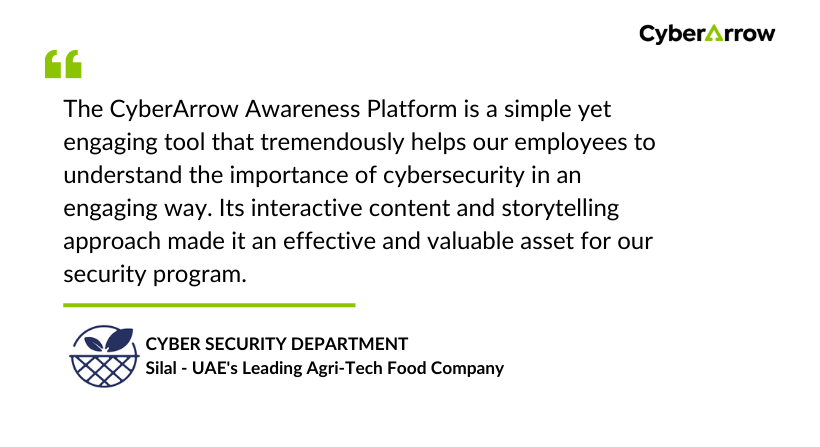
See what Silal has to say about CyberArrow Awareness Platform: