What is an audit trail? A brief guide
In today’s data-driven world, tracking key actions and recording important details is essential for businesses. Whether for compliance, security, or operational clarity, organizations rely on audit trails to keep track of changes, activities, and decisions, all while adhering to data privacy regulations. This means that not everything is tracked, and user privacy is always respected.
If you’ve ever wondered what an audit trail is and why it matters, this guide will walk you through the basics. We’ll break down the concept, discuss its importance, and explore how a robust audit trail can maintain transparency and trust within any organization without compromising individual privacy.
What is an audit trail?
An audit trail is a sequential record of all actions, changes, and transactions in a system. It logs essential information such as who performed an action, what they did, when they did it, and where it occurred. Think of it as a digital footprint that details every step taken within a process, making it possible to trace back any activity.
Audit trails are a vital part of regulatory compliance and organizational accountability. By tracking every action, companies can keep operations transparent, investigate security incidents, and prove they are following compliance standards.
Why are audit trails important?
Audit trails offer numerous benefits, particularly in areas such as compliance, data security, and operational efficiency. Let’s look at why audit trails are crucial:
- Enhancing data security: With audit trails, organizations can monitor who accesses sensitive information and what changes are made. If there’s a security breach, these logs allow IT teams to investigate how it happened and prevent similar incidents in the future.
- Ensuring compliance: Many industries have regulations that require companies to maintain audit trails. Standards like ISO 27001 for information security and ISO 22301 for business continuity highlight the need for detailed logging to prove compliance.
- Improving operational efficiency: By identifying trends and patterns in audit trails, businesses can optimize workflows and improve efficiency. For example, if certain steps consistently cause delays, those areas can be flagged and improved.
- Providing evidence for investigations: In cases of suspected fraud or policy violations, audit trails can serve as evidence. By detailing every action, audit trails help identify the root cause and build a clear picture of what happened.
Types of audit trails
Audit trails come in several types, depending on what they are tracking. Below are some common types of audit trails:
- System audit trails: These record all activities within an IT system. They show user logins, system accesses, and any changes made to the system, helping organizations detect unauthorized access or tampering.
- Application audit trails: Application audit trails focus on activities within a particular software. This type is helpful for understanding user interactions, tracking changes to data, and ensuring application-level security.
- Financial audit trails: This type is used in accounting systems to document every transaction, making it easier to trace financial errors, prevent fraud, and ensure accurate financial reporting.
- Operational audit trails: Operational audit trails track day-to-day activities within an organization. This type provides a record of routine processes and employee actions, which is useful for quality control and improving operational procedures.
Key components of an effective audit trail
For an audit trail to be reliable and valuable, it should include these key elements:
- User information: The identity of the person or system that performed an action, typically captured through usernames or user IDs.
- Timestamp: The exact date and time when the action occurred, allowing accurate tracking and sequencing of events.
- Event details: A clear description of the action or change, including what was modified, added, or deleted.
- Location: Where the action took place within the system, such as a specific IP address or system location.
By including these components, an audit trail provides a comprehensive record of all actions and changes, making it a valuable tool for analysis and compliance.
Best practices for maintaining audit trails
To ensure audit trails remain effective and reliable, organizations should follow these best practices:
- Use automated logging systems: Manually recording every action is time-consuming and error-prone. Automated logging systems capture all actions in real-time, ensuring accuracy and completeness.
- Establish clear policies: Define what needs to be logged, who has access to the audit trail, and how long records will be retained. A clear policy helps maintain consistency and ensures that all critical actions are tracked.
- Implement access controls: Not everyone should have the ability to modify or delete audit trails. By restricting access, organizations can ensure that audit logs remain secure and tamper-proof.
- Regularly review and analyze logs: Conducting regular audits of the logs themselves helps detect potential security issues, process inefficiencies, or compliance gaps early on.
- Ensure data retention and backup: Keep audit trails for a specified period and back them up regularly. This ensures records are available when needed for compliance checks or investigations.
Industries that rely on audit trails
Certain industries rely more heavily on audit trails due to their strict regulatory environments or security needs.
Some of these industries include:
- Finance and banking: Financial institutions use audit trails to track every transaction and meet regulatory standards. These trails help detect fraud and ensure accurate reporting.
- Healthcare: Healthcare organizations keep detailed audit trails to comply with laws like HIPAA, which requires thorough documentation of patient data access.
- Manufacturing: In manufacturing, audit trails track processes and product quality control, ensuring consistency and safety standards.
- Government and public sector: Government agencies maintain audit trails to provide accountability for their operations and protect sensitive information.
Challenges of managing audit trails
While audit trails are essential, managing them can pose some challenges:
- Volume of data: Organizations generate massive amounts of data daily. Managing and storing all this information can be costly and complex.
- Data privacy concerns: Collecting detailed audit trails can raise privacy concerns, especially if personal data is involved. Organizations need to balance the benefits of tracking with data privacy regulations.
- Resource intensive: Reviewing and analyzing audit logs can be time-consuming, especially in large organizations. Automation can help but requires upfront investment.
Conclusion
Maintaining an effective audit trail across various applications is essential for meeting most global security standards. Instead of manually navigating through each system and taking screenshots as evidence, you can streamline this process with CyberArrow GRC. Our platform automates the evidence collection by leveraging integrations to retrieve logs effortlessly.
With CyberArrow GRC, you can quickly assess whether controls are compliant or not. We focus on taking sample evidence to confirm that your audit trail configurations are in place, without processing the logs themselves. This means you get a comprehensive view of your compliance status while saving time and reducing the manual effort involved in evidence collection.
Here are some key features of CyberArrow GRC:
- Automated compliance tracking: Keep up with regulatory requirements effortlessly with automated updates and tracking.
- Risk management module: Identify, assess, and mitigate risks effectively to safeguard your organization.
- Streamlined audit management: Simplify audit processes with organized documentation and real-time reporting.
- Customizable dashboards: Get insights at a glance with customizable dashboards that suit your organization’s needs.
- Collaboration features: Enhance teamwork with shared access to documents and processes across departments.
- User-friendly interface: Navigate our platform easily, thanks to its intuitive design tailored for all users.
Read How Emirates enhanced Information Security by automating ISO 27001 with CyberArrow.
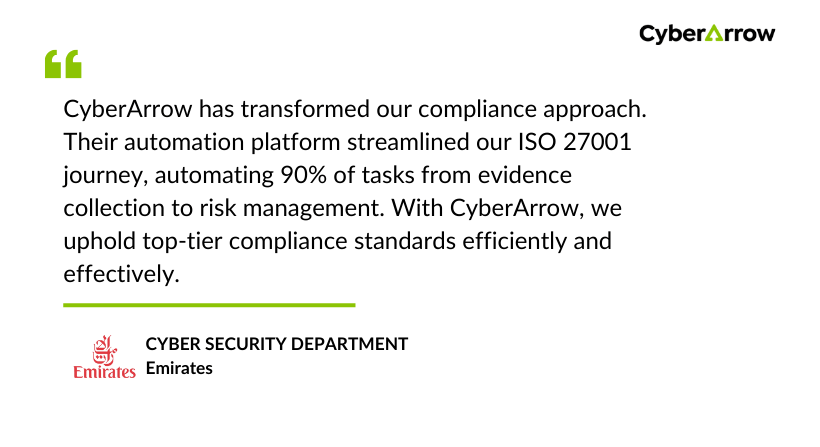
See what Emirates has to say about CyberArrow GRC: