What are internal controls? How CyberArrow GRC helps with internal auditing
Managing a business effectively goes beyond daily operations. Ensuring financial accuracy, compliance with laws, and safeguarding assets are crucial and this is where internal controls come in. These controls help organizations monitor their processes, prevent fraud, and maintain reliable reporting.
In this guide, we’ll explain what internal controls are, why they’re important, and how to implement them. We’ll also look at how CyberArrow GRC can automate and streamline the internal auditing process, ensuring your organization stays on track.
What are internal controls?
Internal controls are policies and procedures designed to safeguard assets, ensure financial accuracy, comply with regulations, and improve operational efficiency. These controls set a framework for how an organization should operate and include monitoring systems to identify issues or risks that could harm the business.
There are several types of internal controls, each serving a different purpose within an organization’s structure.
Types of internal controls
- Preventive controls
- Preventive controls are designed to avoid errors or fraud before they happen.
- Examples include segregation of duties (separating financial tasks among different people) and authorization requirements (approval processes).
- Detective controls
- Detective controls identify errors or issues after they occur, allowing the organization to respond quickly.
- Examples include reconciliations, audits, and inventory checks.
- Corrective controls
- These controls address errors or problems once they’ve been identified.
- Examples include backup procedures, data restoration, and error correction protocols.
- Directive controls
- Directive controls guide employees to follow the correct procedures.
- Examples include policies, training sessions, and operational manuals.
- Compensating controls
- Compensating controls provide additional safeguards if other controls are not fully effective.
- Examples include additional checks and oversight for high-risk areas.
Quick link: A guide to CIS Critical Security Controls
Importance of internal controls
Internal controls are essential for several reasons:
- Protect assets: Safeguarding company assets, like cash, inventory, and data, is crucial. Internal controls prevent loss and fraud.
- Ensure accuracy: Accurate financial records help organizations make informed decisions and meet regulatory requirements.
- Promote compliance: Internal controls support compliance with legal standards, reducing the risk of penalties or legal issues.
- Operational efficiency: By setting clear processes, internal controls promote smoother operations and reduce unnecessary spending.
- Build trust: Transparent processes and accurate records build trust with stakeholders, including investors, employees, and customers.
Key components of an effective internal control system
Creating an effective internal control system requires a balanced structure, often based on the COSO framework. This framework includes five components that work together to create a secure environment:
- Control environment
- Sets the overall tone of an organization, promoting integrity and ethical behavior.
- Includes clear communication, strong leadership, and employee training.
- Risk assessment
- Identifies and evaluates potential risks that could impact the business.
- Involves understanding the likelihood and impact of various risks.
- Control activities
- Consist of policies and procedures that address risks.
- Includes preventive and detective controls, like reconciliations and approvals.
- Information and communication
- Ensures relevant information is collected and communicated across the organization.
- Helps employees stay informed about policies, risks, and changes.
- Monitoring activities
- Regularly assess the effectiveness of controls.
- Involves audits, evaluations, and continuous improvement practices.
Quick link: What is audit management software?
How to implement internal controls
Creating internal controls involves a series of steps to establish and refine an effective framework. Here’s a simple process to follow:
Step 1: Identify risks
- Begin by identifying potential risks that could impact your organization.
- Include risks in financial processes, data security, regulatory compliance, and operational areas.
Step 2: Design controls
- Create specific controls to address each identified risk.
- Use a mix of preventive, detective, and corrective controls for thorough coverage.
Step 3: Assign responsibilities
- Designate employees or departments responsible for implementing each control.
- Ensure clear communication about each person’s role in the internal control system.
Step 4: Implement policies and procedures
- Develop policies that outline how each control should work.
- Provide training and resources to help employees understand and follow procedures.
Step 5: Monitor and evaluate
- Regularly review controls to ensure they’re working effectively.
- Use audits, reviews, and feedback from employees to refine the process.
Step 6: Report and update
- Document any findings, changes, or issues identified during monitoring.
- Update the control system as needed to address new risks or improve efficiency.
Quick link: Top 7 cybersecurity certifications
Role of internal controls in internal auditing
Internal auditing evaluates the effectiveness of internal controls and identifies areas for improvement. Audits review financial records, operational procedures, and compliance efforts to ensure controls are functioning as expected.
Objectives of internal auditing
- Assess control effectiveness: Confirm that controls are working as intended and identify any gaps.
- Improve efficiency: Suggest ways to streamline processes for smoother operations.
- Verify compliance: Check that the organization meets legal and regulatory standards.
- Identify risks: Help the organization address new risks or improve existing controls.
Internal auditing provides a clear picture of an organization’s strengths and weaknesses, helping management make better decisions and implement stronger controls.
Types of internal audits
- Financial audits: Review financial records to ensure accuracy and compliance with accounting standards.
- Operational audits: Assess day-to-day processes for efficiency and effectiveness.
- Compliance audits: Verify that the organization follows laws and regulations.
- Information Technology (IT) audits: Evaluate IT systems for security, accuracy, and efficiency.
- Performance audits: Review specific departments or programs to ensure they meet performance standards.
Challenges in maintaining internal controls
While internal controls are essential, organizations may face challenges:
- Limited resources: Small or growing businesses may lack resources for comprehensive control systems.
- Rapid changes: Business environments change quickly, and controls may need frequent updates.
- Employee resistance: Employees may resist new policies or view them as restrictive.
- Complex regulations: Keeping up with regulations can be challenging, especially for global organizations.
How CyberArrow GRC can help with internal controls and auditing
Maintaining effective internal controls and conducting regular internal audits can be complex, especially in large or fast-growing organizations. CyberArrow GRC simplifies this process by providing a platform that automates and enhances risk management, compliance, and internal auditing efforts.
Here’s how it can help:
- Automated risk assessment: CyberArrow GRC helps identify risks across your organization, assigning appropriate controls and updating them as new risks emerge.
- Real-time control monitoring: With CyberArrow, you can monitor your controls continuously, making it easy to spot weaknesses and respond promptly.
- Efficient audit support: CyberArrow’s platform streamlines internal auditing by providing access to organized, up-to-date records, helping your auditors work efficiently.
- Centralized documentation: CyberArrow GRC stores all internal control data in one place, making it accessible to authorized team members and ensuring clear documentation.
- Compliance tracking: CyberArrow simplifies compliance by helping you stay up-to-date with regulatory changes and adapting your internal controls accordingly.
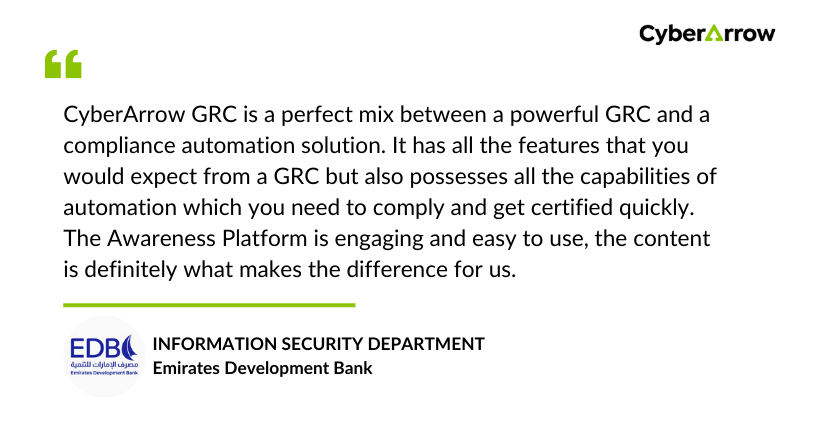
Read Emirates Development Bank ensures continuous cybersecurity compliance by using CyberArrow GRC.
See what EDB has to say about CyberArrow GRC: