

Internal control in auditing: A complete guide for businesses
Every successful business depends on one key element: trust. Stakeholders, investors, and regulators must trust that a company’s financial data is accurate and its operations are well-managed. This is where internal control in auditing becomes essential.
Strong internal controls ensure that financial statements are reliable, processes are efficient, and risks are minimized. In this guide, we will explore what internal control in auditing means, why it matters, its main components, and how modern solutions like CyberArrow GRC simplify the process for organizations of all sizes.
- What is internal control in auditing?
- Why internal control matters in auditing
- Objectives of internal control in auditing
- Components of internal control
- Types of internal controls in auditing
- Role of auditors in evaluating internal controls
- Common examples of internal controls in auditing
- Challenges in maintaining effective internal controls
- How automation transforms internal control management
- CyberArrow GRC: Automating internal control and compliance
- Final thoughts
- FAQs
What is internal control in auditing?
Internal control in auditing refers to the systems, policies, and procedures an organization uses to protect its assets, ensure the accuracy of its financial reporting, and maintain compliance with laws and regulations.
In auditing, internal control acts as the foundation that helps auditors evaluate whether financial statements are free from error or fraud. It also ensures that the organization’s management has adequate processes to detect and prevent irregularities.
Auditors assess the strength of internal control systems before forming an opinion about the financial statements. A strong internal control system means fewer audit issues, while weak controls often result in higher audit risk.
Why internal control matters in auditing
Internal controls are more than just accounting checks, they are essential for the health and sustainability of any organization.
Here’s why internal control in auditing is so important:
- Accuracy of financial information: Strong controls ensure that every financial transaction is recorded correctly, reducing errors and misstatements.
- Fraud prevention: Proper control systems make it harder for employees or third parties to commit fraud or manipulate data.
- Regulatory compliance: Laws such as the Sarbanes-Oxley Act (SOX) require public companies to establish and maintain effective internal controls.
- Operational efficiency: Internal controls streamline workflows, reduce duplication, and help management make better decisions.
- Audit confidence: When auditors see a reliable control environment, they can focus on higher-risk areas, saving time and effort.
In simple terms, effective internal controls create an environment where auditors can verify information with confidence.
Objectives of internal control in auditing
Every internal control system is designed to achieve specific objectives. According to the Committee of Sponsoring Organizations of the Treadway Commission (COSO), internal controls serve five key purposes:
- Operational efficiency and effectiveness: Ensuring that day-to-day operations are optimized and aligned with organizational goals.
- Financial reporting reliability: Guaranteeing that all financial data is complete, accurate, and presented fairly.
- Compliance with regulations: Meeting all legal, regulatory, and contractual obligations.
- Asset protection: Safeguarding cash, inventory, data, and intellectual property from loss or theft.
- Fraud detection and prevention: Implementing mechanisms that can identify irregularities before they escalate.
Components of internal control
The COSO framework breaks internal control into five main components. Each plays a vital role in creating a secure and effective control environment.
1. Control environment
This is the foundation of the entire system. It includes management’s attitude toward integrity, ethics, and accountability. A strong control environment encourages employees to follow procedures and take ownership of their responsibilities.
2. Risk assessment
Organizations must identify potential risks that could affect financial reporting or operations. Auditors evaluate whether management has properly analyzed risks and taken steps to address them.
3. Control activities
These are specific policies and procedures designed to manage risk. Examples include approvals, reconciliations, segregation of duties, and physical access controls.
4. Information and communication
Accurate and timely information must flow across departments. Communication ensures that employees understand their roles in maintaining strong internal controls.
5. Monitoring
Regular reviews and audits help detect weaknesses in control systems. Monitoring ensures continuous improvement and quick correction of any deficiencies.
Types of internal controls in auditing
Internal controls are generally classified into two types: preventive controls and detective controls.
- Preventive controls: These are designed to stop errors or fraud before they happen. Examples include requiring management approvals and segregating duties.
- Detective controls: These identify issues after they occur. Examples include account reconciliations, internal audits, and system logs.
Both preventive and detective controls are essential for maintaining accuracy and trust in financial reporting.
Role of auditors in evaluating internal controls
Auditors assess the adequacy and effectiveness of internal control systems as part of the audit process. The evaluation typically includes:
- Understanding the control system: Auditors gain insight into how controls are designed and implemented.
- Testing the controls: Auditors test a sample of transactions to determine if controls are functioning properly.
- Identifying control weaknesses: If auditors find gaps or inefficiencies, they report them to management with recommendations for improvement.
- Assessing audit risk: The results of internal control testing help determine how much detailed testing is required in the rest of the audit.
A strong internal control system means auditors can rely more on internal data and spend less time performing detailed checks.
Common examples of internal controls in auditing
Here are some practical examples of internal controls that auditors commonly review:
- Segregation of duties (different people handling authorization, recording, and custody)
- Reconciliation of bank accounts and ledgers.
- Restricted access to financial systems.
- Authorization limits for payments and purchases.
- Physical inventory counts.
- Use of audit trails and system logs.
- Regular internal audits and reviews.
These controls together ensure transparency, accountability, and accuracy across the organization.
Challenges in maintaining effective internal controls
Despite their importance, many organizations struggle to maintain effective internal controls due to:
- Manual processes that are time-consuming and error-prone.
- Lack of real-time visibility into risks or compliance status.
- Inconsistent documentation across departments.
- Frequent regulatory changes that require constant updates.
- Limited resources in smaller organizations to monitor controls continuously.
As a result, auditors often face challenges in verifying the reliability of internal controls. This is where automation and modern GRC platforms provide a major advantage.
How automation transforms internal control management
Automation eliminates repetitive tasks, improves accuracy, and strengthens compliance monitoring. It allows organizations to:
- Map and monitor controls in real time.
- Automatically test and validate control effectiveness.
- Generate audit-ready reports instantly.
- Centralize compliance frameworks like SOX, ISO, and NIST.
- Receive alerts for control failures or missing documentation.
By automating internal control processes, businesses reduce human error, save time, and ensure consistency across all departments.
CyberArrow GRC: Automating internal control and compliance
Managing internal controls manually can be overwhelming, especially for growing organizations. CyberArrow GRC is designed to simplify and automate this process for businesses of every type and size.
Here’s how CyberArrow GRC helps:
- Centralized control management: Manage all internal controls from one intuitive platform.
- Automated compliance tracking: Map controls to frameworks like SOX, ISO 27001, NIST, and GDPR.
- Real-time monitoring: Identify control gaps instantly with real-time dashboards.
- Audit-ready reports: Generate reports that meet auditor expectations with one click.
- Scalable solution: Whether you’re a startup or a large enterprise, CyberArrow GRC adapts to your needs.
By integrating automation, analytics, and audit workflows, CyberArrow GRC enables organizations to achieve zero-touch audits, improve governance, and enhance decision-making.
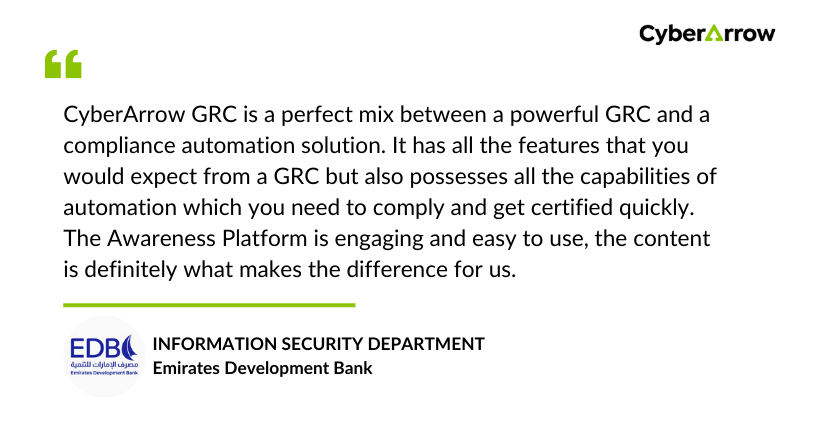
See what Emirates Development Bank has to say about CyberArrow GRC:
Final thoughts
Internal control in auditing is not just about financial accuracy. It’s about protecting your organization, maintaining trust, and ensuring compliance in a fast-changing business world.
A strong internal control system builds confidence among auditors, investors, and regulators. But as businesses grow and regulations become more complex, manual processes can no longer keep up.
That’s why modern organizations choose CyberArrow GRC, a complete governance, risk, and compliance platform that automates controls, streamlines audits, and strengthens organizational resilience.
With CyberArrow GRC, businesses can manage compliance effortlessly, reduce audit fatigue, and focus on growth with confidence.
FAQs
What is internal control in auditing?
Internal control in auditing refers to the systems and procedures an organization uses to safeguard its assets, ensure the accuracy of financial records, and maintain compliance with regulations. Auditors evaluate these controls to confirm whether financial reports are reliable and free from material errors.
Why are internal controls important in auditing?
Internal controls are crucial because they reduce the risk of fraud, improve financial accuracy, and ensure compliance with laws such as the Sarbanes-Oxley Act (SOX). They help auditors verify that management has strong checks and balances to protect company resources and data integrity.
What are the main types of internal controls?
The two main types of internal controls are preventive and detective controls. Preventive controls stop errors or fraud before they happen, while detective controls identify and correct issues after they occur. Both are essential to maintaining transparency and accountability in financial auditing.
How do auditors test internal controls?
Auditors test internal controls by reviewing policies, interviewing employees, and sampling transactions to see if procedures are followed correctly. They assess whether controls are properly designed and operating effectively to prevent or detect material misstatements in financial reports.
How can CyberArrow GRC help automate internal control and auditing processes?
CyberArrow GRC automates internal control management and auditing by centralizing risk, compliance, and control data on one platform. It helps businesses monitor control effectiveness in real time, generate audit-ready reports, and simplify compliance with standards like SOX, ISO, and NIST. This saves time, reduces manual errors, and strengthens overall governance.
