HIPAA certification for healthcare providers: Why it matters and how to get it
The healthcare industry deals with some of the most sensitive personal information: patient medical records, billing details, and insurance data. If this information falls into the wrong hands, it can lead to identity theft, fraud, and severe privacy violations. That’s why the Health Insurance Portability and Accountability Act (HIPAA) sets strict rules for protecting patient health information (PHI).
Many organizations look for HIPAA certification as proof of compliance, but there’s a common misconception: the U.S. government does not issue official HIPAA certification. Instead, covered entities and business associates must follow HIPAA’s guidelines and can seek third-party certification to validate their compliance.
This guide breaks down everything you need to know about HIPAA certification, its importance, requirements, and steps to becoming compliant.
What is HIPAA certification?
HIPAA certification demonstrates compliance with the Health Insurance Portability and Accountability Act (HIPAA), a U.S. federal law designed to protect patient health information (PHI). While there is no official government-issued HIPAA certification, organizations can undergo third-party training and audits to prove their adherence to HIPAA’s privacy and security requirements.
HIPAA enforcement applies to covered entities (healthcare providers, insurers, and clearinghouses) and business associates (vendors and service providers handling PHI). Achieving HIPAA compliance helps organizations protect sensitive patient data, avoid regulatory penalties, and maintain patient trust.
Why HIPAA certification is essential for healthcare providers
Healthcare organizations handle vast amounts of patient data daily, making HIPAA compliance critical for several reasons:
- Protects patient privacy: HIPAA ensures that medical records and other PHI remain confidential and secure.
- Prevents data breaches: Compliance reduces the risk of cyber security threats, ransomware attacks, and insider threats.
- Avoids heavy fines: Non-compliance can lead to penalties ranging from $100 to $50,000 per HIPAA violation, with annual fines reaching millions.
- Enhances patient trust: HIPAA compliance signals a commitment to protecting patient information, fostering trust in healthcare services.
- Ensures legal and regulatory alignment: Many healthcare contracts require proof of HIPAA compliance, especially when working with business associates.
What are the HIPAA certification requirements for covered entities?
While HIPAA does not provide an official certification, organizations must meet several key requirements to be considered HIPAA-compliant. These include:
1. Privacy rule compliance
The HIPAA Privacy Rule governs the use and disclosure of PHI. Covered entities must:
- Limit access to PHI only to authorized personnel.
- Obtain patient consent before sharing their medical data (except in specific cases like law enforcement requests).
- Provide patients with access to their health records upon request.
2. Security rule compliance
The HIPAA Security Rule requires healthcare providers to protect electronic PHI (ePHI) through administrative, physical, and technical safeguards:
- Administrative safeguards: Risk assessments, security policies, and staff training.
- Physical safeguards: Secure data storage, restricted facility access, and workstation security.
- Technical safeguards: Encryption, secure authentication, and intrusion detection systems.
3. Breach notification rule compliance
Organizations must promptly notify affected individuals, the Department of Health and Human Services (HHS), and, in some cases, the media in case of a PHI breach.
4. Remediation plans to address gaps
After conducting risk assessments and HIPAA audits, organizations must create a remediation plan to address security vulnerabilities and compliance gaps. This plan should include timelines, responsibilities, and corrective actions to mitigate risks.
5. Policies and procedures for regulatory compliance
Healthcare organizations must develop and document HIPAA policies and procedures that align with compliance requirements. These documents serve as proof of a “good faith” effort towards compliance and should be updated regularly.
6. Employee training program
All employees, including medical staff, administrative teams, and IT personnel, should receive HIPAA employee training. This program must ensure that employees:
- Understand HIPAA policies and procedures.
- Know how to handle PHI securely.
- Can recognize and respond to potential compliance violations.
7. Documentation audit
HIPAA requires organizations to maintain and store compliance-related documentation, including:
- Security policies and procedures.
- Employee HIPAA training records.
- Incident reports and remediation plans.
- Business Associate Agreements (BAAs).
A documentation audit ensures all required records are accessible and up to date.
8. Business Associate Agreement (BAA) management
If an organization works with third-party vendors that handle PHI, they must:
- Sign BAAs with each vendor to ensure HIPAA compliance.
- Conduct due diligence to verify that vendors have adequate security controls.
- Regularly review vendor compliance status.
Steps to get HIPAA certified
Although the government does not officially issue HIPAA certification, organizations can follow these steps and a HIPAA checklist to ensure compliance and demonstrate their commitment to HIPAA requirements:
1. Conduct a HIPAA risk assessment
A risk assessment helps identify vulnerabilities in data handling, storage, and access controls. This is a mandatory requirement under the HIPAA Security Rule.
2. Implement HIPAA security policies and procedures
Healthcare providers should develop and enforce policies covering data access, PHI handling, incident response, and staff responsibilities. These policies should be documented and regularly updated.
3. Provide HIPAA training to employees
All employees, including medical staff, administrative teams, and IT personnel, should receive HIPAA training. Training should cover:
- Recognizing PHI
- Proper data-sharing protocols
- Password management and security best practices
- Incident reporting procedures
4. Use secure technology and encryption
Encrypt all stored and transmitted ePHI to prevent unauthorized access. Organizations should also implement multi-factor authentication (MFA), firewalls, and endpoint security to enhance data protection.
5. Establish an incident response plan
Prepare for potential data breaches by creating an incident response plan that outlines:
- Steps to contain and mitigate breaches
- Notification procedures for affected individuals and regulatory bodies
- Remediation measures to prevent future incidents
6. Undergo third-party HIPAA certification
While HHS does not issue HIPAA certification, organizations can seek third-party HIPAA compliance audits to validate their adherence to regulations. Popular third-party certification programs include:
- Compliancy Group’s HIPAA Seal of Compliance
- HIPAA One Certification
- HITECH-HIPAA Compliance Audits
These certifications provide external verification of an organization’s compliance and can be used to demonstrate due diligence in handling PHI.
Overcome HIPAA compliance challenges with CyberArrow
Achieving and maintaining HIPAA compliance can be overwhelming, especially for organizations with limited resources. Manual compliance processes often lead to errors, delays, and increased risks of non-compliance. This is where CyberArrow comes in.
CyberArrow GRC simplifies HIPAA certification by:
- Automating security risk assessments: Identify and mitigate compliance risks with real-time assessments.
- Managing policy documentation: Store and update compliance policies in a centralized platform.
- Streamlining employee training: Automate HIPAA training and track completion.
- Ensuring continuous compliance monitoring: Detect and address compliance gaps proactively.
- Generating audit-ready reports: Simplify HIPAA audits with automated evidence collection.
With CyberArrow, healthcare organizations can confidently meet HIPAA requirements, minimize risks, and focus on providing quality patient care.
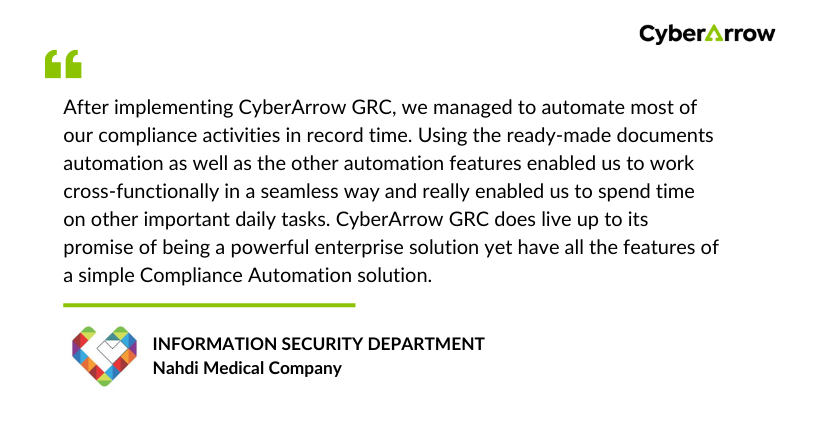
See what companies like Nahdi Medical say about CyberArrow: