Who enforces HIPAA? The role of HHS, OCR, and other authorities
The Health Insurance Portability and Accountability Act (HIPAA) is one of the most critical regulations for protecting healthcare data in the United States.
But who ensures that organizations comply with HIPAA’s privacy and security requirements?
Who enforces HIPAA?
The U.S. Department of Health and Human Services (HHS), specifically through its Office for Civil Rights (OCR).
However, other agencies and state attorneys general also play a role in enforcing HIPAA regulations.
In this article, we’ll explore the authorities responsible for HIPAA enforcement, their roles, and how violations are addressed.
Who enforces HIPAA?
HIPAA enforcement is primarily the responsibility of the Office for Civil Rights (OCR) under the U.S. Department of Health and Human Services (HHS). The OCR oversees compliance with HIPAA’s Privacy, Security, and Breach Notification Rules. It investigates complaints, conducts compliance reviews, and imposes penalties for noncompliance.
However, HIPAA enforcement is not limited to OCR. Other entities involved in enforcement include:
1. The U.S. Department of Health and Human Services (HHS)
HHS oversees HIPAA compliance at a broad level. It establishes regulations, provides guidance to covered entities (such as healthcare providers and insurers), and ensures that policies align with federal healthcare laws.
2. The Office for Civil Rights (OCR)
OCR, a division of HHS, is the primary enforcement agency for HIPAA. Its responsibilities include:
- Investigating HIPAA complaints filed by individuals.
- Conducting audits and compliance reviews of healthcare organizations.
- Issuing civil monetary penalties for HIPAA violations.
- Providing technical assistance to help organizations improve their data protection practices.
OCR also works with healthcare organizations to ensure they understand their obligations and take corrective action when violations occur.
3. The U.S. Department of Justice (DOJ)
The DOJ enforces HIPAA violations that involve criminal activity, such as:
- Knowingly disclosing or obtaining protected health information (PHI) without authorization.
- Using PHI for financial gain or malicious intent.
- Engaging in fraud or identity theft involving healthcare data.
If OCR finds evidence of willful misconduct, it refers the case to the DOJ for criminal prosecution. Penalties can include fines and imprisonment, depending on the severity of the offense.
4. The Federal Trade Commission (FTC)
The FTC enforces HIPAA-related violations for businesses not covered under HHS regulations, such as health apps and wellness programs that collect sensitive data but are not traditional healthcare providers. The FTC applies consumer protection laws to ensure that companies properly handle health data.
5. State Attorneys General
State governments also play a role in HIPAA enforcement. State attorneys general have the authority to investigate HIPAA violations within their jurisdiction and take legal action against organizations that fail to protect patient data. This often results in additional fines or settlements at the state level.
Role of State Attorneys General
Since 2009, state attorneys general have been granted the authority to enforce HIPAA violations within their states. They can:
- File lawsuits against organizations that fail to protect patient data.
- Seek financial penalties and corrective measures.
- Work alongside OCR to investigate HIPAA-related complaints.
State attorneys general are particularly active in cases involving large-scale data breaches or repeated violations.
How HIPAA violations are handled
The OCR follows a structured process to investigate and enforce compliance when a HIPAA complaint is filed. The process includes multiple steps, from initial complaint submission to enforcement actions if a violation is confirmed.
1. Complaint submission
Individuals, whether a patient, employee, or concerned third party, can file a complaint with OCR if they suspect a violation of HIPAA rules. Complaints must meet the following criteria to be reviewed:
- The alleged violation must have occurred within the past 180 days (extensions may be granted in some cases).
- The complaint must involve an entity covered under HIPAA, such as a healthcare provider, health plan, or business associate.
- The complaint must provide enough detail for OCR to investigate.
Complaints can be submitted online, by mail, or via fax through the OCR Complaint Portal. OCR does not investigate complaints that do not fall under HIPAA’s scope but may refer them to other appropriate agencies.
2. Initial review and investigation
Once a complaint is received, OCR determines whether it warrants a formal investigation. If the case moves forward, OCR will do the following:
- Contact the organization to notify them of the complaint and request relevant records.
- Assess compliance by reviewing policies, procedures, and security measures.
- Conduct interviews with employees or affected individuals if necessary.
In cases involving data breaches, OCR may also coordinate with other agencies, such as the Department of Justice (DOJ) or the Federal Trade Commission (FTC), if criminal activity or consumer protection issues are involved.
3. Resolution or enforcement actions
OCR closes the case and informs both parties if no violation is found. However, if a violation is identified, OCR can take several enforcement actions:
Voluntary compliance and corrective action
In cases where violations are unintentional or due to correctable errors, OCR may:
- Provide technical assistance to help the organization fix the issue.
- Require the organization to revise policies and procedures to comply with HIPAA.
- Mandate HIPAA employee training to prevent future violations.
OCR often seeks to resolve minor infractions through corrective action plans (CAPs) rather than imposing penalties immediately.
Civil monetary penalties (CMPs)
OCR may impose fines for more serious violations, especially those involving negligence. The penalties are tiered based on the severity and intent of the violation:
| Violation Type | Penalty Per Violation | Annual Maximum Per Type |
| Unknowing Violation | $100 – $50,000 | $1.5 million |
| Violation due to reasonable cause (not willful neglect) | $1,000 – $50,000 | $1.5 million |
| Willful neglect (corrected) | $10,000 – $50,000 | $1.5 million |
| Willful neglect (not corrected) | $50,000 | $1.5 million |
4. Referral to the Department of Justice (DOJ)
If OCR finds evidence of intentional or criminal misconduct, it refers the case to the DOJ for further action. Examples of criminal HIPAA violations include:
- Knowingly disclosing patient data for financial gain.
- Accessing patient records without authorization for malicious purposes.
- Selling or misusing protected health information (PHI).
Criminal penalties vary depending on the severity of the offense:
- Negligent or unauthorized access: Up to 1 year in prison.
- Offenses under false pretenses: Up to 5 years in prison.
- Malicious intent or financial gain: Up to 10 years in prison.
5. Resolution agreements and ongoing compliance monitoring
In many cases, OCR and the violating organization reach a resolution agreement, which includes:
- A financial settlement (often in the millions of dollars).
- A corrective action plan (CAP) that requires the organization to improve its security practices.
- Ongoing compliance monitoring, where the organization must submit regular reports to OCR for 2–3 years to ensure continued compliance.
Some high-profile HIPAA settlements have exceeded $10 million, especially when large-scale data breaches or repeated violations occur.
Stay compliant and avoid HIPAA violations with CyberArrow
HIPAA enforcement is strict, with HHS, OCR, and other authorities ensuring that healthcare organizations and their partners protect sensitive patient data. Violations can lead to hefty fines, legal action, and even criminal charges, making compliance a critical priority.
The best way to avoid HIPAA violations is to take a proactive approach: implement strong security measures, conduct regular HIPAA audits, and ensure staff is properly trained.
However, manual compliance processes can be time-consuming and prone to errors. That’s where compliance automation solutions like CyberArrow come in.
CyberArrow simplifies compliance by automating key processes, helping organizations stay ahead of HIPAA enforcement agencies like HHS and OCR. With automated evidence collection, real-time risk assessments, security training, and compliance tracking, CyberArrow ensures you meet HIPAA requirements efficiently.
- Automated compliance monitoring: Stay ahead of audits with real-time tracking.
- Security training programs: Educate employees to reduce the risk of violations.
- Risk assessment and mitigation: Identify and address compliance gaps before they become an issue.
- Policy management: Maintain up-to-date policies aligned with HIPAA regulations.
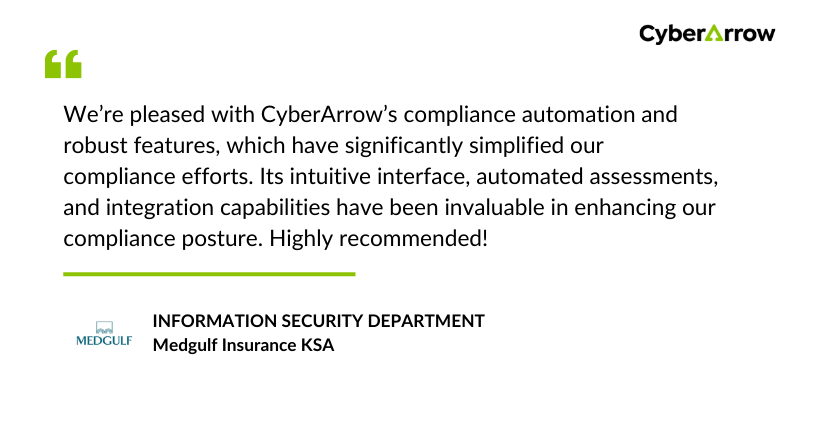
See what companies like Medgulf Insurance say about CyberArrow: