

What is a HIPAA violation? A complete guide
The Health Insurance Portability and Accountability Act (HIPAA), established in 1996, protects the privacy and security of patients’ medical information. HIPAA sets strict guidelines for healthcare providers, insurance companies, and other organizations that handle health data. Violating these rules is called a HIPAA violation.
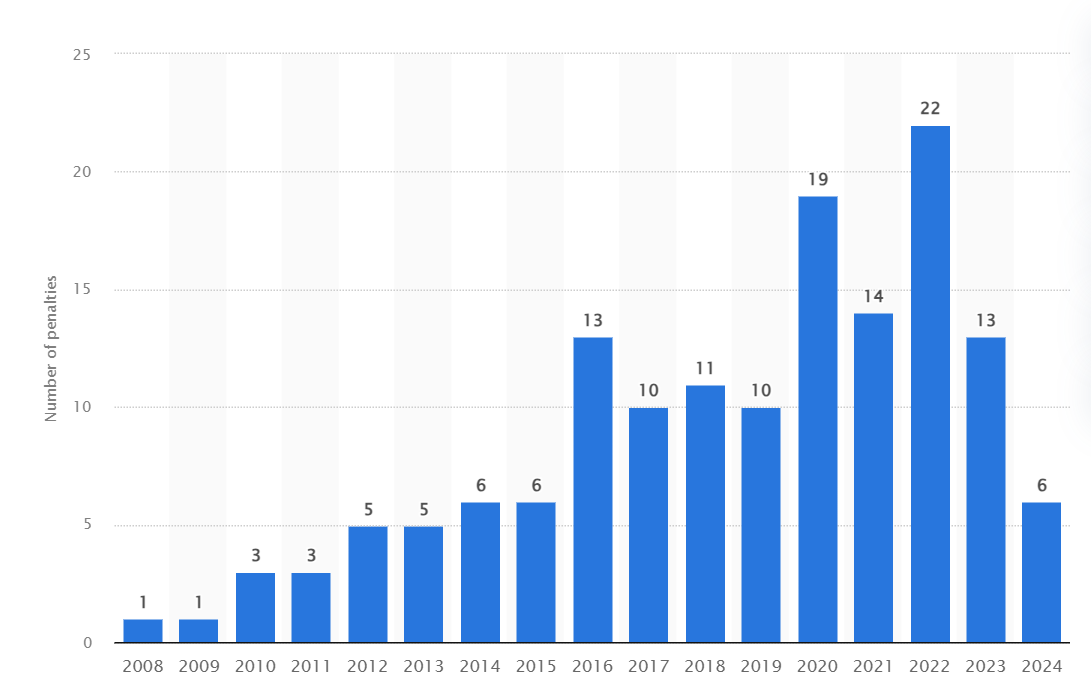
In 2022, the United States Department of Health and Human Services (HHS) Office for Civil Rights (OCR) imposed 22 penalties for violations of the Health Insurance Portability and Accountability Act (HIPAA). This was the highest reported number since 2008. In the first half of 2024, the number of OCR fines was six. The second-highest number of penalties imposed by OCR was in 2020 when due to COVID-19, the healthcare sector was highly targeted by cyber attacks. ~Statista
In this blog, we will explain HIPAA violations, common examples, and how to prevent them. We will also discuss the consequences of not following HIPAA rules and how CyberArrow GRC can help you avoid fines by automating compliance processes.
What is a HIPAA violation?
A HIPAA violation occurs when a healthcare provider, insurance company, or any organization that handles Protected Health Information (PHI) fails to comply with HIPAA rules. PHI includes any personal health information that can identify a patient, such as:
- Medical records
- Test results
- Prescription details
- Billing information
- Names, addresses, and birthdates
HIPAA requires these organizations to take specific measures to protect this information. Failing to do so can result in unauthorized access, theft, or misuse of sensitive data, leading to a HIPAA violation.
Common examples of HIPAA violations
HIPAA violations can happen in various ways. Here are some of the most common examples:
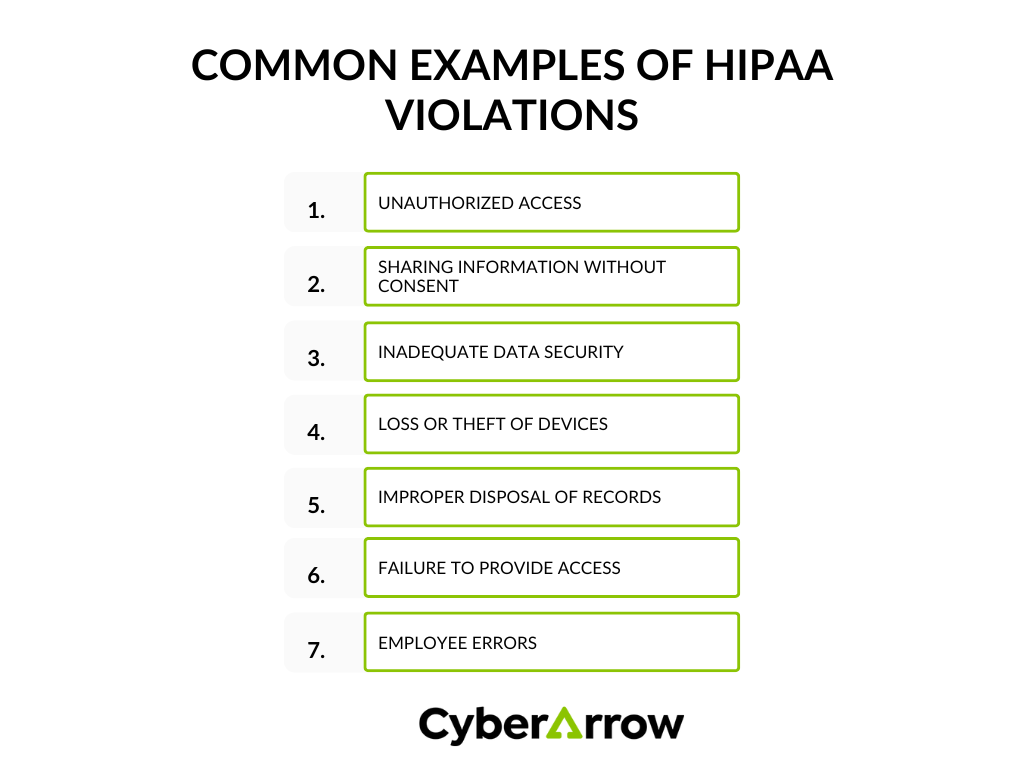
- Unauthorized access: Viewing a patient’s medical records without permission, such as an employee accessing a family member’s file without a valid reason violates HIPPA.
- Sharing information without consent: Discussing a patient’s condition with unauthorized individuals, such as a nurse sharing health details with friends or family without permission violates HIPAA.
- Inadequate data security: HIPAA requires organizations to take strong measures to protect electronic health records (EHRs). Failing to encrypt data, use firewalls, or set up secure passwords can result in data breaches.
- Loss or theft of devices: If a device containing PHI is lost or stolen and the data is not properly secured, it counts as a violation. Healthcare providers must ensure that all devices are encrypted and secured with strong passwords.
- Improper disposal of records: Disposing of patient records without proper shredding or destruction methods, whether physical or digital, is a common violation.
- Failure to provide access: HIPAA gives patients the right to access their own health information. Refusing to give patients access to their medical records or delaying the process can result in a violation.
- Employee errors: Sometimes, a violation happens because of simple mistakes. For instance, sending an email with patient information to the wrong person is a HIPAA violation.
Consequences of a HIPAA violation
HIPAA violations come with severe penalties. Depending on the severity and whether the violation was intentional, fines can range from $100 to $50,000 per violation, with a maximum annual penalty of $1.5 million.
There are four levels of HIPAA violations, each with different consequences:
- Tier 1: The entity was unaware of the violation and couldn’t have avoided it. Fines range from $100 to $50,000.
- Tier 2: The entity knew about the violation but did not act with willful neglect. Fines range from $1,000 to $50,000.
- Tier 3: The violation was due to willful neglect but was corrected within a reasonable timeframe. Fines range from $10,000 to $50,000.
- Tier 4: The violation was due to willful neglect and was not corrected. Fines can go up to $50,000 per violation.
In addition to financial penalties, a HIPAA violation can harm an organization’s reputation, lead to lawsuits, and result in criminal charges. Individuals responsible for intentional violations can face up to 10 years in prison.
How to prevent HIPAA violations
Preventing HIPAA violations requires a strong commitment to data security and patient privacy. Here are some key steps that can help your organization stay compliant:
- Regular employee training: One of the most effective ways to prevent HIPAA violations is to train your employees on HIPAA rules. Staff should understand how to handle sensitive information, avoid common mistakes, and report any suspicious activities.
- Use secure communication tools: When sharing patient information, use secure platforms that encrypt data. Avoid using email, text messages, or other non-secure methods to transmit PHI.
- Encrypt all devices: Make sure that all devices used to store or access PHI are encrypted and password-protected. This includes computers, laptops, mobile phones, and tablets.
- Create strong access controls: Limit who can access PHI. Only employees who need access to patient information should be able to view it. Use strong passwords and two-factor authentication to ensure that only authorized personnel can access sensitive data.
- Implement physical safeguards: In addition to digital protections, physical safeguards are important. Lock filing cabinets, use badge systems for access to restricted areas, and ensure that paper records are securely stored.
- Audit and monitor activity: Regularly audit your systems and monitor employee activity to detect any potential violations early. This helps prevent unauthorized access and alerts you to any suspicious activity.
- Have a breach response plan: In case of a data breach, have a response plan ready. Notify affected individuals, investigate the breach, and take corrective measures to prevent future incidents.
Automate HIPAA compliance with CyberArrow GRC
Staying compliant with HIPAA can be challenging, especially for healthcare organizations handling large amounts of data. Manual processes are prone to errors, and even small mistakes can lead to hefty fines and damage to your organization’s reputation.
CyberArrow GRC (Governance, Risk, and Compliance) offers a solution to simplify and automate the HIPAA compliance process. With CyberArrow GRC, you can:
- Automate risk assessments: Identify potential risks to PHI and generate real-time reports to address them before they turn into violations.
- Centralize documentation: Keep all HIPAA policies, procedures, and audit reports in one place to streamline compliance checks and audits.
- Monitor compliance continuously: With real-time monitoring and alerts, CyberArrow GRC ensures that any changes in your system are compliant with HIPAA rules.
- Reduce human errors: By automating key compliance tasks, CyberArrow GRC reduces the risk of human error that often leads to HIPAA violations.
Read also: How CyberArrow GRC streamlined compliance for Nahdi Medical Company
By using CyberArrow GRC, your organization can avoid hefty HIPAA violations and fines while maintaining the highest level of patient privacy and data security.
