What is NIS2 compliance: Key requirements and implications for organizations
As digital transformation accelerates across Europe, so do the risks associated with cyber security. In response, the European Union (EU) has introduced the NIS2 Directive, a significant update to its original Network and Information Systems (NIS) Directive. This new framework aims to strengthen the security of essential services and critical infrastructure by setting stricter requirements for businesses operating in key sectors.
NIS2 compliance broadens the scope of covered entities and enhances collaboration among member states to address cyber security threats effectively. Understanding NIS2 is crucial for any business operating within the EU as cyber threats evolve.
In this article, we’ll explore NIS2, its implications for businesses, and how you can prepare for the NIS2 Directive.
What is the NIS2 Directive?
The NIS2 is a legislative framework established by the EU to enhance cyber security across member states. Introduced as an update to the original NIS Directive, which came into effect in 2016, NIS2 aims to address the evolving landscape of cyber threats and strengthen the resilience of critical infrastructure.
NIS2 focuses on improving the security of networks and information systems used by essential entities. This includes many sectors, including energy, transport, health, and digital infrastructure.
NIS2 compliance will be implemented across the EU starting October 18, 2024.
Both public and private sector organizations must assess how this directive affects their cyber security practices. They need to outline their compliance strategies and recognize the significant repercussions of non-compliance, which include enhanced oversight, enforcement measures, administrative fines, and personal accountability for senior management.
Who does NIS2 apply to?
NIS2 applies to a range of entities that provide critical services and infrastructure within the EU. Its scope includes:
- Public and private sector organizations that offer essential services.
- Medium-sized and large enterprises operating in the EU.
- Certain entities that are subject to the rules regardless of size.
- Organizations that may be brought under NIS2 by Member States.
- Supply chains of covered entities, which can be indirectly affected.
What major changes does NIS2 compliance bring?
The NIS2 Directive introduces several significant changes to enhance cyber security across the EU. Some of these changes include:
1. Broader scope
NIS2 expands its coverage to include a wider range of sectors and entities. It has expanded its scope from seven sectors to eighteen, significantly increasing the number of entities required to comply.
It establishes clear thresholds based on size, ensuring that all medium and large organizations in designated sectors, including those in the public sector, are included. While exemptions exist, organizations must carefully evaluate their eligibility and whether other regulatory frameworks apply.
2. Stricter security requirements
Organizations must implement comprehensive risk management practices to protect their networks and information systems. For instance, organizations need to establish policies related to risk analysis, information system security, incident management, business continuity, and supply chain security.
Each of these areas must be evaluated about the organization’s existing processes, which must promptly implement all necessary, suitable, and proportional corrective actions.
3. Enhanced incident reporting
NIS2 mandates that organizations report significant cyber security incidents to relevant authorities within a set timeframe, typically within 24 hours of detection, ensuring a swift response to threats.
4. Supply chain security
The directive emphasizes the need for organizations to assess and manage cyber security risks within their supply chains, including third-party and fourth-party risks, strengthening overall security.
5. Stricter enforcement and penalties
NIS2 outlines new enforcement powers that competent authorities must possess, the most notable being the ability to impose administrative fines on entities that violate specific requirements.
Non-compliance with NIS2 can result in fines and penalties, including administrative fines of up to 10 million EUR for essential entities and up to 7 million EUR for important entities.
What are the fines for non-compliance with the NIS2 Directive?
Non-compliance with the NIS2 Directive can result in substantial penalties for organizations. The directive outlines specific fines and repercussions aimed at enforcing cyber security standards. Key details include:
- Organizations classified as essential entities may face fines of up to 10 million EUR or 2% of their total worldwide annual revenue, whichever is higher.
- Depending on the severity of the violation, important entities may incur fines of up to 7 million EUR or 1.4% of their total worldwide annual revenue.
- Senior management may be held personally accountable for infringements of the directive, which can lead to legal repercussions and potential fines.
- Regulatory authorities can temporarily ban senior management in cases of serious non-compliance, limiting their ability to operate in leadership roles.
- In certain situations, organizations may be temporarily suspended from their services as a penalty for failing to comply with NIS2 requirements.
How to prepare your organization for NIS2 compliance?
Preparing for NIS2 compliance involves a comprehensive approach. Here are the key steps to ensure your organization is ready:
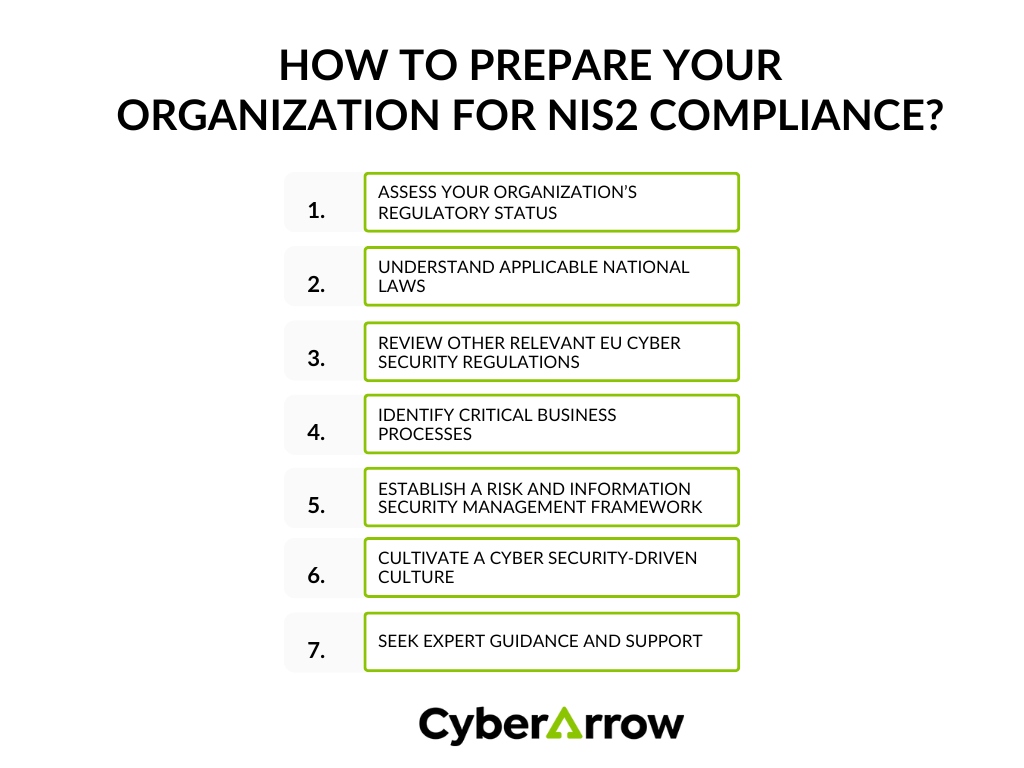
- Assess your organization’s regulatory status: Determine whether your organization is subject to the NIS2 Directive. Evaluate the nature of your services and their criticality to societal functions. This assessment will help you understand if you fall within the directive’s scope and what obligations you must fulfill.
- Understand applicable national laws: Next, identify the laws and regulations specific to your Member State that impact your organization. Each country may have its implementation of NIS2, and understanding these local laws is crucial for ensuring compliance and avoiding penalties.
- Review other relevant EU cyber security regulations: In addition to NIS2, research any other European Union cyber security legislation that may apply to your organization. This includes regulations such as GDPR or the ePrivacy Directive, which can have overlapping requirements related to data protection and security.
- Identify critical business processes: Identify and assess the essential processes within your organization that are vital for delivering your services. Understanding which operations are critical allows you to prioritize them in your compliance efforts and ensure they are adequately protected against cyber threats.
- Establish a risk and information security management framework: Implement a robust risk and information security management system tailored to your organization’s specific needs. This framework should include processes for identifying, assessing, and mitigating risks, as well as protocols for incident response and recovery. Regularly review and update these processes to adapt to evolving threats.
- Cultivate a cyber security-driven culture: Foster a culture of cyber security awareness throughout your organization. Conduct training sessions to educate employees about the importance of security practices and policies and their role in protecting sensitive information. Encourage a proactive approach to enhancing your organization’s overall security posture.
- Seek expert guidance and support: Don’t hesitate to seek assistance from cyber security professionals or legal experts who can provide valuable insights and guidance on NIS2 compliance. Their expertise can help you navigate the complexities of the directive, ensuring that you implement the necessary measures effectively.
How CyberArrow can help?
As your organization prepares for NIS2 compliance, CyberArrow is here to help make compliance easier. CyberArrow GRC automates many of the compliance tasks so you can focus on what matters most.
- Automated compliance processes: CyberArrow streamlines compliance activities, helping you manage and document your NIS2 requirements quickly and accurately.
- Expert guidance: Our GRC experts understand NIS2 inside and out. We can help you grasp the specific requirements that apply to your organization and guide you through the compliance journey.
- Implementation support: We assist you in setting up the requirements, including risk assessments, to meet NIS2 compliance.
With NIS2 going into effect on October 18, 2024, now is the time to prepare. Let CyberArrow support your organization in achieving compliance smoothly.
See what Emirates have to say about CyberArrow GRC: