


What is ISO 31000? A detailed guide to ISO 31000 compliance
Risk is everywhere in business. From financial losses to cyber threats and operational failures, organizations must be prepared to handle uncertainties. Without a structured approach to risk management, businesses can suffer heavy losses, legal issues, and reputational damage.
ISO 31000 provides a global risk management framework that helps businesses identify, assess, and manage risks effectively. Unlike compliance-based standards such as ISO 27001 or ISO 27701, ISO 31000 is a best practice framework rather than a certifiable standard. It applies to businesses of all sizes and industries, helping them create a proactive risk management culture to enhance decision-making and resilience.
In this guide, we will cover what ISO 31000 is, how it works, key principles and structure of the ISO 31000 risk management framework, and how CyberArrow GRC can automate and simplify compliance.
What is ISO 31000?
ISO 31000 is an international risk management standard developed by the International Organization for Standardization (ISO). It provides organizations with a structured framework for managing risks across different business areas, including finance, cyber security, compliance, operations, and strategy.
Unlike ISO 27001, which focuses on information security, ISO 31000 covers all types of risks an organization may face. It helps businesses develop a risk-aware culture by embedding risk management into their decision-making processes.
Key facts about ISO 31000
- First published: 2009 (latest update in 2018).
- Not certifiable: Organizations cannot get ISO 31000 certification.
- Applies to all industries: Used in finance, cyber security, healthcare, government, and more.
- Flexible framework: Can be adapted to any organization’s risk management needs.
ISO 31000 risk management framework
ISO 31000 follows a structured approach to identifying, assessing, and mitigating risks. The framework consists of three main components:
1. Principles of risk management
ISO 31000 defines eight core principles that businesses must follow:
- Value creation: Risk management should help businesses grow and operate efficiently.
- Integration: Risk management should be part of all business activities.
- Customization: Risk strategies should fit the organization’s needs.
- Inclusiveness: Employees, stakeholders, and leadership should be involved in risk decisions.
- Dynamic approach: Risk management should evolve as business risks change.
- Best information use: Decisions should be based on accurate data.
- Human & cultural factors: People and company culture impact risk management success.
- Continuous improvement: Risk management should be reviewed and updated regularly.
2. Risk management framework
The framework ensures that risk management becomes a part of everyday business operations.
It includes:
- Leadership commitment: Top management must support risk management efforts.
- Risk policy development: Organizations should define how risks will be handled.
- Integration into processes: Risk management should be embedded into daily business activities.
- Ongoing monitoring & review: Risk management strategies should be continuously improved.
3. Risk management process
ISO 31000 outlines a step-by-step approach for identifying and managing risks:
Step 1: Risk identification
Organizations must identify potential risks across different areas, such as financial risks, cyber security threats, operational risks, or regulatory compliance risks.
Step 2: Risk analysis
Once risks are identified, businesses must assess their likelihood and impact. Risks should be categorized based on severity levels.
Step 3: Risk evaluation
Companies need to determine which risks require immediate action and which can be monitored. This step helps prioritize risk management efforts.
Step 4: Risk treatment
Risk treatment strategies include:
- Avoiding the risk (changing business processes)
- Reducing the risk (implementing security measures)
- Sharing the risk (outsourcing or insurance)
- Accepting the risk (if the impact is minimal)
Step 5: Monitoring & review
Risk management should be continuously reviewed and improved to adapt to changing risks.
Benefits of implementing ISO 31000
Implementing ISO 31000 brings multiple advantages to businesses, including:
1. Better decision-making
A structured risk management approach helps businesses make informed decisions while reducing uncertainty.
2. Stronger business resilience
Organizations that follow ISO 31000 can handle economic downturns, cyber threats, and compliance changes effectively.
3. Improved compliance with regulations
Many industries require businesses to implement risk management as part of regulatory compliance (e.g., GDPR, ISO 27001, PCI DSS, SOC 2).
4. Cost savings & risk reduction
Proactively managing risks helps prevent financial losses, reputational damage, and legal issues.
5. Enhanced stakeholder trust
Clients, investors, and regulators trust businesses with strong risk management practices.
Steps to achieve ISO 31000 compliance
Businesses should follow these steps to integrate ISO 31000 into their risk management processes:
Step 1: Conduct a risk assessment
Start by identifying risks across business operations. This includes financial, cyber security, legal, and operational risks.
Step 2: Develop a risk management policy
Create a structured risk management framework aligned with ISO 31000 principles.
Step 3: Assign responsibilities
Define who will oversee risk management efforts. Senior leadership and risk officers play a key role in this process.
Step 4: Implement risk controls
Based on the risk evaluation, apply preventative measures such as cyber security protocols, data protection policies, and financial risk controls.
Step 5: Monitor and improve continuously
Regularly review risk management strategies and update them based on new threats and business changes.
How CyberArrow GRC automates ISO 31000 compliance
Managing risk manually is time-consuming. CyberArrow GRC is a powerful compliance automation platform that helps businesses simplify ISO 31000 risk management.
Why choose CyberArrow GRC?
- Automates risk assessments: Identify and evaluate risks across multiple business areas.
- Compliance with multiple standards: Supports ISO 27001, ISO 27701, ISO 27017, PCI DSS, GDPR, SOC 2, and more.
- Real-time monitoring: Track risk levels and compliance status with live dashboards.
- Automated evidence collection: Reduce manual workload with automated reporting and risk tracking.
- 80+ integrations: Seamlessly connects with existing business systems.
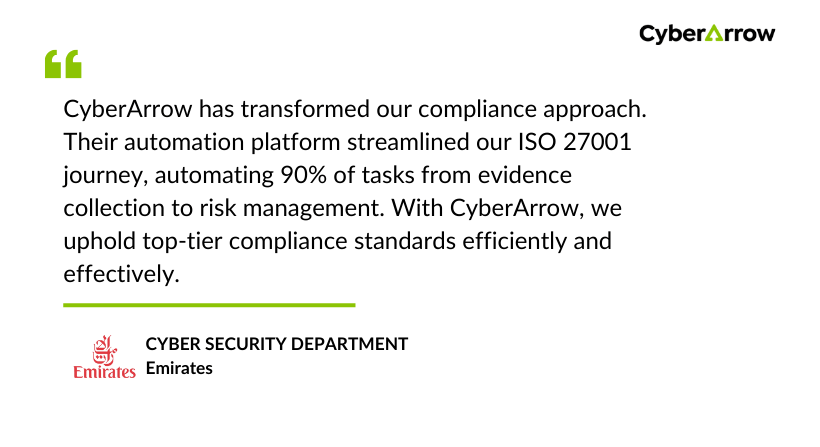
See what global brands like Emirates have to say about CyberArrow GRC:
Conclusion
ISO 31000 provides a structured approach for identifying, analyzing, and managing risks across all industries. While not a certifiable standard, it is widely adopted as a best-practice framework for improving decision-making, strengthening resilience, and ensuring compliance.
For businesses looking to automate ISO 31000 compliance, CyberArrow GRC is the ultimate solution. With risk assessment automation, compliance tracking, and real-time monitoring, CyberArrow GRC simplifies risk management across multiple frameworks.
FAQs
Is ISO 31000 certifiable?
No, ISO 31000 is not a certifiable standard. It provides guidelines and principles for risk management, but organizations cannot receive an official ISO 31000 certification. However, companies can align their risk management processes with ISO 31000 to improve their overall risk framework.
What is the difference between ISO 31000 and ISO 27001?
ISO 31000 focuses on risk management for all types of risks in an organization, covering strategic, financial, operational, and security risks. On the other hand, ISO 27001 is specifically designed for information security risk management, ensuring the protection of sensitive data and cyber security measures.
How can CyberArrow GRC help with ISO 31000 compliance?
CyberArrow GRC simplifies risk management and compliance by automating key processes, offering real-time risk monitoring, and providing cross-mapping with multiple standards like ISO 27001, ISO 27701, GDPR, and more. With automated reporting and risk assessments, CyberArrow GRC helps organizations align with ISO 31000 guidelines efficiently.
