What is the Capability Maturity Model (CMM)? A complete guide
If you want your business to grow, improve, and become more professional, you need a system to measure how well your processes work. That’s where the Capability Maturity Model comes in. It helps organisations check how mature and effective their processes are and shows how to make them better step by step.
In this complete guide, we’ll explain what the Capability Maturity Model is, why it matters, the 5 levels of maturity, and how to improve your maturity stage using smart tools like CyberArrow GRC.
Let’s keep it simple and clear.
What is the Capability Maturity Model?
The Capability Maturity Model (CMM) is a framework that helps businesses understand how good their internal processes are. It shows you where your business stands from basic to excellent and helps you improve step by step.
Think of it like a school report card, but for your company’s processes. Instead of getting grades like A or B, you get placed in a “maturity level” from 1 to 5.
CMM was first created by the Software Engineering Institute (SEI) to help software companies build better systems. Today, it’s used by many industries to improve how they work.
Why is the Capability Maturity Model important?
Using the Capability Maturity Model helps your business:
- Improve process quality.
- Work more efficiently.
- Reduce mistakes and risks.
- Deliver better products and services.
- Save time and money.
- Grow faster.
- Build trust with customers and partners.
Without a clear way to measure progress, it’s hard to grow. The CMM gives you a roadmap so you know exactly what to fix and how to improve.
The 5 levels of Capability Maturity Model
The Capability Maturity Model has 5 levels. Each level shows how mature and reliable your business processes are.
Let’s go through each one in simple words.
Level 1: Initial (Chaotic)
At this level, things are messy. There are no set rules or systems. Everyone works differently. Success depends on individual effort, not on a process.
Common signs:
- No written procedures.
- Work is done randomly.
- Results are unpredictable.
- Quality depends on the person doing the job.
Risk: High. Mistakes and confusion are common.
Level 2: Repeatable
Here, some processes are in place. People start following the same steps for similar tasks. You can repeat successful projects.
Common signs:
- Some basic procedures are documented.
- Similar tasks are done in the same way.
- Teams learn from past projects.
Benefit: Fewer surprises, better control.
Level 3: Defined
At this level, all processes are clearly written, shared, and followed across the company. Everyone knows what to do and how to do it.
Common signs:
- Company-wide rules and policies.
- Standard training for employees.
- Everyone follows the same methods.
Example: A company handbook or process guide.
Level 4: Managed
Now the business starts using numbers and data to measure how well processes work. You track results and try to make things better based on real data.
Common signs:
- Performance is tracked using KPIs.
- Issues are found early using data.
- Quality is predictable and controlled.
Benefit: Data helps you make smart decisions.
Quick link: How to develop a strong cyber security strategy?
Level 5: Optimizing
This is the top level. Here, your business is always looking for ways to improve. You use data, feedback, and new ideas to make systems better every day.
Common signs:
- Continuous improvement.
- Innovations are tested and used.
- Processes are updated often.
Goal: Be the best and stay ahead.
How to improve your Capability Maturity Level
Now that you understand the 5 levels, how can you move up the ladder?
Here are some simple steps to improve your Capability Maturity Model level:
1. Assess where you are
Start by finding your current level. Ask:
- Do we have set processes?
- Are they written down?
- Do people follow them?
- Do we measure performance?
- Do we look for improvements?
You can do this with a self-assessment or get help from experts.
2. Set clear goals
Decide what level you want to reach. Maybe you’re at Level 2 now and want to move to Level 3 in the next 6 months. Set a timeline and break it into small steps.
3. Document your processes
Write down how things should be done. This helps everyone follow the same method. Use simple language, flowcharts, or checklists to make it easy.
4. Train your team
Processes only work if people know and follow them. Run training sessions and share guides to help employees understand what’s expected.
5. Track performance
Use key performance indicators (KPIs) to measure how well your processes are working. This helps you spot problems early and improve faster.
6. Use the right tools
Manual tracking, policies, and reporting can be hard and time-consuming. This is where automation tools like CyberArrow GRC make a big difference (we’ll explain more below).
7. Review and improve
Set regular times to review your processes. What’s working well? What can be better? Use feedback and data to keep improving.
Real-world example
Let’s say you run a software company.
- At Level 1, developers write code differently. Some forget to test. Bugs are common.
- At Level 2, you set a rule: all code must be tested before release.
- At Level 3, you build a full software development lifecycle (SDLC) that everyone follows.
- At Level 4, you start tracking how long each project takes and where bugs appear.
- At Level 5, you use this data to improve how you work and test new tools to speed up development.
This journey makes your company faster, smarter, and more trusted.
Why CyberArrow GRC is the best tool to improve Capability Maturity
Improving your Capability Maturity Model level is important, but doing it manually is hard. You need tools to track, measure, and improve your processes without wasting time.
That’s why smart businesses choose CyberArrow GRC.
CyberArrow helps you:
- Automate risk assessments and compliance tasks.
- Document and share internal policies easily.
- Monitor internal controls in real-time.
- Track KPIs and maturity levels with built-in dashboards.
- Get alerts when processes are not working.
- Use 3000+ pre-mapped risks and controls.
- Follow 100+ industry frameworks (like ISO 27001, NIST, and more).
- Complete certifications in weeks, not months.
Instead of juggling spreadsheets and documents, CyberArrow puts your process improvement on autopilot.
With 80+ integrations and auditor-approved templates, CyberArrow saves time, boosts accuracy, and helps you climb the maturity ladder faster.
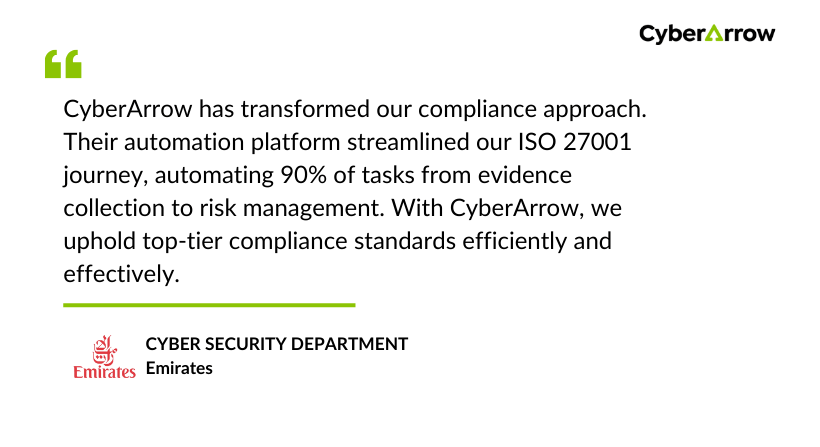
Read how Emirates enhanced Information Security by automating ISO 27001 with CyberArrow GRC.
See what Emirates has to say about CyberArrow GRC: