


How to develop a strong cyber security strategy? A complete guide
Cyber threats are rising every day. From small businesses to big companies, no one is safe. Hackers are getting smarter, and attacks are becoming more common and dangerous. That’s why every organisation needs a strong cyber security strategy.
In this complete guide, we’ll show you how to build a strong cyber security strategy step by step, even if you don’t have deep technical knowledge.
Let’s make your business more secure and future-ready.
- What is a cyber security strategy?
- Why is a cyber security strategy important?
- Step-by-step guide to building a cyber security strategy
- 1. Understand what you need to protect
- 2. Identify cyber threats and risks
- 3. Set clear goals
- 4. Build a cyber security team
- 5. Use the right tools and technology
- 6. Create cyber security policies
- 7. Train your employees
- 8. Monitor and review your systems
- 9. Be ready for incidents
- 10. Stay compliant with standards
- Cyber security strategy checklist
- Why CyberArrow GRC is the best tool for your cyber security compliance needs
- FAQs
What is a cyber security strategy?
A cyber security strategy is a clear plan to protect your organisation’s digital systems, data, and networks from cyber threats. This plan includes tools, rules, people, and actions that help you stay safe online. A good strategy doesn’t just react to problems; it prevents them before they happen.
Think of it like building a strong lock on your front door, installing cameras, and having a plan in case someone tries to break in.
Why is a cyber security strategy important?
A strong cyber security strategy helps you:
- Protect your business and customer data.
- Avoid costly attacks and data breaches.
- Build trust with your clients and partners.
- Stay compliant with laws and regulations.
- Keep your business running smoothly.
Without a strategy, your organisation is like a house with open doors and no alarm system. It’s not a matter of if something will go wrong, it’s when.
Step-by-step guide to building a cyber security strategy
Let’s walk through the steps you need to follow to create a powerful and simple cyber security strategy.
1. Understand what you need to protect
First, list out your key assets:
- Customer information.
- Financial records.
- Emails and communication systems.
- Company software and tools.
- Intellectual property (like designs, plans, or code).
This helps you focus on what matters most. Not all data is equally important, so this step helps you save time and resources.
2. Identify cyber threats and risks
Next, think about what could go wrong. Ask questions like:
- What would happen if hackers stole our customer data?
- What if someone locked us out of our own systems?
- Could someone inside the company leak information?
You can also look at common threats like:
- Phishing emails.
- Ransomware attacks.
- Weak passwords.
- Insider threats.
- Unpatched software.
Knowing your risks helps you prepare better defenses.
3. Set clear goals
Now, set clear goals for your cyber security strategy. These could be:
- “We will reduce phishing attacks by 70% in the next year.”
- “We will train all employees on cyber safety within 3 months.”
- “We will be compliant with ISO 27001 or other standards in 6 months.”
Having goals makes it easier to measure your progress and success.
4. Build a cyber security team
You don’t need a huge team, but you do need responsible people. Your cyber security team should:
- Monitor threats.
- Handle incidents.
- Keep systems updated.
- Train employees.
- Ensure compliance.
This could be in-house staff, an external partner, or both.
5. Use the right tools and technology
Good tools can stop attacks before they even happen. Some common cyber security tools include:
- Firewalls.
- Antivirus software.
- Multi-factor authentication (MFA).
- Data encryption tools.
- Vulnerability scanners.
Automated tools make your job easier and faster. We’ll share the best one later in this post.
6. Create cyber security policies
Policies are rules that everyone in your company must follow. These rules help people know what to do (and not to do). Some important policies include:
- Strong password policy.
- Internet and email usage rules.
- Device and mobile access rules.
- Data protection and backup policies.
- Incident response policy.
Make sure everyone reads and understands these policies.
7. Train your employees
Even with the best tools, human error is still the #1 reason for cyberattacks. Train your staff to:
- Spot phishing emails.
- Use strong passwords.
- Report suspicious activity.
- Follow company rules.
Cyber security is everyone’s job, not just the IT team’s.
8. Monitor and review your systems
Don’t just set it and forget it. You need to check your systems often to:
- Look for weaknesses.
- Review logs for strange activity.
- Ensure tools are working properly.
- Fix any problems quickly.
Real-time monitoring tools help you do this faster.
9. Be ready for incidents
Even with strong security, incidents can still happen. That’s why you need an incident response plan. This plan should include:
- Who to contact.
- What to do first.
- How to reduce damage.
- How to recover quickly.
- How to learn from the attack.
The faster you respond, the less damage you’ll face.
10. Stay compliant with standards
Many industries have rules about how you must protect data. Some popular frameworks include:
Following these standards also helps you gain customer trust and avoid fines.
Cyber security strategy checklist
Here’s a quick checklist to make sure your cyber security strategy is on track:
- Know what data and systems you need to protect.
- Identify threats and risks.
- Set clear security goals.
- Assign a security team.
- Use the right cyber security tools.
- Create and share policies.
- Train employees regularly.
- Monitor systems 24/7.
- Prepare for incidents.
- Follow compliance frameworks.
Why CyberArrow GRC is the best tool for your cyber security compliance needs
Building and managing a cyber security strategy takes time and effort. But what if you could automate 90% of it?
That’s exactly what CyberArrow GRC does.
CyberArrow GRC is an all-in-one platform that helps you:
- Automate risk assessments.
- Monitor compliance in real-time.
- Track internal controls with zero spreadsheets.
- Get certified against 100+ frameworks in just weeks.
- Simplify policy creation and distribution.
- Auto-scan your systems for gaps and issues.
- Receive alerts when controls are not working.
- Generate audit-ready reports in one click.
With 80+ integrations, pre-approved document templates, and real-time dashboards, CyberArrow makes your cyber security plan smart and automatic.
Instead of wasting time on manual tasks, your team can focus on real security improvements. No more hunting for data across systems. No more stress during audits. No more guessing if you’re compliant.
CyberArrow GRC puts your cyber security on autopilot.
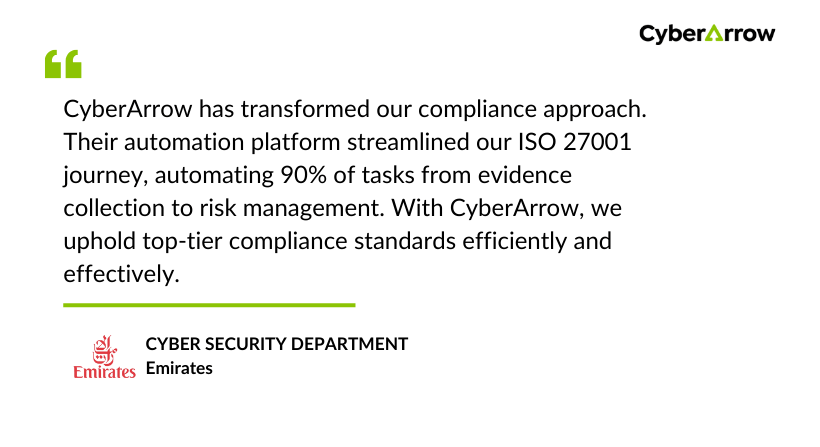
Read how Emirates enhanced Information Security by automating ISO 27001 with CyberArrow GRC.
See what Emirates has to say about CyberArrow GRC:
FAQs
What is a cyber security strategy, and why is it important?
A cyber security strategy is a clear plan that helps protect your data, systems, and networks from cyber threats. It includes rules, tools, and actions that keep your business safe. It’s important because it helps prevent data breaches, builds customer trust, and keeps your business running without interruptions.
How can small businesses build a strong cyber security strategy?
Small businesses can build a strong cyber security strategy by following a few steps: know what data to protect, understand possible risks, use simple tools like firewalls and antivirus software, train employees, and create security policies. Using automated tools like CyberArrow GRC can also make the process much easier and faster.
What tools can help automate a cyber security strategy?
Tools like CyberArrow GRC can automate up to 90% of your cyber security strategy. They help with risk assessments, real-time compliance tracking, policy management, and audit reports. These tools save time and reduce human error, making your business more secure without extra effort.
