


Case study: Famous phishing attacks and their impact
Phishing is one of the oldest tricks in the hacker’s book. It’s simple, sneaky, and shockingly effective. Over the years, even the biggest companies in the world have fallen for phishing attacks, leading to stolen data, lost money, and broken trust.
In this blog, we’ll explore:
- What phishing is and how it works.
- Real case studies of the most famous phishing attacks.
- The lessons we can learn from these cases.
- How the CyberArrow Awareness Platform can protect your business by turning your employees into a human firewall.
Let’s dive into these real-world attacks and discover how to stay safe.
- What are phishing attacks?
- Case study 1: Google and Facebook – $100 million lost (2013–2015)
- Case study 2: Sony Pictures – Email hack before a major movie launch (2014)
- Case Study 3: Ubiquiti Networks – $46.7 million gone (2015)
- Case study 4: Twitter celebrities and bitcoin scam (2020)
- Case study 5: Colonial pipeline – Ransomware started with phishing (2021)
- Common patterns in all these phishing attacks
- How CyberArrow Awareness Platform helps
- Final thoughts: Real stories, real lessons
What are phishing attacks?
Phishing attacks are when hackers trick people into giving away personal or work-related information. This is often done through fake emails, phone calls, or websites.
The goal is to get you to:
- Click a dangerous link.
- Download a harmful file.
- Give up your login credentials.
- Share private or financial data.
Phishing is popular because it targets humans, not just machines. That’s why training your team is one of the best defenses.
Case study 1: Google and Facebook – $100 million lost (2013–2015)
What happened?
Between 2013 and 2015, a hacker named Evaldas Rimasauskas tricked both Google and Facebook into sending him payments. He set up a fake company that looked like a real supplier that the tech giants worked with.
He then sent fake invoices and emails that looked real. Because they trusted the name, both companies transferred over $100 million to him.
Why it worked:
- The emails looked real and used familiar names.
- There was no proper process to verify supplier payments.
- Employees were not trained to spot fraud.
The impact:
- $100 million lost.
- Global news coverage and reputational damage.
- Legal issues and fraud investigations.
Case study 2: Sony Pictures – Email hack before a major movie launch (2014)
What happened?
In 2014, Sony Pictures was preparing to release the film “The Interview.” Before the movie launched, hackers sent phishing emails to Sony executives pretending to be from Apple.
When a few employees clicked the link and entered their details, hackers got full access to Sony’s email system. The attackers then leaked:
- Private emails between staff.
- Actor salaries and personal info.
- Unreleased movie files.
Why it worked:
- The phishing email used a familiar brand (Apple).
- It looked like a routine request.
- Staff were not trained to double-check links or requests.
The impact:
- Massive data leak.
- Public embarrassment for executives.
- Canceled film screenings due to security fears.
- Estimated cost: Over $100 million.
Case Study 3: Ubiquiti Networks – $46.7 million gone (2015)
What happened?
Ubiquiti, a networking tech company, lost $46.7 million due to a phishing scam in 2015. A hacker pretended to be an executive at the company and emailed the finance department.
The message looked urgent and told them to transfer money to a foreign bank account. The finance team did it without confirming the request.
Why it worked:
- The email came from a look-alike domain.
- The message felt urgent and pressured the staff.
- Employees weren’t trained to verify large fund requests.
The impact:
- Millions lost.
- Major loss of trust from shareholders.
- A painful lesson in how social engineering works.
Case study 4: Twitter celebrities and bitcoin scam (2020)
What happened?
In 2020, hackers gained access to Twitter’s internal tools by targeting employees through a phishing attack. Once they got in, they took control of high-profile accounts like:
- Elon Musk.
- Barack Obama.
- Apple.
- Kanye West.
They tweeted out a Bitcoin scam, tricking followers into sending cryptocurrency to a wallet address.
Why it worked:
- Attackers tricked employees into sharing credentials.
- Employees didn’t report the suspicious activity.
- There was no advanced phishing training in place.
The impact:
- Public trust in Twitter dropped.
- Investigations by law enforcement.
- Millions lost in Bitcoin.
- Massive news headlines.
Case study 5: Colonial pipeline – Ransomware started with phishing (2021)
What happened?
The Colonial Pipeline attack caused fuel shortages in the U.S. and shut down a major energy system. It started with a phishing attack that gave hackers access to login credentials.
From there, they launched a ransomware attack that locked systems until a ransom was paid.
Why it worked:
- Login data was stolen through phishing.
- No multi-factor authentication was used.
- Employees were not trained to spot suspicious activity.
The impact:
- Disruption of fuel supply on the East Coast.
- Panic buying and price spikes.
- A ransom of $4.4 million was paid.
Common patterns in all these phishing attacks
Let’s break down what these cases have in common:
| Weakness | Description |
| Lack of training | Employees didn’t know how to spot fake emails or links. |
| Trust in authority | People followed orders from names that looked familiar. |
| Urgency | Emails often used pressure or time-sensitive language. |
| No verification | Requests for money or access weren’t double-checked. |
These patterns prove one thing: phishing attacks target people, not just systems.
How CyberArrow Awareness Platform helps
At the center of all these attacks is human behavior. And that’s exactly what the CyberArrow Awareness Platform helps improve.
CyberArrow trains your team to:
- Spot phishing emails and fake websites.
- Avoid clicking on harmful links or attachments.
- Report suspicious activity before it’s too late.
- Understand how hackers think and act.
Here’s how CyberArrow does it:
Targeted, automated training
- Role-based training for each department.
- Easy-to-follow modules using real-world examples.
- Continuous updates based on the latest threats.
Realistic phishing simulations
- Test your team with fake phishing emails.
- Find out who’s most at risk.
- Give them instant feedback and extra lessons.
Actionable dashboards
- Monitor employee progress and risk levels.
- Get reports on training completion and test results.
- Spot trends and improve your defense over time.
Build a human firewall
With CyberArrow, your people become your strongest security layer. They learn not just to avoid attacks, but to fight them.
Read how CyberArrow awareness platform increased security awareness among Silal’s employees.
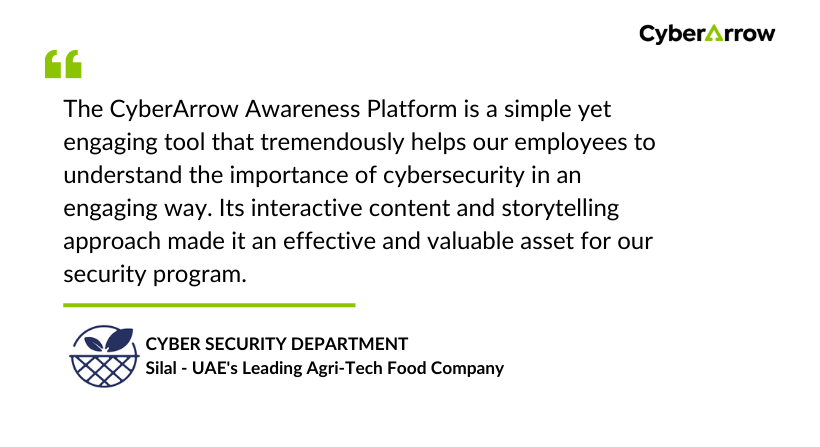
See what Silal has to say about CyberArrow Awareness Platform:
Final thoughts: Real stories, real lessons
These famous phishing attacks show how even the most advanced companies can fall when people aren’t trained. But the good news is that phishing can be stopped.
With the right training and tools, your team can:
- Catch suspicious emails.
- Think twice before clicking.
- Report issues before they become breaches.
