What is enterprise AI GRC, and why it matters for modern organizations
Governance, risk, and compliance (GRC) processes in large organizations are often complex, manual, and time-consuming. As regulations tighten and cyber threats become more sophisticated, traditional GRC tools are no longer keeping up with the rapid changes.
This is where enterprise AI GRC can help. It is a modern approach that uses artificial intelligence to streamline compliance, detect risks faster, and reduce human error. For enterprises dealing with large volumes of data, distributed teams, and constant audits, AI-powered GRC systems offer a more scalable and proactive solution.
In this article, we’ll explore what enterprise AI GRC really means, why it’s becoming a priority for large organizations, and how it helps teams manage compliance more efficiently.
- What is enterprise AI GRC?
- Why enterprises need AI-powered GRC solutions
- How enterprise AI GRC improves risk and compliance outcomes
- Best practices for implementing AI GRC at enterprise scale
- 1. Start with a clear use case and measurable goals
- 2. Assess and centralize your existing GRC data
- 3. Involve compliance, IT, and security teams early
- 4. Choose an AI GRC platform that’s configurable
- 5. Establish data privacy and governance controls
- 6. Integrate GRC with your existing enterprise stack
- 7. Train teams to understand AI-generated outputs
- Streamline enterprise GRC with CyberArrow
What is enterprise AI GRC?
Enterprise AI GRC is the use of artificial intelligence in managing governance, risk, and compliance at scale. These platforms are designed to help large organizations automate repetitive tasks, analyze large datasets in real time, and proactively manage risks across departments and geographies.
Instead of relying on static frameworks and spreadsheets, AI in GRC automation uses machine learning, natural language processing, and intelligent automation to assist with:
- Identifying potential risks before they escalate.
- Automating evidence collection for audits.
- Monitoring compliance gaps continuously.
- Providing smart recommendations based on regulations and internal policies.
Enterprise AI GRC blends the intelligence of AI with the structure of GRC to make risk and compliance workflows more dynamic, data-driven, and efficient.
Key capabilities of enterprise AI GRC platforms
Not all AI GRC tools are built the same. At the enterprise level, the most effective platforms go beyond basic automation and offer intelligent, scalable capabilities that evolve with the organization’s needs.
Here are some core capabilities to look for:
- Identifies risks using AI-powered analysis of structured and unstructured data.
- Offers real-time visibility into compliance status with automated regulatory tracking.
- Streamlines policy management by flagging outdated or conflicting policies.
- Automates control testing and continuously collects audit-ready evidence.
- Uses predictive analytics to forecast potential risks and prevent incidents.
- Simplifies reporting with natural language processing for clear summaries.
- Automates workflows and integrates across departments to eliminate data silos.
Why enterprises need AI-powered GRC solutions
Large organizations today face more risk exposure than ever. Traditional GRC systems, while structured, are often too rigid or manual to manage this growing complexity.
Here’s why enterprise-scale companies are now turning to enterprise AI GRC tools:
- Volume and complexity of data: Enterprises generate massive amounts of data across departments, systems, and locations. AI-powered GRC platforms can automatically scan and analyze this data for anomalies and compliance gaps.
- Faster decision-making: AI systems can surface risk insights in real-time, helping compliance teams respond faster to issues like policy violations, audit requests, or emerging threats. This shortens the gap between detection and response.
- Regulatory pressure and dynamic compliance: Regulations evolve quickly. AI models trained on updated regulatory data can help enterprises stay ahead by flagging requirements they’re likely to miss, reducing the risk of non-compliance.
- Global operations and third-party ecosystems: Managing GRC across regions, subsidiaries, and vendors is a major challenge. AI can centralize and monitor these environments, offering a unified view of compliance health across the entire enterprise.
- Efficiency and cost savings: Automating tasks such as document classification, evidence collection, or risk scoring frees up time for GRC teams to focus on strategic decisions, leading to reduced compliance costs and improved audit outcomes.
How enterprise AI GRC improves risk and compliance outcomes
Enterprise AI GRC platforms are not just about automating tasks; they help shift risk and compliance from reactive checklists to proactive, business-aligned strategies.
Below are ways AI-driven GRC platforms improve outcomes:
- Reduces manual workload and human error: Automated evidence collection, control testing, and reporting free up teams from repetitive tasks and lower the risk of mistakes.
- Improves risk anticipation and response: With AI models trained to detect anomalies and trends, organizations can identify compliance risks early and take action before they escalate.
- Enhances decision-making with real-time insights: Enterprise GRC tools provide dashboards that visualize current risk levels, compliance gaps, and policy violations in real time, enabling informed and faster decisions.
- Increases audit readiness and reduces compliance costs: Continuous control monitoring and auto-generated reports help organizations stay prepared for audits and reduce the need for last-minute efforts.
- Promotes cross-functional alignment: AI GRC tools eliminate silos and align the entire organization around a single source of truth by integrating risk and compliance data across IT, security, legal, and operations.
Quick link: What is Enterprise ITOM?
Best practices for implementing AI GRC at enterprise scale
Successfully implementing AI-driven GRC in an enterprise setting takes more than just choosing the right tool; it requires thoughtful planning, stakeholder buy-in, and long-term governance.
Let’s explore some enterprise-ready best practices to follow:
1. Start with a clear use case and measurable goals
Before investing in AI GRC, identify a high-impact use case such as automated control testing, continuous risk monitoring, or policy enforcement. Define what success looks like; e.g., reducing audit prep time by 40% or improving risk detection by 30%.
2. Assess and centralize your existing GRC data
AI thrives on quality data. Audit your current risk registers, compliance logs, security reports, and policies. Centralize them in a clean, structured format so the AI engine has context to learn from. Without this step, insights will remain shallow.
3. Involve compliance, IT, and security teams early
Cross-functional collaboration is key. Bring in stakeholders from legal, infosec, risk, and IT from the start to align on data needs, access control, and business impact. This also ensures smoother adoption and accountability.
4. Choose an AI GRC platform that’s configurable
Look for solutions that allow customization to your industry, internal frameworks, and evolving compliance needs. The right platform should adapt to your processes, not the other way around.
Tools like CyberArrow GRC offer flexible configurations and built-in automation features that make it easier to manage governance at scale.
5. Establish data privacy and governance controls
AI systems require access to sensitive data. Define clear data access roles, masking rules, and retention policies. Work with your data protection officer (DPO) and security team to ensure compliance with regulations like GDPR, HIPAA, or local standards.
6. Integrate GRC with your existing enterprise stack
Ensure the AI GRC platform integrates with your SIEM, IAM, CMDB, DevOps tools, or ticketing systems (e.g., ServiceNow, Jira). This enables real-time risk signals and streamlines workflows instead of adding yet another silo.
7. Train teams to understand AI-generated outputs
The effectiveness of AI GRC depends on how teams interpret and act on recommendations. Train users on dashboards, anomaly scores, and alert thresholds, so they respond quickly and confidently to risks or compliance flags.
Streamline enterprise GRC with CyberArrow
Managing enterprise risk, compliance, and governance in the age of AI and growing regulations requires more than spreadsheets and manual effort. CyberArrow Enterprise GRC helps you take a modern, automated approach, so your team can stay ahead without getting buried in complexity.
Whether you’re building policies, managing third-party risks, or preparing for audits, CyberArrow can help you move faster and stay compliant.
With CyberArrow Enterprise GRC, you can:
- Automate evidence collection and reporting.
- Customize controls to align with your internal frameworks.
- Monitor key risk indicators and compliance KPIs.
- Simplify third-party risk assessments.
- Assign, track, and document tasks across departments.
- Get real-time visibility through dashboards and alerts.
- Access dedicated support and compliance experts.
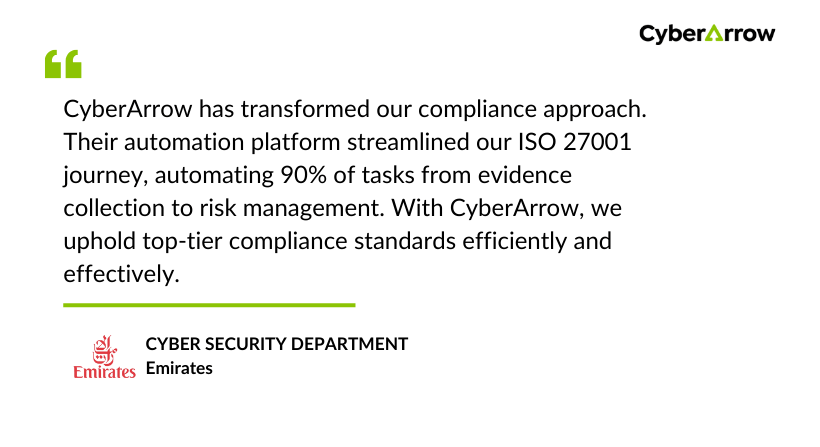
See what global brands like Emirates has to say about CyberArrow GRC: