What is ISO 42001? A guide to the AI management system standard
Artificial intelligence (AI) has become a core part of how organizations operate. But with its growing use come new risks, including bias and privacy issues, lack of oversight, and regulatory uncertainty. Until recently, there wasn’t a global framework to help businesses manage these risks in a structured and auditable way.
ISO 42001 was introduced to solve that. It’s the first international standard focused on how organizations should build, run, and monitor AI systems responsibly.
This article explores what ISO 42001 is, who it’s for, how it compares to other AI regulations, and why it matters for businesses building or adopting AI today.
- What is ISO 42001, and why was it developed?
- Benefits of ISO 42001
- ISO 42001 vs. other AI regulations and frameworks
- ISO 42001 implementation best practices
- 1. Create a centralized inventory of AI systems
- 2. Appoint clear ownership and responsibilities
- 3. Integrate AI risks into your broader GRC framework
- 4. Establish strong documentation practices
- 5. Conduct regular assessments and audits
- 6. Train teams on AI governance principles
- 7. Use automation to stay on track
- Implementing ISO 42001 with the right platform
What is ISO 42001, and why was it developed?
ISO 42001 is an international standard for Artificial Intelligence Management Systems (AIMS). Published in December 2023, it outlines how organizations can manage the development and use of AI in a responsible, ethical, and compliant way.
The standard is structured similarly to ISO 27001 (for information security) and ISO 9001 (for quality management). It takes a risk-based approach to AI governance, encouraging companies to identify and mitigate potential harms, document decision-making processes, and establish clear oversight over AI systems.
It was developed in response to the growing need for consistent guidance across industries and borders. As AI regulations like the EU AI Act gain traction, ISO 42001 helps organizations proactively align with global best practices before regulatory deadlines hit.
Key components of ISO 42001
ISO 42001 covers a wide range of areas needed for responsible AI management. Key components include:
- AI governance structure: Defines roles, responsibilities, and internal oversight for AI systems.
- Risk and impact assessment: Helps identify, assess, and reduce potential risks associated with AI.
- Data and model lifecycle controls: Sets practices for managing datasets, training models, and updating systems.
- Transparency and traceability: Ensures AI decisions can be explained, audited, and understood by relevant stakeholders.
- Human involvement and accountability: Outlines where human review is required and who is responsible for outcomes.
- Monitoring and continual improvement: Encourages regular reviews, incident handling, and performance tracking.
Quick read: What is enterprise AI GRC?
Who should implement ISO 42001?
ISO 42001 is designed for any organization involved in AI, whether you build, deploy, or use AI systems internally. This includes:
- AI startups and software vendors.
- Enterprises using AI for internal operations.
- Service providers integrating AI into customer solutions.
- Government agencies and research institutions.
It’s especially useful for companies operating in regulated industries or seeking to demonstrate responsible AI practices to partners, customers, or auditors.
Benefits of ISO 42001
Implementing ISO 42001 offers both strategic and operational advantages:
- Builds trust with customers and regulators.
- Helps align with global AI policies and upcoming laws.
- Reduces the risk of AI-related failures, bias, or reputational damage.
- Brings internal clarity on roles, processes, and accountability.
- Enables smoother audits and documentation readiness.
For organizations investing heavily in AI, ISO 42001 also acts as a maturity benchmark, showing that their AI practices meet international standards.
ISO 42001 vs. other AI regulations and frameworks
Here’s how ISO 42001 compares to other major AI frameworks:
| ISO 42001 | EU AI Act | NIST AI RMF | |
| Type | International standard (voluntary) | Regulation (legally binding) | Framework (guidance-based) |
| Focus | Management system and governance | Risk classification and compliance | Risk management practices |
| Approach | Process-driven, auditable | Rules-based, categorized by risk | Voluntary, adaptable |
| Target audience | All industries and AI use cases | AI providers and users in the EU | U.S. agencies and the private sector |
| Certification | Yes | No | No |
ISO 42001 implementation best practices
Implementing ISO 42001 isn’t just about checking boxes; it’s about creating a governance system that makes your AI systems safer, more reliable, and compliant. These best practices can help organizations adopt the standard effectively:
1. Create a centralized inventory of AI systems
Identify and catalog all AI technologies and models in use. This includes third-party tools, in-house models, and experimental projects. Having a complete overview is essential to understand what needs to be governed and where potential risks lie.
2. Appoint clear ownership and responsibilities
Assign specific roles for managing AI governance, such as an AI compliance lead or AI ethics officer. These roles should coordinate with existing risk, security, and legal teams to ensure AI systems are managed responsibly across departments.
3. Integrate AI risks into your broader GRC framework
Avoid siloing your AI governance efforts. Instead, align AI-specific risks with your organization’s existing governance, risk, and compliance (GRC) processes. This creates consistency in how risks are identified, assessed, and mitigated, whether they originate from people, systems, or AI.
4. Establish strong documentation practices
ISO 42001 emphasizes transparency, so organizations must clearly document AI system purposes, data sources, decision-making logic, and risk assessments. This not only helps meet compliance requirements but also builds internal and external trust in your AI operations.
5. Conduct regular assessments and audits
AI systems evolve, so should your controls. Periodic audits and impact assessments help ensure that your AI governance remains effective as technology and regulations change. Include performance reviews, fairness checks, and drift detection in your ongoing evaluation.
6. Train teams on AI governance principles
Governance isn’t only technical. Ensure that product teams, developers, compliance officers, and leadership are trained on AI ethics, ISO 42001 requirements, and the organization’s internal policies. Awareness is key to responsible AI deployment.
7. Use automation to stay on track
Manual tracking of ISO 42001 requirements can become overwhelming. Tools like CyberArrow can help automate documentation, track tasks and evidence, provide real-time audit readiness dashboards, and align your controls with ISO 42001 standards, making implementation faster and less resource-intensive.
Implementing ISO 42001 with the right platform
To get the most out of ISO 42001, organizations need more than just documentation; they need tools that support AI governance at scale. One key step is choosing an AI GRC (Governance, Risk, and Compliance) platform that aligns with the standard and your business needs.
Look for platforms that:
- Let you tailor controls and workflows to your industry.
- Support ongoing monitoring and evidence collection.
- Provide role-based access and audit trails.
- Help automate documentation and reporting.
If your team is planning to align with ISO 42001, platforms like CyberArrow GRC can help streamline implementation and reduce manual overhead.
CyberArrow helps automate ISO 42001 implementation with:
- Pre-built policy templates aligned with ISO 42001.
- Automated risk assessments for AI systems.
- Centralized compliance dashboard for real-time visibility.
- Evidence collection and audit readiness support.
- AI-specific controls mapping and tracking.
- Task automation for ongoing compliance workflows.
- Expert guidance from compliance professionals.
CyberArrow makes AI compliance simple, scalable, and effective.
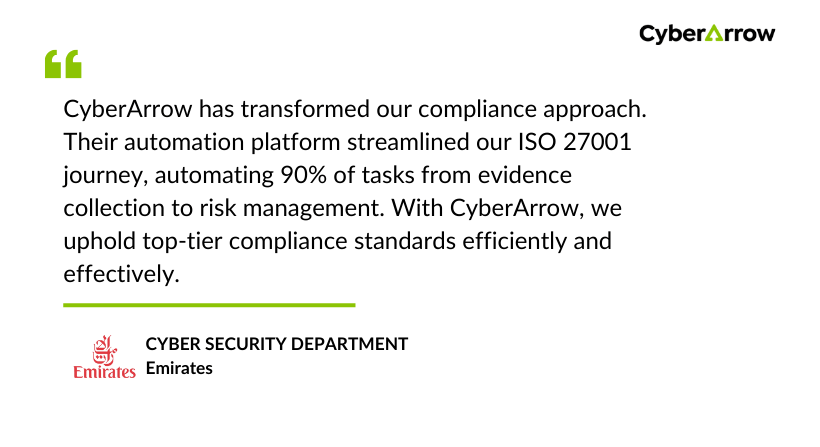
See what global brands like Emirates has to say about CyberArrow GRC: