

UAE IA checklist: Implementation guide + free UAE IA checklist template
The UAE Information Assurance (IA) Regulation outlines specific, actionable requirements for organizations to protect their systems and data. But with its detailed provisions, getting started can feel like a maze. One of the most effective ways to stay on top of UAE IA requirements is to use a detailed checklist that ensures no critical step is overlooked.
This guide breaks down the key components of the UAE IA checklist, offering a step-by-step approach to compliance. With a free checklist template, you can confidently manage your IA obligations and strengthen your organization’s cyber security posture.
So let’s get started!
What is the UAE IA Regulation?
The UAE Information Assurance (IA) Regulation was developed as part of the National Information Assurance Framework (NIAF) to secure the country’s critical information infrastructure. It sets out mandatory cyber security requirements for government entities and sectors flagged critical by the Telecommunications and Digital Government Regulatory Authority (TRA).
Based on global standards like ISO 27001 and NIST, the regulation aims to mitigate cyber threats, enhance national security, and ensure a resilient digital infrastructure across the UAE. The regulation also encourages voluntary adoption by other entities to strengthen cyber security nationwide.
Key components of the UAE IA checklist
The UAE IA checklist offers a framework for organizations to improve their information security in line with the UAE IA Regulation. This checklist outlines essential components that help in UAE IA implementation and strengthen cyber security practices.
1. Risk management and assessment (risk-based approach)
Effective cyber security begins with a thorough risk management process. Organizations must identify and assess potential risks to their information systems and assets. This involves analyzing vulnerabilities, potential threats, and the impact of possible security incidents.
By understanding these risks, entities can develop strategies to mitigate them. This helps ensure appropriate controls are in place to protect against internal and external threats.
2. Information security governance
A strong governance framework helps maintain information security. Set clear policies that define how security is managed within the organization. Roles and responsibilities should be assigned to ensure accountability and designated personnel should oversee the implementation of security measures.
A well-defined governance structure helps align security practices with business objectives and ensures compliance with regulatory requirements.
3. Access control and authentication
Access control measures help secure sensitive information and prevent unauthorized access. Organizations should implement robust authentication processes to verify users’ identities before granting access to systems and data.
This may include multi-factor authentication (MFA), role-based access controls (RBAC), and regular access rights reviews. Organizations can minimize the risk of data leaks and insider threats by controlling who can access what information.
4. Data protection
Organizations must employ encryption technologies to secure data at rest and in transit. Regular data backups can also help ensure that information can be restored in case of loss due to incidents like cyberattacks or system failures.
Additionally, data loss prevention (DLP) strategies should be in place to monitor and control the movement of sensitive information within and outside the organization.
5. Incident response and recovery
Organizations must be prepared to respond to security incidents swiftly and effectively. Developing an incident response plan is critical for outlining the steps to take during a breach. This includes procedures for detecting incidents, containing the threat, eradicating it, and recovering affected systems.
Regular drills and simulations ensure that staff are familiar with the response plan, allowing for a coordinated and efficient recovery process.
6. Monitoring and auditing
Continuous monitoring of information systems is vital for maintaining a secure environment. Organizations should implement security monitoring tools that detect unusual activities and potential threats in real time.
Regular auditing of security controls and compliance checks ensures that policies are being followed and helps identify areas for improvement. These practices contribute to ongoing risk management and enhance the organization’s overall security posture.
7. Training and awareness
Human factors play a significant role in cyber security, making employee training and awareness programs essential. Regular training sessions should be conducted to educate employees about current cyber security threats, safe practices, and their responsibilities in protecting the organization’s information assets.
Promoting a culture of security awareness helps ensure that employees remain vigilant and can recognize and respond to potential security risks.
Step-by-step guide to implementing the UAE IA Regulation
Here’s a step-by-step guide to implementing UAE IA in your organization and achieving UAE IA compliance based on the above-mentioned key components.
Step 1: Conduct an initial gap assessment
- Evaluate your organization’s existing cyber security measures against the UAE IA requirements.
- Identify areas where current practices may fall short.
- Prioritize necessary improvements and allocate resources effectively.
Step 2: Define roles and responsibilities
- Appoint a dedicated security officer to oversee information assurance efforts.
- Create a clear governance structure to ensure accountability.
- Facilitate communication among team members and stakeholders.
Step 3: Develop and implement policies
- Create comprehensive IA policies covering key areas such as:
- Data protection
- Access control
- Incident management
- These policies should outline the standards and procedures that govern how your organization handles sensitive information and responds to security incidents.
- Document and communicate these policies to all employees.
Step 4: Employee training and awareness
- Implement regular training programs on cyber security threats and best practices.
- Cover essential topics, including:
- Recognizing phishing attempts
- Safe password practices
- Reporting suspicious activities
- Foster a culture of security awareness among employees.
Step 5: Continuous monitoring and auditing
- Establish a framework for ongoing monitoring of the cyber security environment.
- Conduct regular audits to assess compliance with IA policies.
- Update security policies to reflect changes in the threat landscape and regulatory requirements.
Overcome UAE IA compliance challenges with CyberArrow
UAE IA compliance can be challenging for organizations. CyberArrow can simplify this process, providing a comprehensive platform that streamlines IA compliance efforts. With its user-friendly interface and robust features, CyberArrow empowers organizations to manage their compliance requirements while effectively reducing the administrative burden.
Key features of CyberArrow:
- Automated risk assessments: CyberArrow conducts thorough risk assessments to identify vulnerabilities and compliance gaps, allowing organizations to address potential risks.
- Centralized policy management: The platform enables organizations to create, update, and manage all IA policies in one place, ensuring consistency and ease of access.
- Evidence collection: CyberArrow automates the collection of compliance evidence, making it easier for organizations to demonstrate adherence to UAE IA regulations during audits.
- Compliance tracking: The tool provides real-time tracking of compliance status, enabling organizations to monitor their progress and quickly respond to any changes in regulatory requirements.
CyberArrow simplifies the IA compliance process and provides organizations with the necessary resources to succeed in today’s regulatory environment.
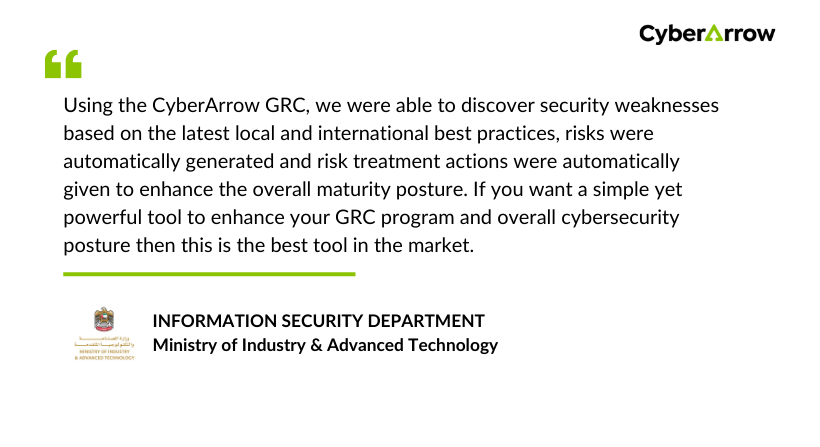
See what our clients have to say about CyberArrow GRC:
Ready to experience CyberArrow?
Schedule a free demo to explore how CyberArrow can transform your compliance efforts. Our expert team will guide you through the platform, showcasing its powerful features that simplify IA compliance and enhance your cyber security posture.
