


Top AI governance tools: Automate AI standards with CyberArrow
AI systems are growing fast across every industry. Companies use AI for automation, analytics, customer service, product recommendations, fraud detection, and many other tasks. But as AI becomes more common, the risks also increase. Organizations must deal with data privacy issues, model bias, security concerns, lack of explainability, and regulatory pressure.
To manage this environment, companies need strong AI governance tools. These tools help track AI models, manage risks, monitor performance, secure training data, and support compliance with global standards. Without the right tools, AI programs become unsafe, hard to manage, and difficult to audit.
This guide explains the top AI governance tools in 2026, what they do, why they matter, and how CyberArrow GRC helps organizations automate AI governance and stay compliant.
What are AI governance tools?
AI governance tools help companies manage the risks and responsibilities connected to artificial intelligence. These tools ensure AI systems are safe, fair, secure, and compliant with regulations.
AI governance tools support tasks such as:
- Tracking AI models.
- Managing training data.
- Detecting bias.
- Documenting decisions.
- Monitoring model performance.
- Managing risks.
- Ensuring transparency.
- Tracking datasets and model versions.
- Following AI standards and regulations.
These tools help teams control AI systems just like they manage other critical systems, such as cloud platforms or applications.
Why AI governance tools matter
AI is no longer experimental. Companies use it in products, workflows, and decision-making. Governments also introduce AI regulations that require monitoring, documentation, and strong controls.
Here are the main reasons AI governance tools matter today:
- AI systems influence financial, medical, legal, and business decisions. They must be controlled properly.
- AI models depend on large datasets that may contain privacy risks or personal information. Governance tools protect this data.
- AI regulations such as the EU AI Act, NIST AI RMF, and ISO 42001 require structured documentation, risk assessments, and regular reviews.
- Models can drift over time. A model that works today may become inaccurate in the future. Governance tools detect drift early.
- AI systems can become biased if training data is not balanced. Governance tools help detect and reduce bias.
- Without governance, teams cannot explain how AI made certain decisions. This reduces trust and increases risk.
AI governance tools help companies control AI programs with the same discipline used for cyber security and compliance.
Core capabilities of AI governance tools
AI governance platforms include several important features. These features help teams manage risks, control models, and stay compliant.
1. Model inventory management
Organizations run many AI models across departments and applications. Governance tools create a central inventory of all models.
- Model inventory helps teams track who owns each model, where it is used, and what data it uses.
- It helps organizations avoid shadow AI systems that are deployed without approval.
- Inventory tools support audits by storing model metadata, documentation, and performance history.
2. Data governance for AI
AI systems depend heavily on quality data. Governance tools help control how data is collected, processed, stored, and used.
- Data governance ensures training data is clean, complete, and used according to privacy rules.
- It ensures sensitive information like personal or medical data is protected.
- It documents data sources to support audits and certifications.
Data governance is essential for safe and trusted AI.
3. Bias detection and fairness monitoring
AI systems must be fair and unbiased. Governance tools include bias detection features that analyze datasets and model outputs.
- These tools check if certain groups are treated unfairly.
- They highlight irregular patterns in predictions.
- They help improve fairness by showing which variables need changes.
Bias detection builds trust in AI systems.
4. Model performance monitoring
AI models can drift when data changes. Governance tools alert teams when performance becomes unsafe.
- Model drift detection monitors accuracy and consistency.
- Performance dashboards show how the model behaves over time.
- Alerts notify teams when action is required.
Continuous monitoring keeps AI reliable.
5. Risk assessment for AI systems
AI systems introduce operational, privacy, security, and ethical risks. Governance tools support risk assessments based on global frameworks.
- Tools provide structured risk questions.
- They track controls for safety, fairness, and transparency.
- They document mitigation steps.
AI risk assessments are becoming required under global AI regulations.
6. Explainability and transparency tools
Some AI models are complex and difficult to understand. Governance tools help explain how a model makes predictions.
- Explainability tools show which features influence decisions.
- Transparency dashboards help teams and auditors understand model logic.
- These features support compliance and improve trust.
Explainability is critical for responsible AI.
Top AI governance tools in 2026
Below are some of the leading AI governance tools used by organizations today. Each one supports different parts of the AI lifecycle.
1. IBM Watson OpenScale
IBM Watson OpenScale offers strong monitoring and fairness features.
- It tracks model performance and detects drift in real time.
- It analyzes bias across demographic groups.
- It helps teams understand model reasoning with explainability tools.
Enterprises use OpenScale to manage production AI at scale.
2. Google Vertex AI Governance
Google Vertex AI includes governance tools integrated into the Google Cloud ecosystem.
- It tracks model versions and metadata.
- It provides automated documentation for audits.
- It includes built-in explainability and data lineage tools.
Companies running AI on Google Cloud use Vertex to manage end-to-end governance.
3. Azure Responsible AI Dashboard
Microsoft Azure provides a set of tools focused on responsible AI.
- It evaluates fairness, security, and data balance.
- It offers transparency features to explain predictions.
- It includes safety checks for sensitive use cases.
Azure’s responsible AI tools help organizations align with global standards.
4. Amazon SageMaker Clarify
AWS Clarify helps detect bias and explain model outputs.
- It scans datasets for imbalances.
- It creates explainability reports.
- It supports both training and inference transparency.
Clarify supports organizations building AI on AWS.
5. DataRobot MLOps
DataRobot focuses on full lifecycle AI governance.
- It monitors model performance and drift.
- It automates documentation.
- It provides audit trails for all model changes.
DataRobot supports enterprise-scale AI programs.
6. Arize AI
Arize AI is designed for observability in machine learning systems.
- It monitors model behavior.
- It supports root cause analysis when performance drops.
- It provides dashboards for drift tracking.
Teams use Arize to improve model visibility.
7. Fiddler AI
Fiddler provides explainability and monitoring features.
- It focuses on transparency for complex models.
- It provides fairness metrics and risk analysis.
- It helps teams reduce bias and improve reliability.
Fiddler is widely used in regulated industries.
How AI governance tools support global AI standards
Companies must follow several AI standards in 2026. These include:
- EU AI Act
- NIST AI RMF
- ISO 42001
- OECD AI Principles
- National data protection rules
AI governance tools help organizations follow these standards by providing:
- Documented workflows.
- Model monitoring.
- Fairness checks.
- Strong audit trails.
- Risk assessments.
- Clear policies.
Without proper governance tools, it becomes difficult to pass audits or show compliance.
Why AI governance needs a complete GRC platform
AI governance tools help manage models, data, and risks, but they do not manage the full compliance program. Organizations still need a complete GRC platform to support:
- Policy management.
- Risk management.
- Internal controls.
- Audit readiness.
- Evidence tracking.
- Third-party risk.
- Governance workflows.
- Compliance frameworks.
AI governance is one part of a much larger responsibility. Companies need both AI governance tools and a strong GRC program. This is where CyberArrow adds value.
How CyberArrow helps automate AI governance
CyberArrow GRC helps organizations manage AI requirements within a complete compliance system. It complements AI governance tools by adding:
Policy automation
CyberArrow manages AI policies, version control, approvals, and review schedules.
Risk management
CyberArrow helps teams map AI risks to standard frameworks and track treatment plans.
Control management
CyberArrow includes ready controls for NIST AI RMF, ISO 42001, and other AI frameworks.
Evidence collection
CyberArrow automates evidence tracking for audits, helping companies show compliance with AI requirements.
Audit readiness
CyberArrow organizes documentation, workflows, and controls for AI audits.
Cross-framework mapping
CyberArrow maps AI requirements across multiple frameworks automatically. CyberArrow gives companies a complete GRC foundation that supports AI governance at scale.
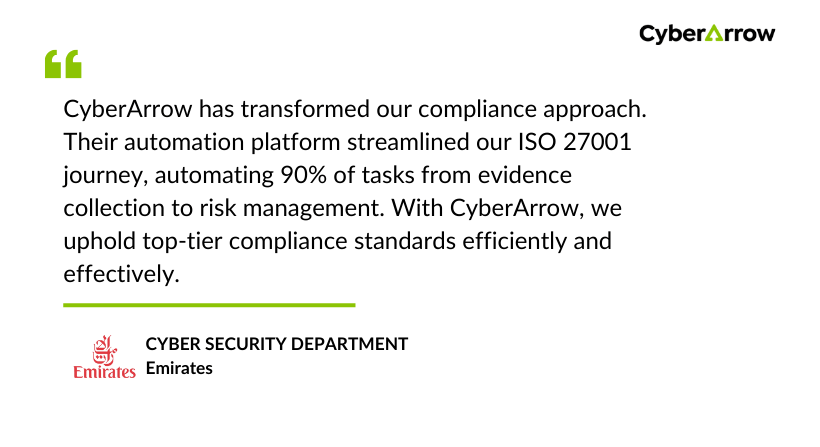
See what our clients have to say about CyberArrow GRC:
Conclusion
AI governance tools are essential for managing the risks, fairness, transparency, and performance of modern AI systems. As AI becomes part of daily business operations, companies must use strong tools to track models, monitor data, detect bias, and follow global standards.
But governance does not stop at the AI layer. Organizations still need a complete GRC program to manage risks, controls, policies, and audits across the entire environment. CyberArrow GRC helps companies automate these responsibilities and stay compliant with both AI and cyber security standards.
If your organization wants to build a responsible and audit-ready AI program, CyberArrow GRC is the strongest platform to support that journey.
FAQs
What are AI governance tools used for?
AI governance tools help organizations manage the risks, performance, and compliance requirements of AI systems. They track models, monitor data, detect bias, document decisions, and support global standards such as the EU AI Act, NIST AI RMF, and ISO 42001. These tools ensure AI systems remain safe, fair, and transparent.
Why do companies need AI governance tools in 2026?
AI systems are used in critical areas like finance, healthcare, cyber security, and operations. Companies must control model behavior, protect sensitive data, manage regulatory requirements, and reduce bias. AI governance tools make this possible by providing structure and continuous monitoring across the entire AI lifecycle.
Do AI governance tools replace a GRC platform?
No. AI governance tools focus on models, datasets, and technical risks. A GRC platform manages policies, controls, evidence, audits, and enterprise risks. Both systems work together. AI governance tools protect AI workloads, while GRC platforms like CyberArrow manage the full compliance program.
Which global standards require AI governance?
Standards such as the EU AI Act, NIST AI Risk Management Framework, ISO 42001, OECD AI Principles, and national data protection laws require AI oversight. These standards focus on transparency, fairness, accountability, and strong documentation. AI governance tools help organizations meet these obligations.
How does CyberArrow GRC support AI governance?
CyberArrow GRC provides policy automation, risk assessments, control management, audit readiness, evidence tracking, and cross-framework mappings for AI standards. It helps companies follow NIST AI RMF, ISO 42001, and other regulations while automating large parts of the compliance workflow. This builds a complete and scalable governance system for AI.
