

A detailed guide to cloud-native security practices
Cloud computing has changed how companies build and deploy software. Traditional security methods are not built for systems that scale automatically, run across different cloud providers, and depend on containers, microservices, APIs, and distributed workloads. Modern environments need security practices that match the speed, flexibility, and complexity of the cloud.
This is why cloud-native security practices have become essential. These practices help teams secure applications, manage risks, and protect data in environments that evolve quickly. Cloud-native security is not just a new trend. It is now a requirement for organizations that use cloud platforms like AWS, Azure, or Google Cloud.
This guide explains cloud-native security practices in detail, why they matter, how they work, and how organizations can use them to protect their systems. It also explains why adding a strong GRC program through CyberArrow helps companies stay compliant and ready for audits.
What are cloud-native security practices?
Cloud-native security practices are methods designed to protect applications that run in modern cloud environments. They focus on automation, scalability, continuous monitoring, and the ability to respond quickly to new threats.
Cloud-native systems include technologies such as:
- Containers
- Kubernetes
- Microservices
- Serverless functions
- API driven architectures
- Infrastructure as Code
- Multi-cloud environments
Traditional security tools are too slow and too manual for these environments. Cloud-native security uses automated checks, continuous scanning, real-time alerts, and strong identity controls to keep systems safe.
Why cloud-native security practices matter
Cloud-native systems move fast. Teams deploy updates daily, services scale automatically, and workloads shift between containers and nodes. Without cloud-native security, companies face the risk of misconfigurations, breaches, outages, and data leaks.
Here are the main reasons cloud-native security practices matter:
- Cloud environments change often, so security must keep up. Cloud-native security improves visibility across containers, clusters, and workloads in real time.
- Cloud systems depend on many moving parts. Security must track every layer, from code to containers to runtime behavior.
- Manual security checks cannot keep up with cloud speed. Automation is necessary to catch misconfigurations early.
- Companies face strict compliance requirements such as SOC 2, ISO 27001, PCI DSS, HIPAA, and NIST. Cloud-native security supports these frameworks with structured controls.
- Attackers target cloud environments because they often contain exposed keys, open ports, and weak identity settings. Strong cloud-native security helps reduce these risks.
Cloud-native security is a key part of keeping systems available, compliant, and safe.
Core cloud-native security practices
Below is a detailed breakdown of the most important cloud-native security practices. Each one supports safe development, strong operations, and reliable system performance.
1. Identity and access management (IAM)
Identity is the foundation of cloud security. The cloud uses identities instead of traditional network boundaries. This means teams must control who can access what.
- IAM helps define roles, permissions, and access levels. When done correctly, it ensures that no user or service can access more than it needs.
- IAM reduces the chance of attackers using stolen credentials because it limits what a compromised account can do.
- IAM makes audits simpler because all access activity is logged and traceable.
Strong IAM settings protect both cloud resources and workloads.
2. Zero trust principles
Zero Trust removes the assumption that anything inside the network is safe. It requires verification for every step, request, and action.
- Zero Trust prevents lateral movement inside cloud environments. Even if one workload is compromised, others stay safe.
- Zero Trust controls access using identity, device health, location, and behavior.
- Zero Trust helps secure microservices that communicate across many network paths.
Zero Trust is a core part of cloud-native security and improves defenses across distributed systems.
3. Secure CI/CD pipelines
Cloud-native teams deploy code quickly using automation. This requires strong security throughout the development process.
- Secure pipelines catch security errors early by scanning code, images, and configurations before deployment.
- Code scanning tools detect secrets, vulnerabilities, and risky dependencies.
- Pipeline controls ensure only approved code can reach production.
This prevents unsafe code from reaching cloud environments.
4. Container security
Containers run many modern applications. They must be secured at every stage.
- Container image scanning detects vulnerabilities before deployment. This reduces the risk of running unsafe images.
- Container registries store approved images only. This prevents unauthorized images from entering the pipeline.
- Runtime monitoring helps track behavior. It detects unusual activity like privilege escalation or unexpected network calls.
Container security helps reduce risks in cloud-native workloads.
5. Kubernetes security
Kubernetes is the standard platform for orchestrating containers. It must be configured correctly to remain secure.
- Role-Based Access Control (RBAC) limits who can manage clusters, nodes, and workloads.
- Network Policies restrict communication between services. This reduces the attack surface.
- Admission Controllers enforce rules during deployment. They block insecure configurations before they reach production.
Kubernetes security ensures clusters remain safe and stable.
6. Secrets management
Cloud systems depend on secrets such as API keys, access tokens, and certificates. Storing these in code or files creates serious risks.
- Secrets managers store sensitive values securely and help rotate them automatically.
- Secret policies prevent hardcoded credentials and reduce the chances of leaks.
- Strong logging helps teams track access to sensitive keys.
Secrets management is essential for cloud-native teams that handle many automated connections.
7. Infrastructure as Code (IaC) security
Modern cloud environments are created using code. This makes them scalable but also increases risk if templates are insecure.
- IaC scanning detects insecure settings before they reach the cloud. This includes open ports, weak policies, and risky configurations.
- IaC templates help enforce consistency across development, testing, and production.
- Version control gives visibility into changes, which helps during audits.
IaC security strengthens cloud environments by ensuring safe and repeatable deployments.
8. Cloud monitoring and logging
Cloud-native systems need strong monitoring to understand what is happening across services.
- Real-time monitoring helps detect errors and outages early.
- Log aggregation improves visibility. Logs from containers, cloud services, and APIs help solve incidents faster.
- Alerts show unusual behavior, failed login attempts, or suspicious access patterns.
Monitoring is essential for both security and operations teams.
9. Threat detection and incident response
Attackers target cloud workloads often. Teams need a structured approach for detection and response.
- Cloud threat detection tools analyze behavior to find unusual activity.
- Automated responses help block harmful actions early.
- Incident response plans help teams react faster and reduce damage.
Threat detection is a core cloud-native security requirement.
Challenges of cloud-native security
Cloud-native systems bring benefits, but they also introduce challenges:
- Microservices increase complexity because more workloads must be monitored.
- Many cloud services create blind spots unless strong monitoring is used.
- Identity sprawl happens when environments grow quickly.
- Misconfigurations are common because settings change often.
- Multi-cloud environments require consistent controls across different platforms.
These challenges show why cloud-native security must be structured, automated, and updated regularly.
Why cloud-native security needs strong GRC
Security tools protect workloads, but companies still need a complete GRC program to manage:
- Controls
- Policies
- Risks
- Evidence
- Third-party security
- Compliance frameworks
- Audit preparation
Cloud-native environments multiply these requirements. Manual compliance methods cannot keep up. This is where CyberArrow GRC plays a major role.
How CyberArrow supports cloud-native security
CyberArrow GRC helps companies build a strong governance structure around their cloud-native environments. It complements cloud security tools by providing:
- Centralized control management.
- Automated evidence collection.
- Clear risk assessments.
- Updated policy management.
- Cross-framework control mapping.
- Third-party security tracking.
- Continuous monitoring for compliance.
- Audit-ready documentation.
CyberArrow helps teams follow frameworks like ISO 27001, SOC 2, PCI DSS, NIST, HIPAA, and more. This makes cloud-native security more mature and reliable.
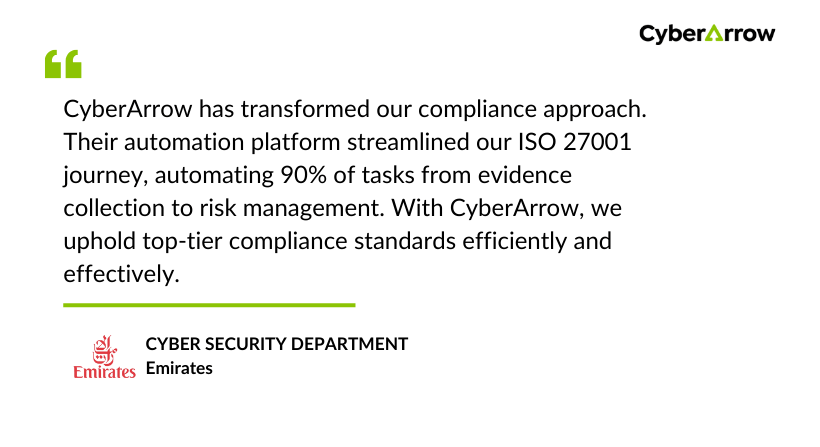
See what our clients have to say about CyberArrow GRC:
Conclusion
Cloud-native security practices are essential for modern organizations that use containers, Kubernetes, microservices, APIs, and cloud automation. These practices help teams stay safe, reduce misconfigurations, prevent breaches, and keep systems available.
But strong security tools are not enough. Companies still need a structured GRC program to manage compliance, risks, policies, and audits. CyberArrow GRC helps teams build this structure and supports a complete security ecosystem.
If your organization wants to strengthen cloud-native security and automate compliance at the same time, CyberArrow GRC is the best solution.
FAQs
What are cloud-native security practices?
Cloud-native security practices are methods designed to protect modern applications that run in the cloud. They focus on identity controls, secure pipelines, container security, Kubernetes hardening, secret management, and continuous monitoring. These practices help teams secure fast-moving and scalable cloud environments.
Why are cloud-native security practices important?
Cloud environments change often, and traditional security tools cannot keep up. Cloud-native security practices help detect misconfigurations, block unsafe deployments, protect microservices, and reduce the risk of cloud breaches. They also support compliance frameworks such as ISO 27001, SOC 2, PCI DSS, and NIST.
How do containers and Kubernetes affect cloud security?
Containers create many small workloads, and Kubernetes manages them. This increases the attack surface. Teams must secure images, apply RBAC rules, configure network policies, and monitor runtime behavior. Without proper cloud-native security practices, Kubernetes clusters can be exposed to threats.
What tools are used to support cloud-native security?
Cloud-native security uses tools such as container scanners, IaC scanners, secrets managers, cloud-native firewalls, identity platforms, and monitoring systems. These tools work together to detect vulnerabilities, prevent unsafe deployments, and monitor real-time activity across cloud services.
How does CyberArrow GRC support cloud-native security?
CyberArrow GRC complements cloud-native security tools by managing controls, risks, policies, evidence, and audits. It helps teams follow standards like ISO 27001 and SOC 2, automate compliance tasks, track third-party risks, and stay audit-ready while running complex cloud environments. It builds the governance foundation needed for a secure cloud program.
