


AI in cyber security: Why you need an AI-powered GRC
Cyber security threats are growing at a fast rate. Companies face more attacks, more compliance rules, and more pressure to protect data. At the same time, businesses use more tools, cloud apps, vendors, and digital services than ever before. This creates more risks that must be managed every day. Traditional security methods cannot keep up with this level of complexity.
This is why AI in cyber security has become essential. AI makes security systems faster, smarter, and more predictive. It helps teams work better by removing manual work and giving early warnings about possible risks. When AI is added to a GRC program, companies can manage security, compliance, and risks with greater accuracy and less stress.
AI-powered GRC is the future. It helps organizations understand threats faster, automate workflows, reduce human errors, and make better security decisions. This blog explains why AI matters, how it improves cyber security, and how AI-powered GRC platforms like CyberArrow help companies stay compliant and secure in a world full of growing threats.
Why AI in cyber security is becoming essential
Cyber security is no longer about simple firewalls or antivirus tools. Attackers use advanced methods that change constantly. Teams cannot review every alert, assess every risk, or watch every system manually. AI solves this problem by helping systems detect and understand patterns faster than humans.
Here are the main reasons AI has become essential in cyber security:
- AI processes large amounts of data much faster than humans. It can analyze logs, network traffic, user activity, and alerts in seconds. This helps teams react faster and avoid missing important threats.
- AI recognizes attack patterns that are too complex for manual review. It can detect unusual behavior, hidden risks, and strange access attempts that would normally go unnoticed.
- AI reduces human errors by making security checks clearer and more accurate. Manual reviews lead to mistakes because teams get tired or overwhelmed by alerts. AI keeps the process consistent.
- AI improves response time by giving early warnings. It can highlight risks before they become major problems. This helps businesses prevent downtime, data leaks, and financial damage.
- AI becomes smarter over time. It learns from new threats and adapts to new attack methods. This makes security stronger each day.
AI gives companies a level of protection that manual methods cannot match.
Why traditional GRC programs cannot keep up
A strong GRC program depends on accurate data, structured workflows, and continuous monitoring. But many companies still run their GRC programs manually using spreadsheets, emails, and disconnected tools. This creates problems that AI can solve.
Here is why traditional GRC methods fall behind:
- Manual risk assessments become outdated quickly because cyber risks change daily. A risk that was low last month may now be high, but teams do not always update it on time.
- Evidence collection takes too long when teams must search for documents, screenshots, and reports. This delays audits and slows down compliance work.
- Third-party security reviews become inconsistent because different teams follow different methods. This creates confusion and weakens the overall security posture.
- Policy reviews get delayed because employees forget tasks or do not understand what they must update. This creates compliance gaps.
- Control mapping across frameworks becomes complicated, especially when companies follow ISO 27001, NIST, SOC 2, PCI DSS, and more.
Without automation, the GRC program becomes slow, reactive, and error-prone.
How AI powers a modern GRC program
AI-powered GRC makes compliance smarter, faster, and easier to manage. It provides support across every part of the program. This gives companies a strong and reliable security foundation.
Here is how AI improves a GRC program:
AI enhances risk management
AI reviews threats, behaviors, and system activity to identify risks that teams may overlook. It can show which risks matter most and which controls need attention. This keeps risk management updated and accurate.
AI supports faster compliance checks
AI analyzes compliance gaps across frameworks and shows which requirements need work. It learns patterns from past audits and helps teams prepare for future ones.
AI improves policy management
AI can identify outdated policies, missing documents, and areas that need updates. This helps teams keep policies clear and aligned with standards without long manual reviews.
AI helps detect security weaknesses
AI scans data and user behavior to find early signs of weakness. This makes the GRC program more proactive instead of reactive.
AI enhances continuous monitoring
AI keeps an eye on system logs, vendor activity, control health, and task completion. It alerts teams when something changes or when a risk begins to increase.
AI-powered GRC transforms compliance from a manual process into a smart, predictive system.
Why companies need AI-powered GRC today
The business world is changing fast. Cloud adoption, remote work, and external vendors increase cyber risks. At the same time, global compliance frameworks are becoming stricter.
Companies need AI-powered GRC for several reasons:
- The number of cyber threats grows each year, making manual security checks impossible to maintain.
- Compliance standards like ISO 27001, SOC 2, PCI DSS, GDPR, NIS2, HIPAA, and others require continuous monitoring that manual teams cannot keep up with.
- Businesses use more third-party tools. Each one introduces new risks that must be assessed and monitored.
- Productivity tools generate more data, making it difficult for teams to track logs and incidents manually.
- Auditors expect organized and updated evidence, which manual systems struggle to provide.
AI-powered GRC gives companies the speed and accuracy needed to stay secure and compliant.
How AI supports the future of cyber security
AI is shaping the future of cyber security by helping teams work smarter. Here are the biggest ways AI supports long-term cyber safety:
- AI improves threat detection by understanding patterns that humans cannot easily see. This reduces the chances of missing attacks.
- AI learns from incidents and improves over time. This creates a smarter security system that adapts without extra effort.
- AI helps reduce false alerts so security teams only focus on real threats. This saves time and reduces stress.
- AI makes compliance easier by analyzing frameworks quickly and suggesting improvements. This helps companies stay ahead of audits.
- AI makes security more predictable by showing risk trends. Companies can prepare early instead of reacting late.
The future of cyber security depends on using AI to stay ahead of attackers and build strong GRC programs.
How CyberArrow delivers AI-powered GRC
CyberArrow GRC is built to help organizations move away from manual work and adopt a smarter, AI-powered approach to compliance and security. It supports all major standards and gives teams a clear, organized system to manage risks, controls, policies, evidence, and third-party security.
AI-driven risk insights
CyberArrow uses AI to highlight risks, show patterns, and help teams understand where they should focus.
Smart control monitoring
CyberArrow supports continuous monitoring and highlights gaps that need attention.
Faster policy updates
CyberArrow uses smart suggestions to help teams update policies, find missing areas, and stay aligned with frameworks.
Improved third-party security
CyberArrow simplifies vendor reviews with AI-driven insights and structured workflows.
Predictive compliance support
CyberArrow helps teams prepare for audits, review controls faster, and stay ahead of any compliance challenges.
Simplified evidence tracking
CyberArrow organizes evidence and shows what is outdated or missing. This helps teams stay audit-ready throughout the year.
CyberArrow GRC uses automation and intelligence to create a mature, scalable GRC program.
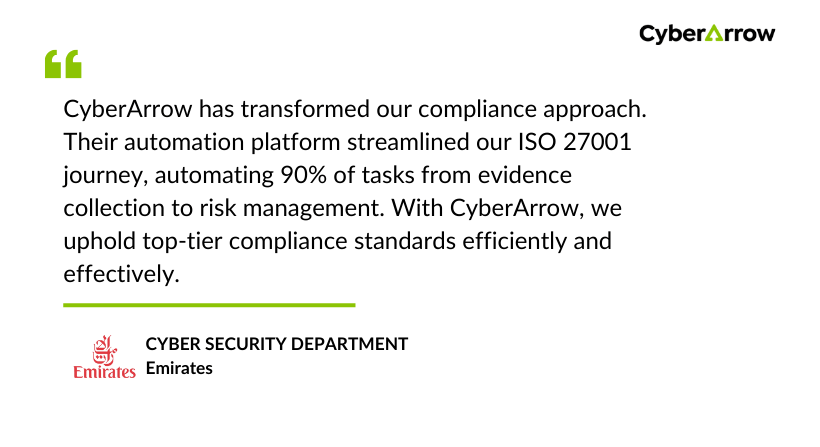
Read how Emirates enhanced Information Security by automating ISO 27001 with CyberArrow GRC.
See what Emirates has to say about CyberArrow GRC:
Conclusion
AI in cyber security is no longer an option. It is a requirement for any company that wants strong protection and smooth compliance. Cyber threats grow daily, and manual GRC programs cannot keep up. AI-powered GRC systems help organizations detect risks faster, manage controls better, automate workflows, and stay compliant with global standards.
CyberArrow GRC brings all these benefits into one simple platform. It helps companies move away from manual work and build a stronger, smarter, and more secure GRC program. If you want a reliable way to improve cyber security, reduce risks, and stay audit-ready, CyberArrow GRC is the best solution.
FAQs
What does AI in cyber security actually do?
AI helps security teams detect threats faster by analyzing large amounts of data and spotting unusual behavior. It looks for patterns, flags risks early, and reduces the chances of missing important alerts. This gives companies stronger protection and faster response times.
Why do GRC programs need AI today?
Cyber security and compliance requirements change quickly. Manual GRC processes are slow and often outdated. AI helps by automating risk analysis, control checks, policy updates, and evidence tracking. This keeps the GRC program accurate, updated, and ready for audits at any time.
How does AI-powered GRC improve compliance?
AI-powered GRC systems review controls, highlight gaps, suggest improvements, and help teams stay aligned with frameworks like ISO 27001, SOC 2, PCI DSS, HIPAA, GDPR, NIST, and others. This makes compliance easier, faster, and more reliable.
Can AI help reduce human errors in cyber security?
Yes. AI reduces human errors by analyzing tasks consistently and monitoring security data without getting tired or overwhelmed. It helps teams focus on important issues instead of trying to manage everything manually.
How does CyberArrow GRC use AI to support organizations?
CyberArrow GRC uses AI to simplify risk management, automate workflows, organize evidence, support policy updates, and improve third-party security reviews. It helps companies build a stronger and smarter GRC program while reducing manual work.
