


How to implement security service edge (SSE) in your organization
Securing the modern enterprise is no longer limited to firewalls and VPNs. Distributed workforces, cloud-first adoption, and an increasingly sophisticated threat landscape demand security that moves with users, no matter where they connect from. Here, security service edge (SSE) can help.
SSE centralizes secure access to corporate resources, applies Zero Trust policies consistently, and reduces the attack surface across cloud, remote, and on-prem environments. But adopting SSE is not a quick switch; it requires strategy, planning, architecture alignment, and cross-department execution.
This guide explains how to implement SSE successfully and best practices for scaling it inside your business.
- Why organizations implement security service edge
- How to implement SSE in your organization (step-by-step)
- 1. Assess your current security and network environment
- 2. Define Zero Trust access and security policies
- 3. Select an SSE solution that aligns with your environment
- 4. Migrate users and applications in phases
- 5. Establish monitoring, analytics, and continuous reporting
- 6. Build awareness and internal readiness
- Security service edge best practices for long-term business success
- Strengthen SSE compliance and governance with CyberArrow
- FAQs
Why organizations implement security service edge
Before planning implementation, it helps to understand why companies move to SSE. SSE provides a single unified framework to address several issues by enforcing consistent security controls at the edge, regardless of where users are or where applications are hosted.
Common triggers include:
- Growing remote and hybrid teams requiring secure access anywhere.
- Too many disconnected security tools increasing cost and complexity.
- Inconsistent access policies across on-prem, SaaS, and cloud apps.
- High VPN dependency slowing performance and user productivity.
- Compliance pressure for data protection, access control, and monitoring.
- Desire to adopt Zero Trust model without heavy infrastructure change.
How to implement SSE in your organization (step-by-step)
Successful adoption is not only technical; it’s operational and cultural. Below is a practical framework organizations can follow:
1. Assess your current security and network environment
Before designing the new model, map what already exists. Organizations can take the following steps:
- Map how users currently access company resources (VPN, direct internet breakout, private network, etc.).
- Identify the tools already in place, such as firewalls, DLP, CASB, SWG, IAM, and Endpoint Protection.
- Review which applications are used across the company: SaaS, cloud-hosted, on-premises, and shadow IT.
- Highlight pain points such as high VPN load, slow access, unmanaged devices, or limited visibility.
- Document regulatory requirements that your organization must comply with.
2. Define Zero Trust access and security policies
A strong policy foundation reduces the risk of misconfigurations later. Security service edge functions best when built on Zero Trust: never trust, always verify.
How to develop Zero Trust policies:
- Define who should have access to what and under what conditions.
- Establish device compliance requirements (patch level, OS version, encryption, MDM enrollment).
- Restrict access based on least privilege, only what is needed for work.
- Decide how sensitive data must be handled, shared, and transferred.
- Set authentication standards such as MFA, SSO, conditional access, session lifetime, etc.
3. Select an SSE solution that aligns with your environment
The vendor you choose determines system performance, scalability, and integration success. Instead of comparing only features, evaluate how well the solution fits your current and future architectures.
What to consider while selecting:
- The maturity of ZTNA as a VPN alternative.
- The depth of SaaS visibility, especially shadow IT and DLP coverage.
- The ease of integration with your identity provider, SIEM, endpoint management, and SOC workflows.
- The geographic coverage of PoPs for remote and global teams.
- Policy customization, flexibility, and automation capabilities.
- Logging, audit trails, reporting, and incident investigation features.
Before committing, run a proof of concept with real employees, live workloads, and measurable performance benchmarks.
4. Migrate users and applications in phases
Switching everything at once increases downtime, user resistance, and operational risk. The safest approach is to migrate gradually.
A structured rollout could look like:
- Begin with a pilot group (e.g., one department, remote workers, or a low-risk environment).
- Replace VPN access with ZTNA for selected applications.
- Migrate high-usage SaaS platforms first: email, productivity suites, and file storage.
- Monitor latency, access failures, application behavior, and user experience closely.
- Expand rollout to the rest of the company once stability is proven.
5. Establish monitoring, analytics, and continuous reporting
SSE is not a one-time implementation but a living security framework. After rollout, visibility and analytics become core necessities.
Maintain security performance by:
- Tracking unusual login behavior, access attempts, and risky SaaS usage.
- Reviewing policy violations and fine-tuning controls to close gaps.
- Generating audit-ready reports for compliance frameworks such as SOC 2, ISO 27001, PCI DSS, HIPAA, etc.
- Integrating alerts into SIEM tools or SOC workflows for faster investigation and response.
- Reviewing metrics monthly or quarterly to maintain system reliability.
6. Build awareness and internal readiness
Technology alone cannot secure access. Employees, IT teams, and business leadership must understand how SSE works and why processes are changing.
Strengthening internal adoption:
- Train employees on new login and access processes.
- Inform departments why VPN access reduction or policy tightening is necessary.
- Run phishing and social engineering awareness campaigns.
- Encourage early feedback for usability, performance, or accessibility issues.
- Document runbooks for IT, SOC, and compliance teams for incident handling.
Security service edge best practices for long-term business success
Strengthening security service edge maturity goes beyond implementation. Consider the following practices as an ongoing strategy:
- Adopt a least-privilege approach by default: Give users access only to the applications and data required for their job role. Expand permissions only when justified.
- Integrate identity into every access decision: Centralize authentication through SSO and enforce MFA. Treat identity as the new perimeter of security.
- Prioritize user experience during rollout: Slow networks, blocked apps, or login friction will push employees to bypass controls. Optimize for usability alongside security.
- Continuously revise access and data policies: Business operations evolve, so should your SSE rules. Schedule periodic reviews for permissions, threat analytics, and DLP configurations.
- Monitor, measure, and report risk indicators over time: Track security events, session logs, blocked threats, and risky user behavior. Metrics help prove ROI and justify future scaling.
- Align SSE with compliance requirements: Map policies to frameworks like ISO 27001, NIST CSF, SOC 2, PCI DSS, HIPAA, and GDPR. This ensures readiness for audits and regulatory reviews.
Strengthen SSE compliance and governance with CyberArrow
A secure SSE rollout requires more than the right security stack; it also needs strong governance, clear risk ownership, and continuous compliance monitoring. CyberArrow helps organizations manage security frameworks, maintain control effectiveness, and generate audit-ready documentation without manual overhead.
With CyberArrow, you can:
- Track risks, controls, and remediation status.
- Automate evidence collection and compliance reporting.
- Monitor KPIs to assess the ongoing health of your security posture.
- Centralize GRC workflows for consistent governance at scale.
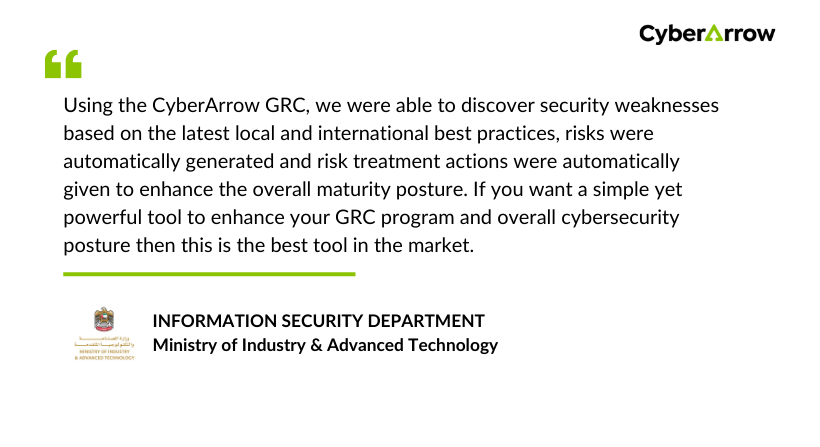
See what our clients have to say about CyberArrow GRC:
FAQs
What is security service edge (SSE)?
SSE is a cloud-delivered security framework that protects users, devices, and data regardless of location. It includes tools like SWG (Secure Web Gateway), CASB (Cloud Access Security Broker), ZTNA (Zero Trust Network Access), and DLP (Data Loss Prevention).
How does SSE support remote work and cloud security?
SSE ensures secure access to cloud applications and the internet by enforcing consistent security policies, monitoring threats, and preventing data leaks all without relying on traditional network perimeters.
What should organizations consider when choosing an SSE solution?
Focus on features like strong access control, real-time threat protection, cloud visibility, DLP, ease of integration, and zero-trust support. Scalability and simplicity of deployment are also key for long-term effectiveness.
