SAMA CSF checklist: Implementation guide + free SAMA CSF checklist template
Implementing the SAMA Cybersecurity Framework (CSF) isn’t just about checking boxes—it’s crucial for financial institutions in Saudi Arabia to protect their digital assets and meet regulatory requirements. As cyber threats evolve and new technologies emerge, staying compliant with the SAMA CSF helps organizations keep their systems secure while minimizing risks.
This guide will walk you through the SAMA CSF checklist, providing a clear and practical approach to ensure your business is aligned with the framework’s cybersecurity standards.
- What is the SAMA Cybersecurity Framework (CSF)?
- Why the SAMA CSF checklist is essential?
- Pre-implementation steps
- Step-by-step implementation of the SAMA CSF checklist
- 1. Establish cyber security governance
- 2. Develop and implement a cyber security strategy
- 3. Create and enforce cyber security policies
- 4. Implement risk management controls
- 5. Conduct regular cyber security awareness training
- 6. Perform continuous risk assessments
- 7. Set up a monitoring and reporting system
- 8. Create an incident response plan
- 9. Conduct audits and continuous improvement
- Overcome SAMA CSF implementation challenges with CyberArrow
What is the SAMA Cybersecurity Framework (CSF)?
The SAMA Cybersecurity Framework (CSF) is a set of guidelines developed by the Saudi Arabian Monetary Authority (SAMA) to help financial institutions protect their digital assets and ensure cyber security compliance. Launched in 2017, this framework sets out clear objectives for maintaining the confidentiality, integrity, and availability of information across banks, insurance companies, and other regulated entities in Saudi Arabia.
The framework aligns with international standards like ISO 27001, PCI DSS, and the National Institute of Standards and Technology (NIST). This makes it easier for organizations to adopt global best practices while meeting local regulatory requirements. It covers various cyber security aspects, from risk management and data protection to incident response and employee training.
Why the SAMA CSF checklist is essential?
The SAMA CSF checklist helps organizations systematically implement and maintain compliance with the framework. It provides a structured approach to ensure all necessary cyber security measures are in place.
Here’s why it’s so important:
- Simplifies compliance: The checklist breaks down complex SAMA CSF requirements into manageable steps, making it easier for financial institutions to stay on top of their obligations. By following the checklist, organizations can ensure they meet SAMA standards without missing any critical elements.
- Identifies gaps and weaknesses: The checklist helps organizations assess their current cyber security practices and identify areas for improvement. This approach ensures that security gaps are addressed before cybercriminals can exploit them.
- Enhances risk management: The checklist encourages regular risk assessments, vital for understanding potential threats and vulnerabilities. This allows institutions to tailor their cyber security strategies to the specific risks they face.
- Streamlines audits and reporting: SAMA CSF compliance often requires detailed documentation and regular audits. The checklist ensures that all necessary processes are followed, making audits and reporting much smoother and more efficient.
Pre-implementation steps
Before diving into the SAMA CSF checklist, setting the foundation for the successful SAMA CSF implementation is essential.
Here are some key pre-implementation steps:
- Risk assessment: The first step is to conduct a thorough risk assessment to identify and understand your organization’s unique cyber security threats and vulnerabilities. This assessment will help prioritize which areas of the framework need the most attention and allow you to tailor your strategy accordingly.
- Asset identification: You need to clearly understand what assets you’re protecting. This includes digital data and systems, networks, and even personnel with access to sensitive information. Identifying critical assets will help you focus your security measures more effectively.
- Gap analysis: Conduct a gap analysis to compare your current security posture with the SAMA CSF requirements. This will highlight any areas where your organization falls short and give you a roadmap for improvement.
Step-by-step implementation of the SAMA CSF checklist
Once the pre-implementation groundwork is laid, you can follow the SAMA CSF checklist.
Below are the key steps:
1. Establish cyber security governance
Develop a clear cyber security governance structure. This includes defining roles and responsibilities, ensuring accountability, and setting up committees or teams to manage cyber security efforts. The governance framework should align with the business’s overall strategy and risk tolerance.
2. Develop and implement a cyber security strategy
Create a comprehensive cyber security strategy that addresses the risks identified during the risk assessment. This strategy should cover both short-term and long-term goals and be aligned with the business objectives. It should also include key performance indicators (KPIs) to measure the effectiveness of the cyber security efforts.
3. Create and enforce cyber security policies
Develop and implement policies that meet SAMA CSF requirements. These policies should cover critical areas such as access control, data encryption, incident response, and third-party risk management. Ensure policies are well-documented, communicated across the organization, and enforced consistently.
4. Implement risk management controls
Apply technical and administrative controls to manage risks effectively. This can include deploying firewalls, implementing data encryption, multi-factor authentication, and regular backups. Administrative controls may involve setting up proper access management protocols, conducting background checks, and establishing clear incident reporting procedures.
5. Conduct regular cyber security awareness training
Ensure that all employees, including top management, are aware of the organization’s cyber security policies and know how to respond to cyber threats. This is a critical part of the SAMA CSF, as human error is one of the biggest contributors to cyber security breaches.
6. Perform continuous risk assessments
Conduct periodic risk assessments to keep track of new or evolving threats. The cyber security landscape changes rapidly, and continuous risk assessment will allow your organization to adapt its strategy to mitigate new risks.
7. Set up a monitoring and reporting system
Implement monitoring systems to track and log suspicious activities, detect anomalies, and assess the overall effectiveness of the cyber security measures. The governance team should prepare and review regular reports to ensure that the organization complies with SAMA CSF standards.
8. Create an incident response plan
Establish a formal incident response plan that outlines how to respond to security breaches or incidents. This plan should include steps for identifying, containing, eradicating, and recovering from incidents, along with communication protocols to notify stakeholders, including SAMA, if required.
9. Conduct audits and continuous improvement
Regular audits are essential to ensure compliance with SAMA CSF and to check the effectiveness of the implemented measures. Use the results of these audits to make continuous improvements to your cyber security program, adapting to new threats or changes in your business environment.
Overcome SAMA CSF implementation challenges with CyberArrow
Implementing the SAMA CSF can be a complex and resource-intensive process for organizations. Common challenges include managing multiple compliance requirements, ensuring ongoing adherence to the framework’s guidelines, and maintaining detailed documentation for audits.
Additionally, many organizations struggle with the manual processes involved in tracking progress and collecting evidence, which can lead to inefficiencies and gaps in security.
This is where compliance automation tools like CyberArrow can help. CyberArrow simplifies the entire process by automating key tasks such as risk assessments and policy management. It also streamlines evidence collection, provides real-time tracking of compliance status, and ensures that your organization stays on top of SAMA’s evolving standards.
How Medgulf Insurance achieved SAMA compliance with CyberArrow
Medgulf Insurance KSA faced the challenge of aligning with multiple regulatory frameworks, including SAMA, SDAIA, and NDMO. To streamline compliance processes, they adopted the CyberArrow GRC platform.
CyberArrow provided:
- Automated security assessments for compliance controls.
- Continuous monitoring for ongoing regulatory adherence.
- Seamless integration with existing systems and processes.
- Simplified evidence gathering using pre-approved templates.
- Enhanced risk assessments and easy-to-use reporting dashboards.
This led to increased efficiency, reduced costs, and a strengthened competitive advantage.
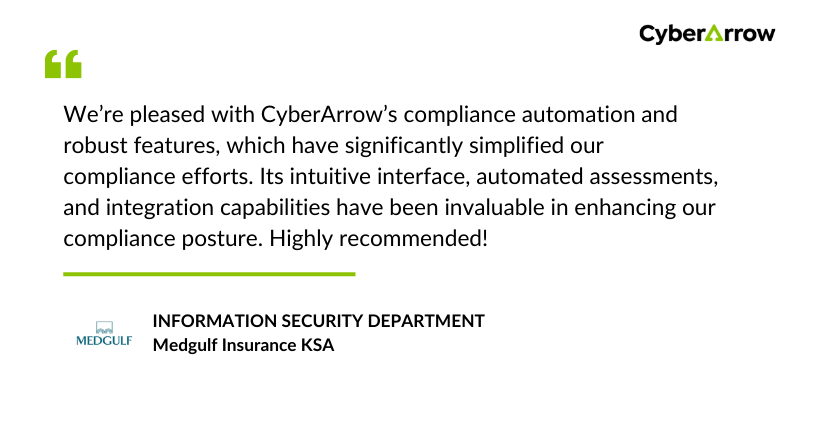
Here’s what Medgulf Insurance says about CyberArrow: