SAMA compliance: A competitive advantage for businesses
Regulatory compliance has become more than a legal requirement in today’s global business landscape. A strategic imperative can set companies apart in a more fiercely competitive environment. One such regulatory authority that profoundly impacts businesses in Saudi Arabia is the Saudi Arabian Monetary Authority (SAMA). As the regulatory landscape continues to evolve, SAMA Compliance emerges as a necessity and a potent competitive advantage for businesses.
In this article, we explore the essential role of SAMA Compliance and its far-reaching implications for businesses. Let’s discuss how embracing the SAMA Cyber Security Framework can become a driving force for your businesses, positioning them for long-term success in the global market.
Understanding SAMA compliance

The Saudi Arabian Monetary Authority (SAMA) is the primary guardian of stability and integrity within the Kingdom of Saudi Arabia. SAMA compliance, established to secure the Kingdom’s monetary and financial systems, has regulations businesses must adhere to. These regulations span various financial activities, including banking, insurance, credit bureaus, financing companies, and capital markets.
From cyber threat intelligence to risk management controls, SAMA’s guidelines are comprehensive, reflecting a commitment to enabling a secure economic environment. With SAMA compliance, companies fulfill their legal obligations and demonstrate their commitment to ethical business practices and financial prudence. This cultivates an environment of trust among stakeholders, enhancing the business’ reputation within the national and international arenas.
Business benefits of SAMA compliance
Here are some of the benefits that SAMA Compliance provides to businesses:
1. Enhanced business reputation and trust
SAMA Compliance serves as a testament to a company’s commitment to ethical and transparent business practices. Customers and stakeholders are more likely to trust businesses that adhere to regulatory standards, enabling long-term relationships. Moreover, compliance with SAMA regulations contributes to a positive brand image.
2. Mitigation of legal risks
SAMA Compliance ensures businesses avoid financial penalties and fines. Avoiding fines and penalties is a financial benefit and a proactive strategy to safeguard resources and maintain financial health. Also, compliance provides legal protection against potential lawsuits and regulatory actions.
3. Enhanced operational efficiency
Aligning with SAMA regulations encourages the development of efficient internal processes. Companies often find that compliance necessitates streamlined workflows, reducing redundancies and enhancing overall operational efficiency.
4. Global market access
In an era of globalized economies, meeting international standards is a gateway to expanded market access. SAMA Compliance positions businesses to meet international financial standards, such as PCI DSS. Compliance with SAMA regulations signals stability and reliability to foreign investors.
5. Competitive advantage
Differentiation in a crowded marketplace is a constant challenge. SAMA Compliance, however, offers a distinctive advantage. It differentiates businesses from competitors that neglect regulatory obligations. Companies adhering to SAMA regulations are preferred partners in business collaborations.
Consequences of non-compliance with SAMA regulations

Non-compliance with SAMA regulations can result in several severe consequences, impacting businesses’ financial stability and reputation. Here are the key repercussions:
- Penalties: Businesses may face substantial penalties determined by the severity and duration of non-compliance. Penalties are designed to act as a deterrent and ensure adherence to SAMA regulations.
- Regulatory sanctions: SAMA can impose regulatory sanctions, including restrictions on certain business activities or operations. Sanctions may vary based on the nature of the non-compliance and its impact on the financial system.
- Operational disruptions: Non-compliance may lead to operational disruptions as businesses may need to halt or adjust certain activities to align with regulatory requirements. Changes in operations can result in increased costs and decreased efficiency.
- Reputational damage: Failure to comply with SAMA Compliance can damage the reputation of a business. Negative publicity and loss of trust among stakeholders, including clients, investors, and partners, can have lasting repercussions.
- Legal consequences: Non-compliance may expose businesses to legal action, including lawsuits and litigation. Legal consequences can further increase financial burdens and damage corporate standing.
- Loss of business opportunities: Non-compliance may lead to exclusion from certain business opportunities, partnerships, or contracts. Businesses that do not meet SAMA Compliance standards may find it challenging to participate in international transactions or collaborations.
- Strain on relationships: Non-compliance can strain relationships with clients, investors, and partners who prioritize working with entities adhering to regulatory standards. Rebuilding trust after a compliance breach can be a lengthy and challenging process.
Quick link: A closer look at ISO 27001 & SAMA CSF
Implementing strategies to comply with SAMA regulations

Here are a few strategies businesses can follow to ensure SAMA Compliance:
- Compliance framework: Establish a robust compliance framework aligned with SAMA regulations. Conduct regular audits for continual improvement and to ensure the effectiveness of compliance measures.
- Training and education: Initiate employee training programs to deepen understanding and commitment to SAMA regulations. Enable a culture of compliance, making regulatory adherence a shared responsibility. Businesses can benefit from security awareness platforms, such as Cyber Arrow Awareness Platform, to enhance employees’ cyber security awareness.
- Technology integration: Leverage technology for real-time monitoring and reporting. Implement compliance software, such as the Cyber Arrow Compliance Automation Platform, for centralized management and documentation, enhancing efficiency in meeting SAMA requirements. This integrated approach ensures ongoing compliance and adaptability to evolving regulatory landscapes.
Case study: Streamlining SAMA compliance with automation at Bupa Insurance
Bupa Insurance, a prominent global healthcare insurance provider with over 70 years of experience, serves over 30 million members across 190 countries. Operating in adherence to the Council of Cooperative Health Insurance and the Saudi Arabian Monetary Authority (SAMA), Bupa Insurance evolved from a joint venture to a publicly listed company offering cooperative health insurance.
The challenge
As a healthcare insurance provider, Bupa Insurance faced significant challenges in manually managing compliance with the SAMA Cyber Security Framework. Issues included ineffective risk management, manual evidence collection, limited visibility into security status, and difficulty mapping various regulations with similar requirements.
Implementing SAMA compliance automation
To address these challenges, Bupa Insurance implemented the Cyber Arrow Compliance Automation Platform to automate SAMA Compliance. The shift to automation aimed to streamline compliance activities and swiftly achieve adherence to the SAMA Cyber Security Framework without the complexities of manual processes.
Business benefits realized
- Efficiency gains: SAMA Compliance Automation significantly reduced the time and effort invested in manual compliance tasks.
- Immediate compliance: Automation facilitated quick adherence to SAMA requirements, ensuring timely and accurate compliance.
- Enhanced risk management: Automatic evidence collection improved overall risk management practices for Bupa Insurance.
- Visibility and monitoring: The automated solution provided increased visibility into the company’s security posture and enabled ongoing monitoring of SAMA CSF, ensuring proactive risk management.
- Time and resource savings: Bupa Insurance was able to redirect focus from complex manual compliance tasks to other critical business operations.
SAMA Compliance Automation at Bupa Insurance emerged as a strategic move to navigate and conquer the challenges posed by manual compliance processes.
Want to achieve substantial business benefits by automating SAMA compliance with CyberArrow? Schedule a free demo today to automate SAMA Compliance and get a competitive advantage as Bupa Insurance got with CyberArrow.
FAQs
What is the significance of SAMA Compliance for businesses in Saudi Arabia?
SAMA Compliance is crucial for businesses operating in Saudi Arabia as it ensures adherence to regulatory standards set by the Saudi Arabian Monetary Authority. Compliance is not only a legal requirement but also a strategic imperative, contributing to enhanced reputation, trust, and global market access.
Why should businesses consider automating their SAMA Compliance processes?
Automating SAMA Compliance processes brings efficiency gains, reduces manual errors, and ensures timely adherence to regulatory frameworks. It enhances risk management, provides real-time monitoring, and allows businesses to focus on core operations while maintaining regulatory compliance.
What are the key business benefits of SAMA Compliance automation?
SAMA Compliance automation offers several benefits, including increased operational efficiency, immediate compliance, enhanced risk management practices, improved visibility into security posture, and significant time and resource savings. It enables businesses to navigate the complexities of regulatory requirements with agility and confidence.
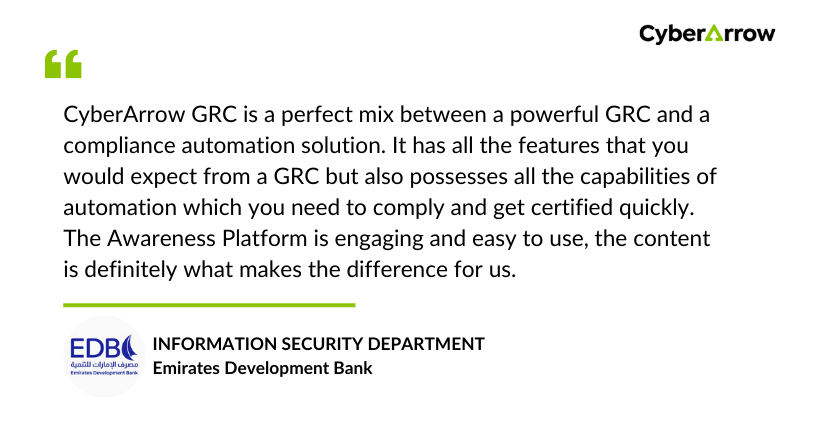
See what our clients have to say about CyberArrow GRC: