A SAMA compliance roadmap for fintech companies operating in KSA
Are you a fintech company in Saudi Arabia and wondering how to comply with the Saudi Central Bank (SAMA) regulations? Staying compliant with SAMA’s regulatory requirements isn’t just about ticking boxes; it’s about safeguarding your business, building customer trust, and ensuring long-term growth. But the journey to SAMA compliance can feel overwhelming, especially with a vast set of regulations to cover.
This guide is here to help you get there. We’ll break down the essentials of SAMA compliance, explain why it matters, and walk you through a clear roadmap for SAMA CSF implementation.
So, let’s get started!
What is SAMA compliance?
The Saudi Central Bank, known as SAMA (Saudi Arabian Monetary Authority), regulates the financial industry in KSA. The SAMA Cyber Security framework ensures financial stability, consumer protection, and industry transparency. Adhering to SAMA CSF requirements is crucial for fintech companies operating in KSA to operate legally and avoid penalties.
SAMA compliance covers areas like:
- Cyber security: Protecting customer data and financial information.
- Data privacy: Ensuring customer data is managed ethically and legally.
- Risk management: Developing processes to identify and mitigate risks.
- Anti-money laundering (AML): Complying with AML laws to detect and prevent financial crime.
Each area involves specific guidelines, processes, and controls that fintechs must implement to comply with SAMA regulations.
Why SAMA compliance is crucial for fintech in KSA
For fintechs in Saudi Arabia, being compliant with SAMA regulations brings a variety of advantages:
- Operational legitimacy: Compliance with SAMA CSF requirements is mandatory for licensing. Without it, fintechs cannot legally operate in KSA.
- Customer trust: Compliance promotes trust as customers are more likely to choose a secure and legally compliant service.
- Risk mitigation: Proper compliance helps minimize risks associated with data breaches, financial fraud, and operational disruptions.
- Market expansion: Many investors and partners require SAMA compliance before collaborating with fintech firms in Saudi Arabia.
Failure to comply can result in fines, operational restrictions, and reputational damage that could severely impact your business.
SAMA compliance roadmap for fintechs in KSA
Here’s a step-by-step roadmap to help fintech companies achieve SAMA CSF compliance.
Step 1: Understand SAMA’s regulations
Start by thoroughly reviewing SAMA’s regulatory requirements that are relevant to your business. SAMA’s guidelines cover everything from financial transparency to customer protection. Familiarize yourself with:
- SAMA Cyber Security Framework: This framework outlines the cyber security requirements, including data encryption, incident management, and network security.
- Data Privacy Requirements: These guidelines are in place to protect customer data from misuse.
- AML and Counter-Terrorist Financing (CTF) Regulations: These regulations require fintechs to monitor, report, and prevent money laundering activities.
Quick link: Your trusted partner for GRC automation in Middle East & North Africa
Step 2: Conduct a compliance assessment
Perform a comprehensive compliance assessment to identify gaps between your current operations and SAMA’s requirements. The assessment should involve:
- Reviewing your existing policies, processes, and controls.
- Identifying compliance risks.
- Pinpointing areas where your business needs improvement to meet SAMA standards.
Consider hiring a compliance expert or using a GRC platform like CyberArrow to help you with this assessment.
Step 3: Develop a compliance strategy
Once you’ve identified your compliance gaps, develop a strategy to address them. Your compliance strategy should cover the following:
- Risk assessment and management: Implement controls to identify and mitigate potential risks.
- Data privacy protocols: Set up data protection measures to secure customer information.
- Cyber security policies: Establish a robust cyber security framework, including incident response plans, data encryption, and regular vulnerability assessments.
Map out a timeline and allocate resources for each compliance activity. Make sure to prioritize high-risk areas and involve relevant departments like IT, legal, and customer service.
Step 4: Implement compliance controls
To meet SAMA CSF requirements, fintechs must implement specific operational controls. Key areas to focus on include:
- Cyber security controls: Ensure your systems are protected from cyber threats through network security, endpoint protection, and regular monitoring.
- Data access controls: Set up strict data access protocols to limit unauthorized access.
- Transaction monitoring: Develop real-time monitoring for suspicious transactions to detect and prevent money laundering.
- Audit and documentation: Maintain proper records of all compliance activities and conduct regular audits.
Step 5: Train your team
Compliance is not a one-person job; it requires everyone in your organization to understand their role. Conduct training sessions to help employees:
- Recognize data privacy requirements.
- Understand cyber security best practices.
- Follow anti-money laundering guidelines.
Regular training ensures compliance and strengthens your organization’s security culture.
Step 6: Monitor and update compliance practices
Regulations and risks evolve, and so should your compliance practices. Establish a system to monitor regulatory updates from SAMA and regularly review your compliance measures. This will help ensure your fintech remains compliant in the long term.
Step 7: Conduct internal audits
Internal audits play a crucial role in maintaining compliance. Schedule regular audits to:
- Verify that all compliance measures are correctly implemented.
- Identify potential issues before they become serious risks.
- Ensure records and documentation meet regulatory standards.
Consider using a GRC platform that simplifies auditing, helping you track and document all compliance activities.
Step 8: Report compliance to SAMA
SAMA may require periodic reports from fintechs to demonstrate compliance. Prepare these reports by:
- Compiling all necessary documents and records.
- Ensuring accuracy in your reports.
- Submitting them within specified deadlines.
By reporting your compliance status to SAMA, you demonstrate your commitment to regulatory standards, which can positively impact your reputation and business operations.
Best practices for maintaining SAMA compliance
Maintaining compliance is an ongoing effort that requires a proactive approach. Here are some best practices for sustaining SAMA compliance:
- Stay updated on regulations: Regularly monitor SAMA’s announcements to stay informed about regulatory changes.
- Use automation tools: SAMA compliance automation simplifies repetitive tasks, like monitoring transactions and generating reports, reducing human error and saving time.
- Document everything: Keep a record of all compliance activities, training sessions, audits, and reports.
- Implement a continuous improvement plan: Regularly evaluate and update your compliance program to adapt to new risks or regulatory changes.
- Engage with experts: Consult compliance experts to help you manage complex requirements and navigate SAMA’s regulatory landscape.
Achieve seamless SAMA compliance with CyberArrow
Navigating SAMA compliance requirements doesn’t have to be a complex task. CyberArrow, a compliance automation platform, simplifies your journey toward SAMA CSF implementation with features designed to save you time, reduce risk, and streamline operations.
Here’s how CyberArrow can help:
- Automated risk assessments: Identify and assess risks with automated risk assessment tools, reducing the manual workload.
- Policy and procedure management: Centralize and manage your policies and procedures, ensuring they align with SAMA requirements.
- Automated evidence collection: Save time on audits with CyberArrow’s automated evidence collection feature, which helps you gather and store compliance documents.
- Continuous monitoring: Monitor compliance metrics in real-time to ensure continuous alignment with SAMA standards.
- Customizable reporting: Generate customized reports that meet SAMA’s requirements and simplify the reporting process.
- Dedicated support team: Receive guidance from a dedicated team of compliance experts to help you implement and maintain SAMA compliance.
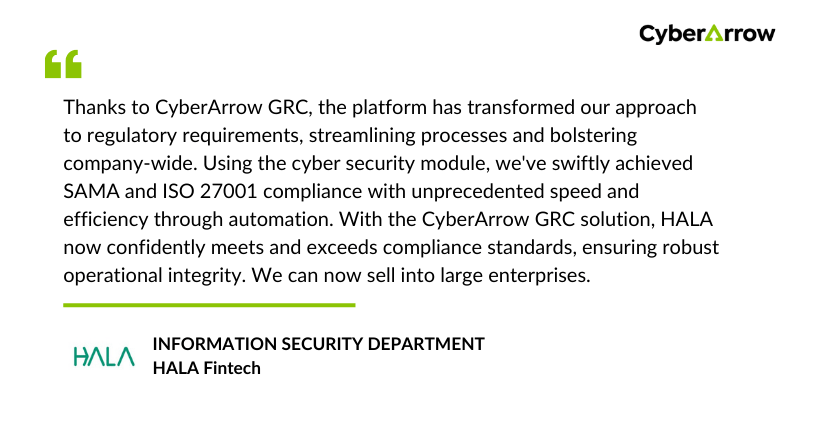
Discover how HALA achieved SAMA compliance with CyberArrow in record speed.
See what HALA has to say about CyberArrow GRC: