

Risk intelligence: A complete guide & how CyberArrow GRC transforms risk management
Risk intelligence is becoming a crucial element for businesses aiming to stay ahead of threats and uncertainties. In today’s fast-changing digital world, companies must anticipate, assess, and manage risks before they turn into serious issues. Organizations that lack strong risk intelligence may face security breaches, compliance failures, and financial losses.
But what exactly is risk intelligence? How can businesses implement it effectively? And how does CyberArrow GRC, along with its CyberArrow ERM module, help enterprises automate and strengthen risk intelligence?
This detailed guide will cover everything you need to know.
What is risk intelligence?
Risk intelligence refers to the ability of an organization to identify, analyze, and respond to risks in a proactive and data-driven way. It involves using real-time insights, analytics, and predictive models to understand potential threats before they impact business operations.
Organizations with strong risk intelligence can:
- Detect risks early and take preventive actions.
- Enhance decision-making by analyzing data-driven insights.
- Ensure compliance with international cyber security frameworks.
- Safeguard reputation by avoiding security and compliance failures.
Risk intelligence is a combination of technology, data, and strategy that allows businesses to operate with confidence, knowing they are protected from potential threats.
Key components of risk intelligence
1. Data collection and analysis
Risk intelligence depends on real-time data from multiple sources, such as IT systems, security logs, compliance reports, and third-party vendors. Analyzing this data helps organizations detect patterns, identify risks, and predict future threats.
2. Threat detection & risk assessment
Once data is collected, businesses need advanced tools to analyze risks, measure their impact, and prioritize responses. CyberArrow ERM automates this step, providing real-time risk assessment and proactive monitoring.
3. Compliance & regulatory requirements
Many industries must follow strict regulations like ISO 27001, GDPR, and SOC 2. Risk intelligence helps organizations stay compliant by continuously monitoring risks that could lead to regulatory violations.
4. Automated risk mitigation strategies
With AI-driven risk intelligence, companies can automate risk mitigation instead of relying on manual processes. CyberArrow ERM allows businesses to track risks, assign mitigation actions, and ensure compliance with regulatory standards.
5. Continuous risk monitoring
Risk intelligence is not a one-time process, it requires ongoing monitoring. Companies need to track risks in real time and update their risk strategies to stay protected against evolving threats.
Cyber security standards that require risk intelligence
Risk intelligence plays a critical role in compliance with several cyber security and risk management frameworks. Here are some of the most important ones:
1. ISO 27001
ISO 27001 is an international standard for information security management systems (ISMS). It requires organizations to identify, assess, and mitigate security risks to ensure the confidentiality, integrity, and availability of data.
2. ISO 31000
ISO 31000 is the global standard for risk management. It provides a structured approach for identifying and managing enterprise risks, making risk intelligence a critical element for compliance.
3. NIST cyber security framework
The National Institute of Standards and Technology (NIST) Cyber security Framework outlines best practices for managing cyber risks. It requires organizations to have real-time risk intelligence capabilities to detect and respond to threats.
4. GDPR (General Data Protection Regulation)
GDPR mandates that companies manage data security risks to protect personal information. Businesses need strong risk intelligence strategies to prevent data breaches and comply with GDPR’s strict requirements.
5. PCI DSS (Payment Card Industry Data Security Standard)
Companies that process credit card payments must comply with PCI DSS, which requires continuous risk assessment and threat monitoring to prevent fraud and data breaches.
6. SOC 2 (System and Organization Controls 2)
SOC 2 compliance is essential for businesses that handle customer data. It requires companies to implement risk intelligence strategies to manage security, availability, processing integrity, confidentiality, and privacy risks.
Quick link: US cyber security laws
How CyberArrow GRC & CyberArrow ERM enhance risk intelligence
CyberArrow GRC: The ultimate risk & compliance solution
CyberArrow GRC is an advanced Enterprise GRC software designed to automate governance, risk, and compliance processes. It helps organizations streamline compliance, manage risks effectively, and monitor cyber security threats in real time.
CyberArrow ERM: Transforming enterprise risk management
CyberArrow ERM is a powerful risk management module that automates risk assessments, threat detection, and mitigation strategies. Here’s how it helps businesses strengthen risk intelligence:
- Automated risk identification: CyberArrow ERM continuously scans for potential risks across the organization.
- Real-time risk assessment: Businesses can analyze risks instantly and prioritize mitigation efforts.
- Proactive monitoring & alerts: CyberArrow ERM sends automated alerts for emerging threats, helping businesses stay one step ahead.
- Seamless compliance integration: The platform supports multiple cyber security frameworks, ensuring organizations meet compliance standards like ISO 27001, ISO 31000, GDPR, and PCI DSS.
- Data-driven decision making: CyberArrow ERM provides in-depth risk analytics, helping leadership teams make informed decisions.
With CyberArrow ERM, organizations can eliminate manual risk management processes and adopt an AI-powered, automated approach to enterprise risk management.
Read how CyberArrow ERM improved risk assessment across departments for the DCD – Abu Dhabi.
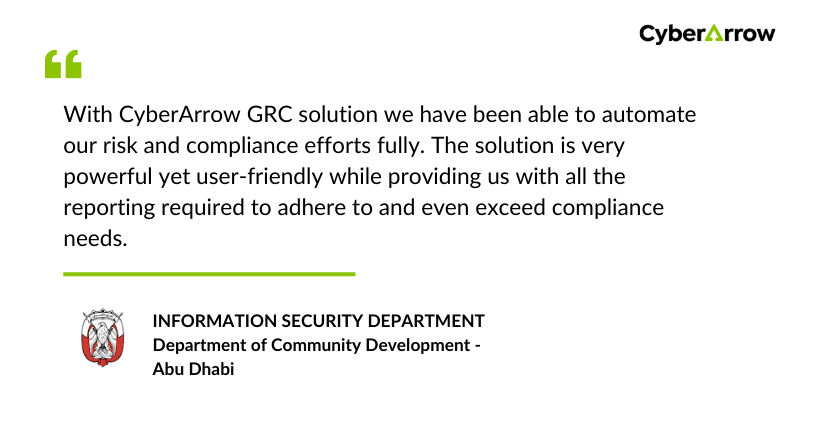
See what DCD – Abu Dhabi has to say about CyberArrow GRC:
Benefits of implementing risk intelligence with CyberArrow
1. Enhanced cyber security posture
By automating risk detection and mitigation, CyberArrow ERM helps organizations reduce vulnerabilities and prevent cyber attacks.
2. Improved regulatory compliance
CyberArrow ERM ensures that businesses meet the requirements of multiple compliance frameworks, reducing the risk of penalties and legal issues.
3. Faster decision-making
With real-time risk intelligence, leadership teams can make faster, data-driven decisions to minimize threats and improve operational efficiency.
4. Reduced operational costs
Manual risk management processes are time-consuming and expensive. CyberArrow ERM automates risk assessments, saving time and resources.
5. Increased business resilience
Organizations with strong risk intelligence can adapt quickly to emerging threats and disruptions, ensuring long-term business success.
Conclusion
Risk intelligence is no longer optional, it’s a business necessity. Organizations that fail to implement risk intelligence strategies may face financial losses, security breaches, and compliance violations. By integrating CyberArrow GRC and CyberArrow ERM, businesses can automate risk management, enhance cyber security, and achieve compliance seamlessly.
If you want to strengthen your organization’s risk intelligence and eliminate manual risk management processes, CyberArrow ERM is the ultimate solution.
FAQs
What is risk intelligence, and why is it important?
Risk intelligence is the ability to identify, assess, and mitigate risks using data-driven insights and automation. It helps businesses prevent security threats, ensure compliance, and make informed decisions.
Which industries need risk intelligence the most?
Industries such as finance, healthcare, technology, and government rely on risk intelligence to manage cyber security threats, regulatory risks, and operational risks effectively.
How does CyberArrow ERM improve risk intelligence?
CyberArrow ERM automates risk assessments, threat monitoring, and mitigation strategies, providing businesses with real-time risk intelligence and compliance automation.
