

A complete guide to risk management process & steps
Every business, regardless of its size or industry, faces risks. These risks can come from cyber threats, financial instability, regulatory non-compliance, or operational failures. Without a proper risk management process, organizations may struggle to protect their assets, reputation, and future growth.
This guide will provide a detailed breakdown of the risk management process, explain its key steps, and discuss how businesses can handle risks efficiently. Additionally, we will explore how CyberArrow ERM automates risk management, making it easier for enterprises to identify, assess, and mitigate risks in real time.
What is risk management?
Risk management is the systematic process of identifying, analyzing, and mitigating risks that could negatively impact an organization. The goal is to minimize financial loss, improve business resilience, and ensure regulatory compliance.
Organizations can experience security breaches, financial failures, or legal penalties without a structured risk management framework. That’s why every business must implement a strong risk management process to stay protected.
Why is risk management important?
A proper risk management process helps organizations in several ways:
- Prevents financial loss: Identifies threats before they impact business finances.
- Ensures compliance: Helps meet industry regulations and avoid legal penalties.
- Protects reputation: Reduces security incidents and operational failures.
- Improves decision-making: Provides better insights for strategic planning.
- Enhances business continuity: Helps organizations stay prepared for unexpected challenges.
Without a structured approach to risk management, businesses remain vulnerable to threats that can jeopardize their operations and long-term success.
Risk management process: Step-by-step guide
A structured risk management process ensures that risks are identified, analyzed, and controlled efficiently. Below are the five essential steps:
1. Identifying risks
The first step in risk management is to identify potential risks that could impact the organization. These risks can come from different sources, such as:
- Cyber security risks: Data breaches, hacking attempts, malware, and phishing attacks.
- Financial risks: Market fluctuations, unexpected expenses, and economic downturns.
- Operational risks: Equipment failures, supply chain disruptions, and process inefficiencies.
- Regulatory & compliance risks: Failure to comply with data protection laws like GDPR, ISO 27001, PCI DSS, and more.
- Strategic risks: Poor business decisions, competition, and changes in consumer demand.
Businesses use risk assessment frameworks, employee feedback, and historical data to identify risks effectively.
2. Analyzing and assessing risks
Once risks are identified, the next step is to analyze and assess their potential impact.
Businesses typically evaluate risks based on two factors:
- Likelihood: How often is this risk likely to occur?
- Impact: What are the potential consequences if the risk happens?
A risk matrix is commonly used to classify risks into low, medium, or high severity. High-risk threats require immediate attention, while low-risk issues can be monitored over time.
3. Risk mitigation and treatment
After assessing risks, organizations must develop a strategy to reduce or eliminate them. The four main approaches to risk treatment include:
- Avoidance: Eliminating the activity that causes the risk.
- Mitigation: Taking preventive measures to reduce the impact of the risk.
- Transfer: Shifting the risk to a third party (e.g., insurance, outsourcing).
- Acceptance: Accepting the risk and preparing for its consequences.
For example, to mitigate cyber security risks, organizations can implement firewalls, multi-factor authentication, and regular employee training.
4. Risk monitoring and review
Risk management is an ongoing process. Organizations must constantly monitor risks, reassess threats, and update their risk strategies.
Regular risk assessments, compliance audits, and automated monitoring tools help businesses stay ahead of evolving risks.
5. Risk reporting and documentation
Proper documentation is essential for tracking risks, improving strategies, and proving compliance. Businesses use risk management software to automate reports, making data-driven decisions easier.
Challenges in traditional risk management
Many businesses still rely on manual risk management processes, which come with several challenges:
- Time-consuming: Manual assessments take too long and often delay risk response.
- Human errors: Spreadsheets and paperwork increase the chances of missed risks.
- Lack of real-time monitoring: Without automation, businesses struggle to detect risks instantly.
- Difficult compliance management: Keeping up with multiple regulations manually is inefficient.
To solve these challenges, organizations need an automated risk management system that simplifies risk tracking and compliance.
Quick link: CyberArrow partners with RiskRecon by MasterCard to enhance third-party risk management.
How CyberArrow ERM simplifies risk management
Managing risks manually is inefficient and error-prone. CyberArrow ERM automates the entire risk management process, ensuring businesses can identify, assess, and mitigate risks effortlessly.
What is CyberArrow ERM?
CyberArrow ERM is a powerful enterprise risk management software that automates risk identification, assessment, and mitigation. It eliminates manual processes, making risk management seamless.
Key features of CyberArrow ERM
- Automated risk assessment: CyberArrow ERM automatically identifies and evaluates risks, reducing manual effort.
- Real-time risk monitoring: The system continuously tracks risks and alerts businesses about potential threats.
- Regulatory compliance management: Supports multiple frameworks, including ISO 27001, PCI DSS, GDPR, and more.
- Comprehensive risk reporting: Provides real-time insights and risk intelligence for better decision-making.
- User-friendly interface: Allows both technical and non-technical teams to manage risks with ease.
Why choose CyberArrow ERM?
- Eliminates manual work: Automates risk tracking and compliance processes.
- Enhances risk visibility: Provides better risk insights for smarter decision-making.
- Improves compliance: Helps organizations meet international regulations effortlessly.
Read how CyberArrow ERM improved risk assessment across departments for the DCD – Abu Dhabi.
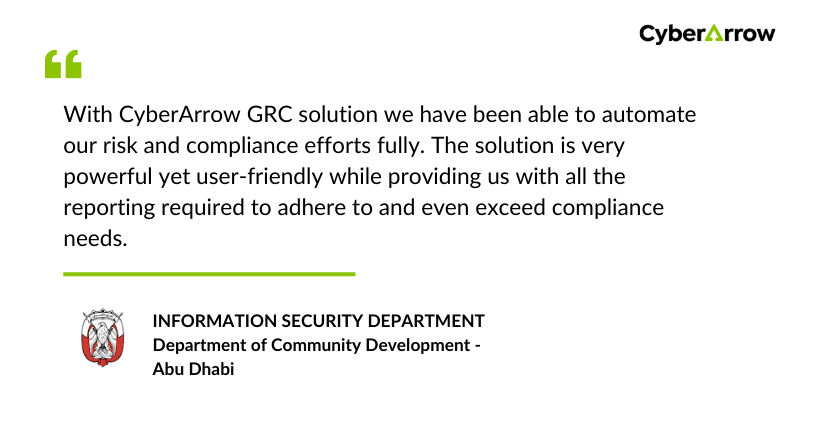
See what DCD – Abu Dhabi has to say about CyberArrow GRC:
Final thoughts
A well-structured risk management process helps businesses identify, assess, and mitigate threats efficiently. Without a proper framework, organizations may struggle to prevent security breaches, financial losses, and compliance issues.
However, manual risk management is outdated. Businesses need an automated solution like CyberArrow ERM to stay ahead of risks and ensure compliance.
FAQs
What are the key steps in the risk management process?
The risk management process includes five main steps: identifying risks, analyzing and assessing risks, mitigating risks, monitoring risks, and documenting/reporting risks. These steps help organizations proactively manage threats and minimize their impact.
Why is risk management important for businesses?
Risk management is crucial because it helps businesses prevent financial losses, ensure compliance, protect their reputation, and make better strategic decisions. Without a structured approach, companies may struggle with unexpected risks that can disrupt operations.
How does CyberArrow ERM help automate risk management?
CyberArrow ERM automates the entire risk management process by identifying, assessing, and mitigating risks in real-time. It eliminates manual work, provides real-time risk monitoring, and helps organizations comply with multiple regulatory frameworks like ISO 27001, PCI DSS, and GDPR.
