ISO 9001 training: Benefits, types, and best practices
Quality is more than just a goal for businesses today; it is a necessity. Customers expect reliable products and services, regulators demand compliance, and businesses need efficient processes to stay ahead. ISO 9001, the world’s most recognized quality management standard, provides a framework to achieve all these objectives. But implementing the standard requires more than policies and procedures. It requires people who understand its requirements and know how to apply them in daily operations.
This is what ISO 9001 training offers. Training ensures that employees, managers, and auditors not only understand the requirements but can also integrate them into processes, culture, and long-term strategies.
Let’s explore ISO 9001 training, its benefits, and best practices for success.
What is ISO 9001 training?
ISO 9001 training is a structured learning program that helps individuals and organizations understand and apply the requirements of the ISO 9001:2015 Quality Management System (QMS). It covers the seven quality management principles, process approach, risk-based thinking, and continuous improvement practices.
The training is not limited to quality managers. Different levels of training exist to target various roles within an organization. These may include employees who need general awareness, internal auditors who evaluate compliance, and lead auditors who conduct certification audits.
By the end of training, participants should be able to:
- Understand ISO 9001 requirements.
- Apply quality management principles to real scenarios.
- Contribute to process improvement.
- Support audit readiness and certification.
Why ISO 9001 training is important
Organizations often underestimate the human side of quality management. A written compliance policy alone cannot ensure compliance if employees don’t understand what it means in practice. ISO 9001 training bridges that gap.
Here are some reasons why training is vital:
- Employees can learn what clauses mean and how they apply to daily work.
- Skilled staff are better equipped to identify risks, opportunities, and areas for improvement.
- Internal and external audits run more smoothly when everyone understands their role.
- Training drives a culture of ongoing learning and process refinement.
- Beyond compliance, training helps reduce errors, improve efficiency, and boost customer satisfaction.
Quick link: ISO 9001 certification cost
Types of ISO 9001 training
Different organizations and roles require different levels of training. The main categories include:
1. Awareness training
Awareness training introduces employees to the basics of ISO 9001. It explains why the organization is adopting the standard, what quality management means, and how each individual contributes to achieving compliance. This training is usually short and focuses on building awareness rather than technical knowledge. For example, employees learn about the quality policy, customer focus, and their role in following procedures.
Who it’s for: All employees, especially frontline staff, so they understand the importance of quality management in their daily work.
2. Implementation training
Implementation training is more in-depth and is designed for managers, supervisors, and quality teams who are responsible for building or improving the Quality Management System (QMS). It covers the ISO 9001 requirements clause by clause and teaches how to design processes that meet those requirements. It also provides guidance on creating documentation such as policies, procedures, and records.
Who it’s for: Quality managers, process owners, and leadership teams responsible for developing and maintaining the QMS.
3. Internal auditor training
Internal auditor training teaches participants how to assess whether the QMS is being followed correctly. It covers audit planning, conducting interviews, reviewing policy documentation, identifying nonconformities, and preparing audit reports. This training ensures that internal audits are conducted systematically and provide real value for continuous improvement.
Who it’s for: Employees who will be performing internal audits within their organization. It is essential for maintaining compliance between certification audits.
4. Lead auditor training
Lead auditor training is the most advanced level. It prepares participants to conduct third-party certification audits on behalf of accredited certification bodies. This training goes beyond internal auditing by teaching advanced auditing techniques, leadership skills, and international auditing standards. It also requires participants to demonstrate competence through exams and practical assessments.
Who it’s for: Professionals seeking to become certified lead auditors who can audit external organizations and issue ISO 9001 certification recommendations.
Who needs ISO 9001 training?
Not everyone in an organization requires the same depth of ISO 9001 knowledge. The type of training depends on the role and responsibilities of the individual. Here’s a breakdown:
| Role/group | Why they need training | Type of training |
| All employees | To understand the organization’s quality policy and its role in achieving it. | Awareness training |
| Managers and supervisors | To implement ISO 9001 processes and oversee compliance in their departments. | Implementation training |
| Quality team | To manage the QMS, maintain documentation, and ensure ongoing compliance. | Implementation + Internal auditor training |
| Internal auditors | To conduct systematic audits that identify gaps and improve processes. | Internal auditor training |
| Senior leadership | To understand strategic quality management and ensure alignment with business goals. | Awareness + implementation training |
| External auditors | To audit organizations for certification and compliance. | Lead auditor training |
How to choose the right ISO 9001 training program
Not all training programs are created equal. Organizations should carefully evaluate options to ensure maximum value.
Key factors to consider:
- Training goals: Decide whether you need awareness for staff, implementation support, or auditor-level training.
- Delivery format: Choose between classroom sessions, online courses, or blended approaches depending on your team’s availability.
- Accredited providers: Work with training organizations recognized by certification bodies to ensure credibility.
- Updated content: Verify that the training is based on ISO 9001:2015, the latest version of the standard.
- Practical examples: Look for case studies, workshops, and exercises that make training interactive and useful.
ISO 9001 training and compliance readiness
Training is more than an educational exercise; it is a compliance tool. Employees who understand ISO 9001 requirements are better prepared for internal audits and external certification.
ISO 9001 training ensures that:
- Teams can demonstrate compliance during audits.
- Processes are consistently applied across departments.
- Records and documentation are correctly maintained.
- Organizations achieve certification more efficiently and maintain it over time.
Simplify ISO 9001 compliance with CyberArrow
Managing ISO 9001 requirements can be complex, especially when it comes to training, documentation, and audit preparation. CyberArrow helps organizations streamline compliance by offering:
- Centralized policy and document management.
- Automated evidence collection for audits.
- Compliance mapping across multiple frameworks.
- Integrated training and awareness support.
- Real-time dashboards to track compliance progress.
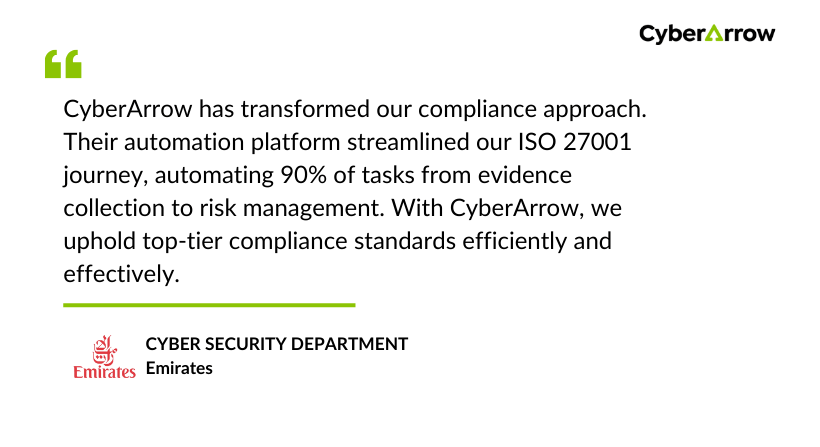
See what global brands like Emirates has to say about CyberArrow GRC: