How much does ISO 9001 certification cost? A complete breakdown
ISO 9001 is one of the most widely recognized quality management certifications in the world. It helps businesses prove their commitment to quality, consistency, and customer satisfaction. For many organizations, the biggest question before starting the journey is simple: how much does ISO 9001 certification cost?
The answer depends on several factors, such as company size, industry, and current level of compliance. Costs can range from a few thousand dollars for a small business to tens of thousands for large enterprises. Understanding these costs upfront can help you prepare a realistic budget and avoid surprises later in the process.
So, let’s get started!
What is ISO 9001 certification?
ISO 9001 certification verifies that an organization has implemented a quality management system (QMS) that meets the standards set by the International Organization for Standardization (ISO).
Certification involves a third-party audit and ongoing monitoring to ensure that your processes align with customer expectations, regulatory requirements, and continuous improvement principles.
For businesses, certification means more than just a certificate. It demonstrates credibility, builds customer trust, and opens opportunities for new contracts, especially where compliance with ISO 9001 is mandatory.
How much does ISO 9001 certification cost?
There is no fixed price for ISO 9001 certification. Costs vary based on the size and complexity of your organization, the number of employees, and the scope of your operations. Below is a general cost range for different business sizes:
| Business size | Cost range | Notes |
| Small business (1–50 employees) | $3,000 – $6,000 | Costs depend on audit days, readiness, and whether external consultants are used. |
| Medium business (51–250 employees) | $10000-$15000 | More employees and multiple sites increase audit and training expenses. |
| Large enterprise (250+ employees, multiple sites) | $20000-$30000+ | Complex operations require longer audits, more training, and additional resources. |
These costs cover certification audits and some preparation, but do not include hidden or ongoing expenses, which we will discuss later.
Factors that influence ISO 9001 certification cost
Several elements directly affect the cost of certification:
- Organization size and complexity: Larger companies and those with multiple business units or sites require more audit days and preparation.
- Number of employees: Costs scale with the size of your workforce, as more processes and records need to be reviewed.
- Current compliance level: Companies that already follow quality management practices will need fewer resources to close gaps.
- Certification body fees: Fees differ between accredited bodies and depend on location and industry.
- Travel and auditor expenses: If auditors must travel, additional costs will apply.
- Internal resource costs: Time spent by employees on ISO 9001 training, documentation, and audits should be factored into the overall cost.
Breakdown of ISO 9001 certification costs
Certification costs typically fall into the following categories:
1. Pre-certification gap analysis
Before starting certification, many organizations carry out a gap analysis. This is an optional but useful step where either internal staff or external consultants review your current processes against ISO 9001 requirements. The outcome highlights missing elements or weak areas that must be addressed. Costs vary depending on company size, but small businesses can expect $1,000–$3,000, while larger enterprises may spend $5,000–$10,000.
2. Training and awareness programs
Employees must understand ISO 9001 requirements and their role in maintaining a quality management system (QMS). Training programs may include:
- Awareness sessions for all staff.
- Internal auditor training for selected employees.
- Quality management training for senior managers.
Depending on the type of training and provider, costs can range from $500 for basic online courses to $5,000+ for in-person workshops covering multiple employees.
3. Consulting support (optional)
Some companies hire external consultants to design and implement the QMS. Consultants can prepare policy documentation, guide internal audits, and ensure readiness before certification. While this speeds up the process, it is often one of the most expensive components, costing anywhere from $2,000 for small businesses to over $20,000 for large organizations with complex operations.
4. Internal resource time
Even if you do not use consultants, your employees will need to spend time preparing policies, documenting processes, and correcting nonconformities. This is not a direct cash expense, but it represents a hidden cost in terms of lost productivity. On average, preparation can take several weeks to several months, depending on the maturity of your processes.
5. Certification audits (Stage 1 and Stage 2)
The certification process includes two main audit stages:
- Stage 1 audit: A documentation review to check whether your QMS is ready for full certification.
- Stage 2 audit: A detailed on-site (or hybrid) audit of your actual practices and processes.
Certification body fees typically make up the bulk of your ISO 9001 cost. For small businesses, this may be $3,000–$7,000, while medium to large organizations may spend $10,000–$30,000 or more depending on complexity and audit duration.
6. Ongoing surveillance audits
Certification is valid for three years, but you must undergo annual surveillance audits to maintain it. These are shorter than the initial audit but still involve certification body fees. Expect costs of $1,500–$5,000 per year, depending on company size.
Hidden or ongoing costs of ISO 9001 certification
Beyond the upfront expenses, organizations should also plan for:
- Updates to documentation and policies.
- Corrective actions after audits.
- Continuous improvement initiatives.
- Internal audit programs.
- Recertification every three years.
How to optimize ISO 9001 certification costs
Certification does not always have to be expensive. Practical ways to reduce costs include:
- Invest in internal training to reduce reliance on consultants.
- Automate documentation and evidence collection with compliance tools.
- Align multiple frameworks at once (e.g., ISO 27001, ISO 22301) to save on audit and preparation costs.
- Plan audits strategically to minimize travel and extra audit days.
- Start with a focused scope and expand gradually as your QMS matures.
Why ISO 9001 certification is worth the investment
While certification can be costly, the return on investment is significant. Organizations benefit from improved efficiency, reduced errors, higher customer trust, and access to markets or contracts that require ISO 9001 compliance. Over time, these benefits outweigh the certification cost by driving growth and operational excellence.
Get audit-ready with CyberArrow
Managing ISO 9001 certification can feel overwhelming, especially when balancing costs, audits, and documentation. CyberArrow helps reduce the burden by automating compliance processes and making your organization audit-ready in weeks.
Key features of CyberArrow:
- Automates evidence collection for ISO 9001 controls.
- Provides cross-standard mapping to align with other ISO standards.
- Includes auditor-approved templates to simplify documentation.
- Offers real-time compliance monitoring and reporting.
- Dedicated customer success team for ongoing support.
Schedule a free demo with CyberArrow today and see how easily you can achieve ISO 9001 certification while keeping costs under control.
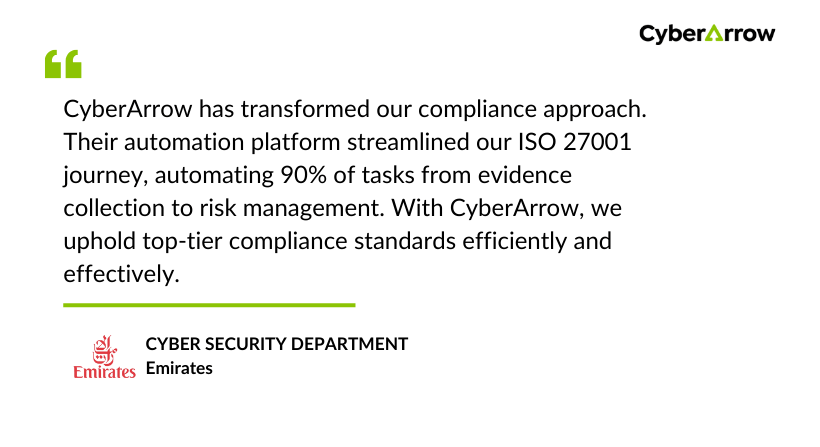
See what global brands like Emirates has to say about CyberArrow GRC: