

GDPR compliance strategies: A complete guide
Data is the backbone of modern business. Every click, purchase, and interaction generates valuable information. At the same time, individuals have become more aware of how their data is used. This awareness, combined with rising concerns about privacy breaches, gave birth to one of the world’s most important regulations: the General Data Protection Regulation (GDPR).
Since GDPR became enforceable in May 2018, organizations across the globe have faced strict requirements for collecting, storing, and processing personal data of European Union (EU) citizens. Non-compliance has proven costly. According to the European Data Protection Board, fines have exceeded €4 billion since GDPR enforcement began.
This guide explains GDPR compliance strategies, why they matter, and how businesses can implement them effectively.
What is GDPR?
The General Data Protection Regulation (GDPR) is a legal framework introduced by the European Union to protect the personal data of its citizens. Unlike many regulations, GDPR has an extra-territorial scope. That means any company, no matter where it is based, must comply if it processes or stores data of people in the EU.
The regulation focuses on giving individuals more control over their personal information while holding organizations accountable for how they handle that data.
Key rights under GDPR include:
- The right to access personal data.
- The right to correct inaccurate data.
- The right to erasure (also known as the right to be forgotten).
- The right to restrict processing.
- The right to data portability.
Why GDPR compliance matters
GDPR compliance is more than avoiding penalties. It is about building trust, improving business processes, and reducing risks.
Some important reasons include:
Avoiding heavy fines: Organizations that violate GDPR can face penalties of up to €20 million or 4% of their annual global turnover, whichever is higher.
Protecting reputation: Data breaches not only result in fines but also destroy customer trust. Research by PwC found that 85% of consumers will not do business with a company if they are worried about its data practices.
Staying competitive: Many global firms now prefer working with GDPR-compliant vendors. Certification and compliance make it easier to win contracts and expand into new markets.
Strengthening security posture: GDPR encourages organizations to adopt strong security and governance practices. This results in fewer risks of breaches and cyberattacks.
Core GDPR compliance requirements
To achieve compliance, organizations must address several requirements, such as:
- Lawful basis for processing: Companies must have a legal reason to collect and use personal data, such as user consent or contract fulfilment.
- Data protection officer (DPO): Certain companies must appoint a DPO to oversee compliance.
- Data subject rights: Processes must be in place to handle requests for access, correction, or deletion.
- Breach notification: Organizations must report data breaches within 72 hours to authorities.
- Data minimization: Collect only the data necessary for the specific purpose.
- Accountability and documentation: Organizations must show proof of compliance, including policies and audit trails.
Common challenges in GDPR compliance
While the regulation sounds straightforward, many businesses face challenges:
- Manual processes: Relying on spreadsheets to track compliance leads to errors and wasted time.
- Complex frameworks: GDPR overlaps with other frameworks like ISO 27001, SOC 2, and CCPA, creating duplication.
- Third-party risks: Vendors and partners may not meet GDPR standards, increasing overall exposure.
- Data mapping issues: Many organizations struggle to identify where all personal data is stored and who has access.
These challenges highlight why businesses need structured GDPR compliance strategies.
Effective GDPR compliance strategies
1. Conduct a GDPR gap analysis
Start by assessing where your organization stands today. A gap analysis compares your current practices against GDPR requirements. It identifies missing policies, weak controls, and risks.
2. Create a data inventory and map
GDPR compliance requires organizations to know what personal data they collect, where it is stored, who accesses it, and why. Data mapping helps eliminate redundant or unnecessary data.
3. Define a lawful basis for processing
Every piece of data must have a legal basis. For example, collecting email addresses for a newsletter requires explicit user consent. Document these bases for transparency.
4. Strengthen data security controls
Encryption, access management, and regular security audits are key. GDPR requires “appropriate technical and organizational measures” to protect data.
5. Train employees on GDPR awareness
Employees are the first line of defense. Training helps them understand rules around data handling, breach reporting, and customer requests.
6. Implement vendor risk management
If third parties handle your data, you remain responsible for compliance. Assess vendor contracts and include GDPR clauses to reduce risks.
7. Establish breach response procedures
Organizations must notify authorities within 72 hours of a breach. A well-defined incident response plan is critical for meeting this requirement.
8. Automate GDPR compliance
Manual tracking slows businesses down. Automating evidence collection, risk management, and reporting saves time while ensuring accuracy.
The role of technology in GDPR compliance
Manual compliance strategies are no longer sustainable. According to Gartner, by 2026 more than 70% of organizations will use compliance automation platforms to manage regulatory requirements.
Technology solutions provide:
- Centralized compliance dashboards.
- Automated evidence collection.
- Continuous monitoring of risks.
- Cross-mapping of GDPR with other frameworks.
This shift not only reduces human error but also ensures businesses are always audit-ready.
Why choose CyberArrow GRC for GDPR compliance?
CyberArrow GRC is designed to simplify GDPR compliance and help businesses of all sizes stay ahead of regulatory demands. Unlike manual approaches or consultant-heavy methods, CyberArrow puts compliance on autopilot.
With CyberArrow GRC, organizations can:
- Automate GDPR controls: Evidence collection and documentation are handled automatically.
- Use a zero-touch audit approach: Stay prepared for audits without extra manual effort.
- Cross-map with other standards: Map GDPR controls to ISO, NIST, SOC 2, and more without duplication.
- Manage risks with ease: Built-in risk libraries make GDPR risk management straightforward.
- Save time and resources: What previously took hundreds of hours can now be managed in weeks.
By automating GDPR compliance, CyberArrow GRC not only helps businesses avoid fines but also builds trust with customers and regulators.
Final thoughts
GDPR compliance strategies are essential for every business that handles EU personal data. Beyond fines, the regulation emphasizes accountability, transparency, and customer trust.
While traditional methods like spreadsheets and manual checklists may have worked in the past, they are no longer efficient in a fast-moving regulatory environment. Automation through solutions like CyberArrow GRC ensures accuracy, scalability, and continuous compliance.
If you want to cut down on manual effort and adopt a zero-touch audit approach, CyberArrow GRC is your best choice.
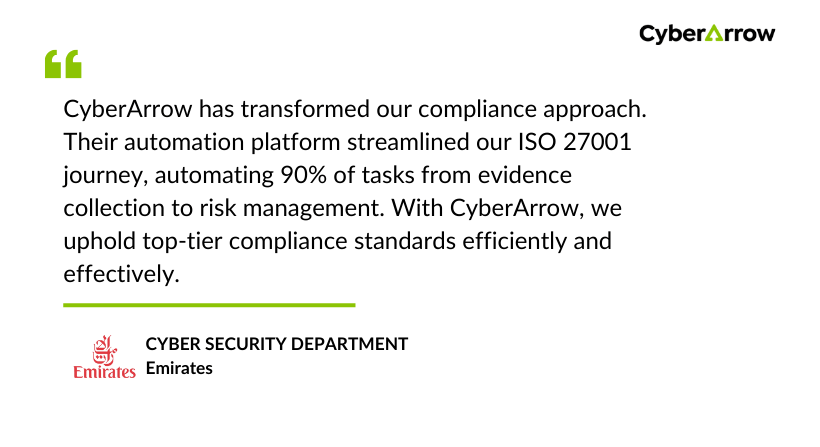
See what global brands like Emirates has to say about CyberArrow GRC:
FAQs
What is the main goal of GDPR compliance?
The main goal is to protect the personal data of EU citizens, ensuring businesses handle it responsibly and transparently.
What are the penalties for non-compliance with GDPR?
Fines can reach up to €20 million or 4% of annual global revenue, whichever is higher.
Can CyberArrow GRC help small businesses with GDPR compliance?
Yes, CyberArrow GRC is built for organizations of all sizes, making GDPR compliance easier and faster for startups, SMEs, and large enterprises.
