

ISO 27001 GRC automation: The ultimate checklist for global security certification
Every business today depends on digital systems to operate, store data, and serve customers. But with this comes a big responsibility: keeping information secure. Cyberattacks, data leaks, and privacy breaches are now common headlines. That is why global standards like ISO 27001 exist.
ISO 27001 is the world’s most recognized standard for information security management. It helps companies prove that they handle sensitive data safely. However, meeting all its requirements manually can be time-consuming and stressful. This is where ISO 27001 GRC automation changes everything.
This blog will guide you through a complete checklist to achieve ISO 27001 certification using automation for faster results, less manual work, and stronger compliance.
- What is ISO 27001 GRC automation?
- Why automation is a game-changer
- The ultimate ISO 27001 GRC automation checklist
- 1. Define scope and build your team
- 2. Identify and assess risks
- 3. Create your Statement of Applicability (SoA)
- 4. Develop policies and implement controls
- 5. Run awareness and training programs
- 6. Conduct internal audits
- 7. Perform management reviews
- 8. Prepare for the external audit
- 9. Focus on continuous improvement
- 10. Scale globally and maintain consistency
- The business benefits of ISO 27001 GRC automation
- Final thoughts: Achieve global security excellence with CyberArrow GRC
- FAQs
Every business today depends on digital systems to operate, store data, and serve customers. But with this comes a big responsibility: keeping information secure. Cyberattacks, data leaks, and privacy breaches are now common headlines. That is why global standards like ISO 27001 exist.
ISO 27001 is the world’s most recognized standard for information security management. It helps companies prove that they handle sensitive data safely. However, meeting all its requirements manually can be time-consuming and stressful. This is where ISO 27001 GRC automation changes everything.
This blog will guide you through a complete checklist to achieve ISO 27001 certification using automation for faster results, less manual work, and stronger compliance.
What is ISO 27001 GRC automation?
ISO 27001 GRC automation means using technology to manage governance, risk, and compliance tasks required for ISO 27001 certification. Instead of tracking everything in spreadsheets or emails, automation brings everything into one platform.
It simplifies how you identify risks, implement security controls, document policies, and prepare for audits. Automated reminders, dashboards, and reports help you stay audit-ready all year instead of rushing right before the certification.
Why automation is a game-changer
In traditional compliance programs, teams often spend weeks collecting evidence, updating spreadsheets, and following up with departments. Automation replaces these repetitive tasks with intelligent workflows.
It provides real-time visibility into your compliance status, helps assign responsibilities, and ensures that no step is missed. With ISO 27001 GRC automation, your company saves time, reduces costs, and minimizes human error. Most importantly, it keeps you compliant and confident in front of any auditor.
The ultimate ISO 27001 GRC automation checklist
Here is your detailed step-by-step checklist to prepare for ISO 27001 certification while using automation to make every step easier.
1. Define scope and build your team
Start by defining the boundaries of your Information Security Management System (ISMS). Identify which departments, locations, and assets are included. Then, form a dedicated ISMS team with members from IT, HR, operations, and management.
Automation helps here by assigning clear roles, tracking responsibilities, and sending alerts when actions are pending.
2. Identify and assess risks
ISO 27001 focuses on managing risks to your information. Begin by listing all critical assets, such as data, systems, and applications. Identify potential threats and weaknesses, and calculate the likelihood and impact of each risk.
An automated GRC tool can generate a digital risk register, calculate risk levels, and suggest mitigation steps. It saves hours of manual effort while ensuring consistency across the organization.
3. Create your Statement of Applicability (SoA)
The Statement of Applicability (SoA) lists which security controls apply to your business and why. It connects risks to the right security measures and explains any exclusions.
Using an automated platform makes this task simple. You can use pre-built templates for ISO 27001 controls, link them to risks, and generate the SoA instantly. This ensures nothing is missed and your documentation is always up to date.
4. Develop policies and implement controls
ISO 27001 requires documented policies, from access control and data protection to incident management and business continuity.
Automation helps by providing ready-made templates, tracking document approvals, and managing versions. It also ensures that every employee reads and acknowledges the latest policies.
At the same time, automated task management helps track control implementation so you can see progress in real time.
5. Run awareness and training programs
Human error is one of the biggest causes of security breaches. Regular training is essential for ISO 27001 compliance.
Automation makes this process easier by scheduling sessions, sending reminders, tracking completion rates, and storing evidence. With all training records available in one place, you are always prepared for audit review.
6. Conduct internal audits
Before applying for certification, your internal audit team should test whether all processes and controls are working as expected.
A GRC automation platform can schedule audits, assign auditors, capture findings, and track corrective actions. The built-in dashboards make it easy to see which issues are pending and which have been resolved.
7. Perform management reviews
Top management must review the performance of the ISMS at planned intervals. This includes evaluating incidents, audit results, and overall risk posture.
Automation gathers all metrics in one place and generates clear reports. This helps leadership make quick and informed decisions without chasing multiple teams for updates.
8. Prepare for the external audit
Once you are confident that your ISMS meets ISO 27001 requirements, it is time for an external certification audit.
With automation, evidence collection becomes quick and organized. The system keeps all records, controls, and policies ready for inspection. It also allows auditors to review evidence securely, saving days of back-and-forth communication.
9. Focus on continuous improvement
ISO 27001 is not a one-time project. You must keep improving your ISMS over time.
Automation plays a key role here, too. It tracks the performance of controls, sends alerts when documents expire, and helps you manage recurring reviews. It also enables continuous monitoring so you stay compliant even as your business grows.
10. Scale globally and maintain consistency
If your organization operates in multiple regions, maintaining consistent security standards can be tough. Automation simplifies global rollout by using a single system across all locations.
You can apply the same policies, risk models, and controls everywhere while allowing local teams to manage specific activities. Central dashboards help track progress and compliance levels across all units.
Quick link: SOC 2 GRC automation: The ultimate checklist for sealing enterprise SaaS deals
The business benefits of ISO 27001 GRC automation
Beyond compliance, ISO 27001 GRC automation delivers long-term business value. Here are the key advantages:
- Faster certification: Automation reduces preparation time by handling evidence, workflows, and documentation automatically.
- Lower costs: It cuts down on manual work and repetitive tasks, helping teams focus on strategic improvements.
- Better visibility: Dashboards and analytics give leadership real-time updates on compliance health.
- Improved trust: ISO 27001 certification builds confidence among customers, investors, and partners.
- Scalability: The automated approach supports multiple standards and frameworks without starting from scratch.
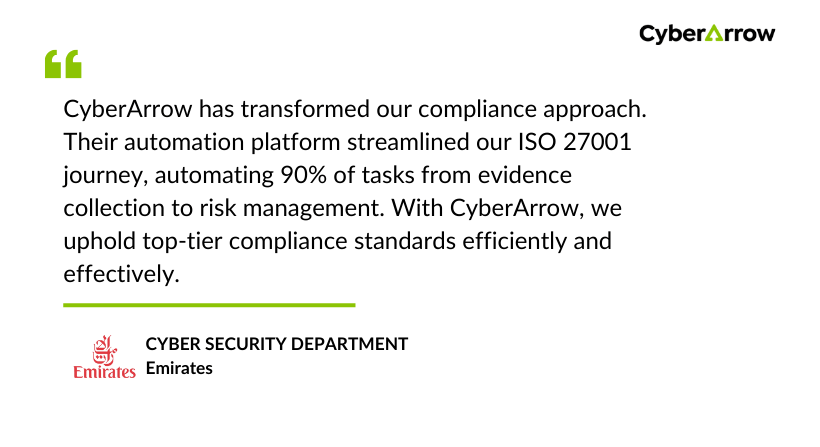
Read how Emirates enhanced Information Security by automating ISO 27001 with CyberArrow.
See what Emirates has to say about CyberArrow GRC:
Final thoughts: Achieve global security excellence with CyberArrow GRC
Achieving ISO 27001 certification shows the world that your company takes information security seriously. But manual work can slow you down. With the right automation platform, you can streamline every step from risk assessment to audit readiness and maintain compliance without stress.
CyberArrow GRC is one of the most advanced platforms designed for ISO 27001 GRC automation. It helps organizations automate up to 90 percent of the work required for certification. From policy management and risk tracking to continuous monitoring and audit reporting, everything happens inside one unified system.
By using CyberArrow GRC, you save time, stay audit-ready year-round, and strengthen your global security posture. The result is faster certification, higher efficiency, and a proven commitment to data protection.
If your goal is to achieve ISO 27001 certification and maintain it with confidence, start your journey with CyberArrow GRC today and experience what true automation can do for your compliance success.
FAQs
What is ISO 27001 GRC automation?
ISO 27001 GRC automation means using software to manage governance, risk, and compliance tasks for ISO 27001 certification. It helps automate evidence collection, policy management, and risk tracking so businesses can stay audit-ready and save time.
How does automation help with ISO 27001 certification?
Automation reduces manual work, tracks progress, and ensures that every control and policy is in place. It provides dashboards, reminders, and reports that make the audit process faster and easier while improving accuracy and consistency.
Why should companies use CyberArrow GRC for ISO 27001 automation?
CyberArrow GRC helps automate up to 90% of the ISO 27001 process. It offers templates, risk libraries, and real-time dashboards that keep your organization compliant and ready for certification audits. It saves time, reduces errors, and strengthens your overall security program.
