

GDPR GRC automation: The ultimate checklist for European data protection
Data is the new currency of the digital world. Every business collects, stores, and processes customer information, from contact details to payment data. With this power comes a major responsibility: keeping that data safe.
The European Union created the General Data Protection Regulation (GDPR) to ensure that all organizations protect personal information responsibly. Companies that fail to follow GDPR can face massive fines and reputation damage.
Yet many businesses still struggle to manage the complex rules and documentation needed for compliance. This is where GDPR GRC automation becomes essential.
In this guide, we’ll explore what GDPR automation means, why it matters, and provide a complete checklist to help you achieve and maintain compliance easily.
- What is GDPR GRC automation?
- Why GDPR compliance is crucial for businesses
- Why automation is the smart way forward
- The ultimate GDPR GRC automation checklist
- 1. Identify and classify personal data
- 2. Define data processing activities
- 3. Establish a lawful basis for processing
- 4. Manage user consent
- 5. Conduct Data Protection Impact Assessments (DPIAs)
- 6. Implement and monitor security controls
- 7. Manage third-party vendors
- 8. Maintain data subject rights requests
- 9. Train employees on GDPR policies
- 10. Monitor and report incidents
- 11. Review and update policies regularly
- 12. Conduct regular audits and continuous improvement
- Key benefits of GDPR GRC automation
- Conclusion: Simplify GDPR compliance with CyberArrow GRC
- FAQs
What is GDPR GRC automation?
GDPR GRC automation means using technology to manage governance, risk, and compliance activities required under the GDPR law.
Instead of manually tracking consent records, risk assessments, and policies across spreadsheets, automation centralizes all your compliance processes in one place.
A GRC platform helps you monitor risks, track user consents, manage data protection policies, and prepare audit reports automatically. It ensures that your business stays compliant without spending endless hours on manual documentation.
Why GDPR compliance is crucial for businesses
GDPR applies to any organization that handles the personal data of EU citizens, even if the company is outside Europe. It protects how data is collected, processed, stored, and shared.
Non-compliance can lead to fines of up to €20 million or 4% of global annual turnover, whichever is higher. Beyond the penalties, failure to comply can destroy customer trust.
With strict regulations and growing public awareness, businesses must show transparency and accountability in how they handle data. GDPR compliance is not just a legal requirement; it is a business advantage that builds trust with clients and partners.
Why automation is the smart way forward
Managing GDPR manually can be overwhelming. There are dozens of documentation requirements, policies, and ongoing audits to maintain. Manual work often leads to errors, delays, and incomplete records.
Automation makes compliance simpler, faster, and more reliable. With an automated GRC tool, you can:
- Track all data processing activities in one dashboard.
- Generate reports for regulators in minutes.
- Monitor risks and assign remediation tasks automatically.
- Keep your policies, records, and training up to date.
Automation not only reduces workload but also strengthens your company’s ability to prove compliance at any time.
The ultimate GDPR GRC automation checklist
Here’s a complete step-by-step checklist to help your organization achieve GDPR compliance using automation effectively.
1. Identify and classify personal data
Start by mapping all personal data your organization collects. This includes customer names, email addresses, financial information, or employee records.
With automation, you can scan databases, CRM systems, and cloud storage to automatically detect and classify personal data. This saves time and ensures nothing is missed during data inventory creation.
2. Define data processing activities
GDPR requires organizations to keep detailed records of how data is processed, who processes it, and for what purpose.
A GRC automation system can automatically create and update your Record of Processing Activities (RoPA), linking each activity with its purpose, lawful basis, and retention period.
3. Establish a lawful basis for processing
Every time your organization collects personal data, it must have a lawful reason for doing so. These include consent, contract, legal obligation, vital interest, public task, or legitimate interest.
Automation tools help track the lawful basis for each dataset and ensure that new processes cannot start without proper justification. This reduces compliance gaps and protects against data misuse.
4. Manage user consent
Consent management is one of the most important parts of GDPR. You must be able to show proof that users gave permission for their data to be used.
An automated GRC platform can manage consent forms, store timestamps, and update records when users withdraw consent. It also ensures all marketing tools and websites stay synchronized with consent settings.
5. Conduct Data Protection Impact Assessments (DPIAs)
A DPIA is required whenever a data processing activity could pose high risks to individual privacy.
Automation makes this process simple by providing templates, risk scoring, and automated approval workflows. The system guides you through each question, assigns reviewers, and stores results for auditors.
6. Implement and monitor security controls
GDPR requires strong technical and organizational measures to protect personal data. This includes encryption, access controls, and incident management.
Automation platforms integrate with your existing security systems to monitor controls continuously. If a vulnerability appears or a control fails, the system alerts your team immediately and logs the event for review.
7. Manage third-party vendors
If you share data with third-party processors such as cloud providers or marketing agencies, GDPR makes you responsible for their compliance too.
Automation tools track all vendors, their contracts, and their compliance status. They also send reminders for contract renewals and automatically record any data-sharing activities.
8. Maintain data subject rights requests
GDPR gives individuals several rights, including:
- Right to access their data.
- Right to correct errors.
- Right to delete data.
- Right to restrict or object to processing.
Automation makes handling these requests much faster. A GRC system can receive, log, assign, and track requests automatically, ensuring that each one is handled within the legal deadline.
9. Train employees on GDPR policies
Employees are often the weakest link in data protection. Regular training is essential to keep everyone aware of their responsibilities.
An automated GRC platform can assign training courses, track completion, and remind users when refreshers are due. It also stores completion certificates for compliance proof during audits.
10. Monitor and report incidents
Data breaches must be reported to authorities within 72 hours under GDPR. Having an automated system ensures you never miss that window.
The platform logs incidents, notifies the right teams, and creates a timeline of events. It also generates reports ready for submission to regulators, saving time and reducing human error during stressful situations.
11. Review and update policies regularly
GDPR compliance is an ongoing process. Your policies must evolve with changes in your business operations or legal requirements.
Automation helps track policy expiration dates, version history, and review cycles. It also sends alerts when a document is due for review or employee acknowledgment.
12. Conduct regular audits and continuous improvement
To maintain compliance, organizations must perform regular internal audits.
Automation simplifies this by scheduling audits, recording findings, and tracking corrective actions. The system provides a full audit trail, making external audits faster and less disruptive.
Key benefits of GDPR GRC automation
Implementing GDPR GRC automation offers multiple advantages beyond compliance:
- Time savings: Automates repetitive documentation and reporting tasks.
- Improved accuracy: Reduces human error by standardizing workflows.
- Centralized management: Keeps all compliance activities, evidence, and policies in one platform.
- Faster audits: Prepares you for inspections and certifications with minimal effort.
- Enhanced trust: Shows clients and partners that you prioritize data protection and transparency.
By replacing spreadsheets and manual checklists with an intelligent system, your compliance program becomes more reliable and efficient.
Conclusion: Simplify GDPR compliance with CyberArrow GRC
Achieving and maintaining GDPR compliance can seem complex, but automation changes everything. It allows you to handle privacy regulations efficiently, reduce risks, and build stronger customer trust.
CyberArrow GRC is designed to make this process seamless. It helps automate up to 90 percent of your GDPR compliance tasks, from consent management and risk assessments to policy tracking and audit readiness.
With CyberArrow GRC, organizations can manage all their data protection obligations inside one secure platform. The result is faster compliance, reduced manual effort, and a stronger reputation for privacy and trust.
If your business operates in or serves the European market, now is the perfect time to take control of data protection.
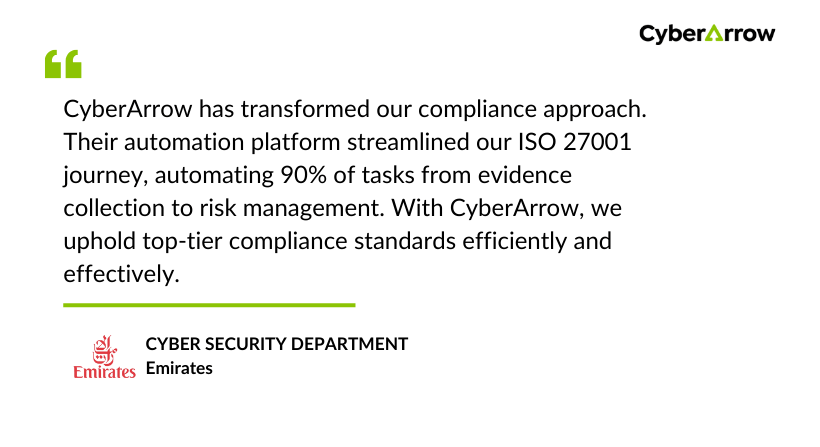
See what our clients have to say about CyberArrow GRC:
Choose CyberArrow GRC to simplify GDPR compliance and safeguard your customers’ trust for the long term.
FAQs
What is GDPR GRC automation?
GDPR GRC automation uses software to manage governance, risk, and compliance tasks for GDPR requirements. It automates data mapping, consent tracking, and reporting so organizations stay compliant with less manual work.
How does automation help with GDPR compliance?
Automation centralizes all GDPR processes in one platform. It tracks risks, manages data subject requests, updates policies, and creates audit reports automatically. This saves time and keeps records accurate and audit-ready.
Why choose CyberArrow GRC for GDPR automation?
CyberArrow GRC automates up to 90 percent of GDPR tasks. It handles consent management, risk assessments, and policy tracking in one secure system, helping companies stay compliant and build trust with customers across Europe.
