


SOC 2 GRC automation: The ultimate checklist for sealing enterprise SaaS deals
In the world of SaaS, trust is everything. Companies that handle sensitive customer data must prove they can keep it secure. When potential clients, especially large enterprises, review your product, one of the first questions they ask is: “Are you SOC 2 compliant?”
SOC 2 certification has become the golden standard for security assurance in the SaaS industry. It shows that your company has strong controls around data privacy, security, and reliability. But the certification path is not always simple. Manual processes can make it slow, costly, and difficult to manage.
By automating governance, risk, and compliance (GRC) workflows, organizations can achieve certification faster, maintain it with less effort, and win enterprise clients more confidently.
This guide breaks down everything you need to know about SOC 2 automation and gives you a complete checklist to help your SaaS business seal more deals with ease.
- What is SOC 2 GRC automation?
- Why SOC 2 matters for enterprise SaaS deals
- The ultimate SOC 2 GRC automation checklist
- 1. Understand SOC 2 requirements
- 2. Define the scope of your audit
- 3. Conduct a readiness assessment
- 4. Create and document policies
- 5. Implement technical and administrative controls
- 6. Build a risk management framework
- 7. Track employee training and awareness
- 8. Perform internal audits
- 9. Collect and manage evidence automatically
- 10. Conduct the external audit
- 11. Maintain Continuous Compliance
- 12. Use SOC 2 certification as a sales advantage
- The benefits of SOC 2 GRC automation for SaaS companies
- Conclusion: Seal enterprise deals faster with CyberArrow GRC
- FAQs
What is SOC 2 GRC automation?
SOC 2 GRC automation means using software tools to manage all the governance, risk, and compliance processes required for SOC 2 certification.
Instead of managing policies, evidence, and risk reports through spreadsheets and emails, automation brings everything into one centralized system. The platform automatically collects evidence, monitors controls, tracks compliance tasks, and prepares you for external audits.
For growing SaaS companies, this automation saves hundreds of hours and prevents human errors that often delay certification.
Why SOC 2 matters for enterprise SaaS deals
When large enterprises buy SaaS products, they are not only paying for features. They are trusting your company with their data. SOC 2 certification acts as proof that your company follows strict data protection standards.
Without it, most enterprise clients will not even consider signing a contract. SOC 2 compliance can be the difference between closing a major deal and losing it to a competitor who can prove their trustworthiness.
By combining certification with automation, SaaS businesses can achieve compliance faster and use it as a powerful sales advantage.
The ultimate SOC 2 GRC automation checklist
To make the process easier, here is a complete step-by-step checklist that will help your company prepare for SOC 2 certification through automation.
1. Understand SOC 2 requirements
SOC 2 is based on five Trust Services Criteria:
- Security
- Availability
- Processing Integrity
- Confidentiality
- Privacy
Every organization must meet the security criteria, while the others depend on your services. Begin by understanding which criteria apply to your company and your clients’ expectations.
Automation tools often include pre-built templates for SOC 2 controls, which help you identify what applies to your environment and what needs to be implemented.
2. Define the scope of your audit
Clearly define what systems, applications, and data fall within your SOC 2 audit scope. This includes your cloud platforms, databases, access systems, and third-party integrations.
Automation platforms can help visualize and map the entire environment, ensuring you do not miss critical systems during the audit.
3. Conduct a readiness assessment
Before you start the official audit, perform a readiness assessment. This is like a practice run to identify any control gaps or weaknesses.
A GRC automation system can run built-in gap assessments, compare your current security posture against SOC 2 requirements, and provide clear reports highlighting what needs to be fixed before the official audit begins.
4. Create and document policies
Policies are the foundation of SOC 2 compliance. They define how your company manages data, security, and employee behavior.
Examples include:
- Access control policy.
- Change management policy.
- Incident response policy.
- Vendor management policy.
Automation tools make this simple by offering ready-made policy templates that can be customized. They also handle version control, approval workflows, and employee acknowledgment tracking.
5. Implement technical and administrative controls
Once your policies are in place, it’s time to enforce them. Implement security controls such as:
- Multi-factor authentication.
- Regular vulnerability scans.
- System monitoring.
- Encryption for sensitive data.
Automation helps monitor these controls continuously. It can integrate with your cloud services, identity systems, and monitoring tools to collect data and generate compliance evidence automatically.
6. Build a risk management framework
SOC 2 requires organizations to identify, assess, and manage risks that could impact data security or availability.
Automation makes this easier through centralized risk registers, scoring models, and automatic task assignments. Every risk can be tracked from identification to mitigation, ensuring accountability and visibility across the company.
7. Track employee training and awareness
Human error is one of the biggest security risks. SOC 2 expects companies to train employees on policies, data handling, and incident reporting.
With automation, you can assign training modules, send reminders, and record completions automatically. The system stores all evidence so you can show auditors that training was completed by every employee.
8. Perform internal audits
Internal audits are a key part of SOC 2 preparation. They ensure your processes and controls are functioning as intended before the external auditor arrives.
GRC automation tools simplify this process by scheduling audits, managing findings, and tracking remediation steps. This keeps your audit program consistent and reduces preparation time.
9. Collect and manage evidence automatically
The most time-consuming part of SOC 2 compliance is collecting audit evidence. Automation solves this problem by connecting directly to your systems and pulling the required data automatically.
For example, it can capture access logs, change history, incident records, and backup reports in real time. The collected evidence is securely stored, organized, and ready for auditor review whenever needed.
10. Conduct the external audit
Once your organization is ready, it’s time for the official audit. The external auditor reviews your controls, evidence, and processes to confirm compliance.
Because automation keeps everything documented and up to date, this stage becomes much smoother. You can share evidence securely, answer auditor questions faster, and minimize business disruption during the audit.
Quick link: SOX 404 requirements explained
11. Maintain Continuous Compliance
SOC 2 certification is valid for a year, but compliance should never stop after the audit.
Automation platforms continuously monitor your controls, track updates, and alert you to issues. They help your team stay compliant at all times instead of scrambling for renewal preparation each year. This proactive approach builds long-term trust with enterprise clients.
12. Use SOC 2 certification as a sales advantage
Once certified, promote your SOC 2 status confidently. It proves that your company values data protection and follows best practices.
When you integrate this into your sales and marketing process, it gives clients peace of mind and positions your company as a reliable SaaS partner. Many GRC tools also help generate executive-level reports you can share with prospects to demonstrate compliance maturity.
The benefits of SOC 2 GRC automation for SaaS companies
Implementing SOC 2 GRC automation brings a wide range of business benefits that go far beyond certification.
- Faster time to compliance: Automation reduces manual work and keeps documentation up to date.
- Audit readiness year-round: Always have evidence available for auditors or clients.
- Reduced human error: Automated data collection prevents mistakes that could lead to audit findings.
- Centralized control: Manage all compliance activities from a single dashboard.
- Improved customer trust: Show clients that your systems and data are secure.
- Easier scaling: As your company grows, automation adapts to new teams, regions, and systems effortlessly.
In today’s competitive SaaS market, compliance automation is not just a technical upgrade. It is a strategic advantage that builds credibility and accelerates sales.
Conclusion: Seal enterprise deals faster with CyberArrow GRC
SOC 2 compliance proves your business is secure, reliable, and enterprise-ready. But achieving it manually can slow down your growth. The smarter path is automation.
CyberArrow GRC makes the entire SOC 2 journey easier by automating up to 90 percent of the work. It simplifies risk assessments, policy management, evidence collection, and audit preparation inside one unified platform.
With real-time dashboards, automated workflows, and built-in frameworks, CyberArrow GRC helps SaaS companies reach certification faster and stay compliant continuously. It turns compliance from a challenge into a competitive strength.
If your goal is to close enterprise SaaS deals faster and earn long-term trust, start your SOC 2 GRC automation journey today with CyberArrow GRC, your trusted partner for secure, seamless, and scalable compliance.
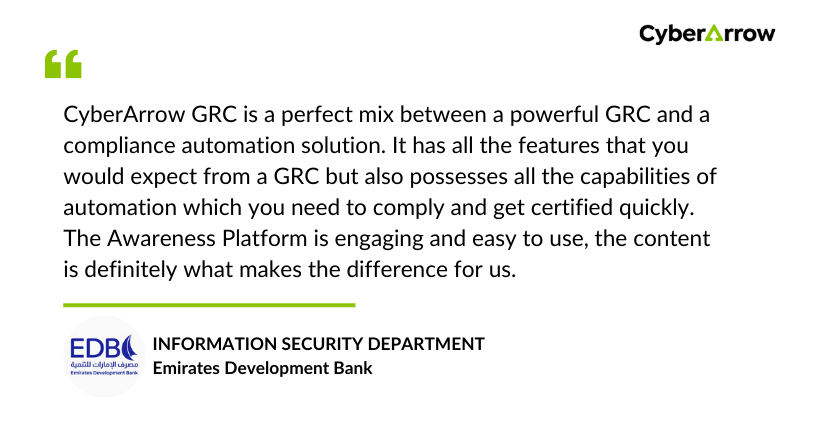
See what our clients have to say about CyberArrow GRC:
FAQs
What is SOC 2 GRC automation?
SOC 2 GRC automation is the use of software to manage governance, risk, and compliance tasks for SOC 2 certification. It automates policy tracking, evidence collection, and audits so SaaS companies can stay compliant with less manual work.
How does automation help SaaS companies achieve SOC 2 compliance?
Automation replaces spreadsheets and manual tracking with a central platform. It monitors controls, gathers audit evidence, and keeps records ready for review. This reduces effort, saves time, and helps companies achieve SOC 2 certification faster.
Why choose CyberArrow GRC for SOC 2 automation?
CyberArrow GRC helps SaaS companies automate up to 90 percent of the SOC 2 process. It simplifies risk assessments, policy management, and audit preparation inside one platform. The result is faster certification and greater trust with enterprise clients.
