

CIA in cyber security and how organizations apply the CIA triad
Cyber security decisions often fail not because organizations lack tools, but because they lack a clear way to decide what actually needs protection and why. When security controls are implemented without a guiding framework, teams either overprotect low-risk systems or leave critical assets exposed.
Here, the CIA in cyber security can help. Confidentiality, integrity, and availability provide a simple but powerful lens for designing security controls, assessing risks, and meeting compliance expectations.
Rather than focusing on specific technologies, the CIA model helps organizations think clearly about how information should be protected and how systems should behave under normal and adverse conditions.
This article explains the CIA triad and, more importantly, how organizations apply it in real environments.
Understanding the CIA triad in cyber security
The CIA triad is a foundational security model used to guide how information and systems are protected. It does not prescribe tools or technologies. Instead, it defines three security outcomes that every organization should aim to achieve.
- Confidentiality focuses on who can access information.
- Integrity focuses on whether information can be trusted.
- Availability focuses on whether systems and data are accessible when needed.
Most security risks, incidents, and cyber security audit findings can be traced back to a failure in one or more of these three areas.
1. Confidentiality in cyber security
Confidentiality ensures that sensitive information is accessible only to authorized individuals, systems, or processes. In practice, confidentiality failures occur when data is exposed to the wrong audience. This could include employees accessing information outside their role, attackers exploiting weak authentication, or third parties receiving more access than necessary.
Common confidentiality controls include:
- User access management based on roles and responsibilities.
- Strong authentication methods, such as multi-factor authentication.
- Data classification to identify what information requires stronger protection.
- Encryption for data stored or transmitted across networks.
2. Integrity in cyber security
Integrity ensures that information remains accurate, complete, and unaltered unless changes are authorized. Integrity issues often go unnoticed because data may still be accessible and systems may still function. However, incorrect or manipulated data can cause serious operational, financial, and compliance problems.
Integrity controls focus on preventing unauthorized changes and detecting errors quickly. These include:
- Change management processes for systems and configurations.
- Logging and audit trails that record who changed what and when.
- Approval workflows for critical data and system updates.
- Validation mechanisms to detect unauthorized or unexpected modifications.
3. Availability in cyber security
Availability ensures that systems, applications, and data remain accessible when the business needs them. Availability failures include system outages, ransomware incidents, denial-of-service attacks, and operational disruptions caused by misconfigurations or unplanned changes.
Controls that support availability include:
- Redundancy and failover mechanisms.
- Regular backups and tested recovery procedures.
- Monitoring to detect performance issues early.
- Incident response planning to restore services quickly.
How organizations can implement the CIA in cyber security
Implementing the CIA in cyber security effectively requires translating abstract principles into operational decisions. Organizations that succeed treat the CIA triad as part of their governance and risk processes, not as a one-time security exercise.
Quick link: How to develop a strong cyber security strategy?
1. Identify what truly matters
Mapping assets to business impact clarifies where each CIA element carries the most weight. Identify the systems, data, and processes that support critical business activities. Not all assets require the same level of protection.
For example:
- Customer databases may demand strong confidentiality and integrity.
- Financial reporting systems require high integrity and availability.
- Public-facing services may prioritize availability over strict confidentiality.
2. Define CIA priorities for each asset
For each critical asset, explicitly document which CIA element is most important and why. This avoids conflicting security decisions later.
An internal HR system may prioritize confidentiality, while a production control system may prioritize availability. Making these priorities explicit helps teams design appropriate controls instead of applying generic security measures everywhere.
3. Design controls around real workflows
Controls should align with how people actually work. Overly restrictive controls often lead to workarounds that undermine security. Security controls should support the business, not obstruct it.
- For confidentiality, this means granting access based on real job responsibilities rather than broad departments.
- For integrity, it means embedding approvals and validation into existing operational processes.
- For availability, it means planning maintenance, updates, and monitoring around business hours and operational cycles.
4. Embed CIA into risk assessments
Risk assessments become far more effective when risks are evaluated through the CIA lens.
Instead of asking whether a system is secure, assess:
- What happens if confidentiality is breached?
- What happens if data integrity is compromised?
- What happens if the system becomes unavailable?
This approach produces clearer risk statements and more actionable remediation plans.
5. Monitor and review continuously
CIA priorities change as systems evolve, new integrations are added, and business models shift. Controls that were appropriate last year may no longer be sufficient.
Regular reviews ensure that confidentiality, integrity, and availability controls remain aligned with current operations and risk exposure.
Quick link: Cyber security monitoring for businesses
CIA triad and compliance standards
Many security and compliance standards are built on CIA principles, even if they do not reference the model explicitly. Some of them include the following:
- ISO 27001 emphasizes confidentiality, integrity, and availability through its risk-based control framework.
- SOC 2 Trust Services Criteria directly align with these principles.
- NIST frameworks use CIA concepts when defining security objectives and control categories.
Applying the CIA triad makes it easier to align security practices with compliance requirements and demonstrate intent during audits.
Strengthen CIA-aligned security practices with CyberArrow
CyberArrow supports organizations in managing security controls that align with confidentiality, integrity, and availability requirements by helping teams:
- Map security controls to standards such as ISO 27001 and SOC 2.
- Track compliance risks related to data access, system changes, and service availability.
- Maintain centralized, audit-ready evidence for security reviews.
- Monitor control, ownership, and implementation status.
- Support ongoing security governance without manual tracking.
Book a free demo with CyberArrow to see how you can apply CIA in cyber security principles and controls across your security and compliance workflows with less manual effort.
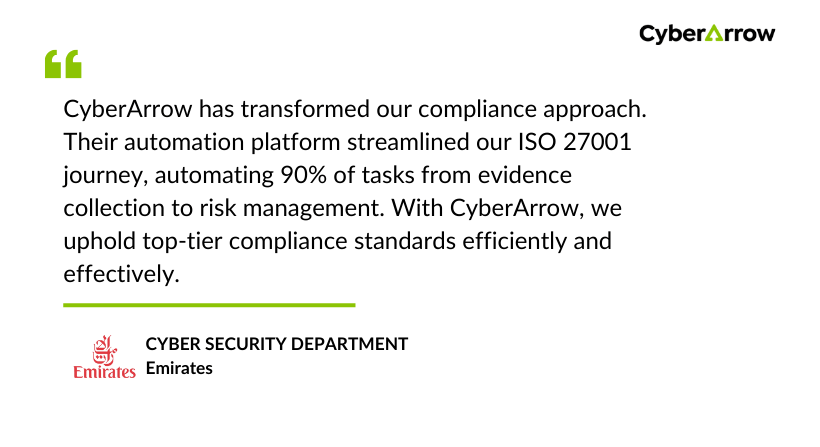
See what our clients have to say about CyberArrow GRC:
FAQs
What does CIA stand for in cyber security?
CIA stands for confidentiality, integrity, and availability. These three principles describe how information and systems should be protected.
Is the CIA triad still relevant today?
Yes. Despite technological changes, most security risks still affect confidentiality, integrity, availability, or a combination of the three.
How does the CIA triad support risk management?
It provides a structured way to evaluate the impact of risks and prioritize controls based on business needs.
Can the CIA triad be applied to cloud and SaaS environments?
Yes. CIA principles apply equally to on-premises, cloud, and SaaS systems, though the controls used may differ across them.
