SOC analyst: Career, roles, and salary guide
Are you interested in a career in cyber security? With the rise in cyber threats, the role of a SOC analyst (Security Operations Center analyst) is one of the most sought-after positions in the cyber security field. SOC analysts are on the front lines of defense against cyberattacks, protecting an organization’s digital assets, data, and systems from malicious activities.
This guide will cover everything you need to know about a SOC analyst’s career, roles, skills, and salary expectations.
- What is a SOC analyst?
- Why is the role of a SOC analyst important?
- SOC analyst career path
- Essential skills for a SOC analyst
- Roles and responsibilities of a SOC analyst
- SOC analyst salary guide
- Steps to become a SOC Analyst
- Tools used by SOC analysts
- Career growth opportunities for SOC analysts
- How CyberArrow GRC helps SOC analysts
What is a SOC analyst?
A SOC analyst is a cyber security professional responsible for monitoring, detecting, analyzing, and responding to cyber security incidents. Working in the Security Operations Center (SOC), these experts protect an organization’s networks and systems, ensuring no malicious activities go undetected. SOC analysts are often the first line of defense, identifying potential threats and mitigating them before they cause harm.
Their job involves constant vigilance and quick action to safeguard sensitive data and systems, making this role crucial in today’s digital age.
Why is the role of a SOC analyst important?
With more organizations relying on digital solutions, cyber threats are at an all-time high. Data breaches, malware, ransomware, and phishing attacks can disrupt business operations and lead to significant financial and reputational losses. SOC analysts play a critical role in preventing these threats from impacting an organization.
Some key reasons why SOC analysts are essential include:
- Constant threat monitoring: SOC analysts monitor systems 24/7 to identify unusual or suspicious activities.
- Quick response to incidents: They respond quickly to security incidents, minimizing potential damages.
- Protection of sensitive data: SOC analysts help protect valuable data from being compromised by malicious actors.
- Support for business continuity: By preventing cyberattacks, SOC analysts help ensure business operations can continue smoothly.
Quick link: Cyber security analyst salary guide
SOC analyst career path
The career path for a SOC analyst often starts with entry-level positions, leading to more senior and specialized roles as one gains experience and expertise. Here’s a breakdown of the typical SOC analyst career progression:
- Junior SOC analyst (Entry-level):
- Junior SOC analysts are responsible for monitoring alerts, analyzing security events, and assisting in incident response.
- This role is perfect for beginners with foundational cyber security knowledge.
- SOC analyst (Mid-level):
- At this stage, SOC analysts handle more complex security events, conduct deeper analysis, and work closely with other IT and security teams.
- They may also assist in creating security policies and incident response plans.
- Senior SOC analyst (Advanced level):
- Senior SOC analysts are experienced professionals who lead incident response efforts, mentor junior analysts, and analyze advanced threats.
- They are also involved in threat hunting, a proactive approach to finding hidden threats in a network.
- SOC manager/lead:
- SOC managers lead the SOC team, manage security policies, oversee daily operations, and coordinate incident response.
- This role requires a strong background in cyber security and management skills.
- Cyber security specialist (Advanced):
- After gaining experience as a SOC manager, one can move into specialized cyber security roles, like a cyber security architect, penetration tester, or threat intelligence analyst.
Essential skills for a SOC analyst
A SOC analyst needs a mix of technical and analytical skills to perform their job effectively. Here are some essential skills:
- Cyber security fundamentals: SOC analysts should understand key cyber security principles, including network security, malware types, and attack vectors.
- Knowledge of security tools: Proficiency with tools like SIEM (Security Information and Event Management) systems, firewalls, antivirus software, and intrusion detection/prevention systems.
- Analytical skills: SOC analysts need strong analytical abilities to assess security data, identify threats, and make quick decisions.
- Threat intelligence: Understanding threat intelligence helps SOC analysts recognize new and emerging threats, enhancing their response capabilities.
- Incident response: This includes procedures for handling and containing security incidents to minimize damage.
- Communication skills: SOC analysts must communicate security incidents and solutions clearly to IT teams, management, and non-technical staff.
Roles and responsibilities of a SOC analyst
SOC analysts have a wide range of responsibilities to keep an organization safe from cyber threats. Here’s what a typical SOC analyst does daily:
Monitoring security alerts
SOC analysts use security tools to monitor network traffic, identify suspicious activity, and respond to alerts from various systems.
Investigating security incidents
When a potential threat is detected, SOC analysts investigate the incident, determining its source, nature, and potential impact.
Analyzing threats and vulnerabilities
SOC analysts assess vulnerabilities in the system and work to understand the methods used by attackers to prevent future incidents.
Implementing incident response
SOC analysts follow incident response plans to contain, mitigate, and resolve security incidents promptly.
Conducting threat hunting
Experienced SOC analysts engage in proactive threat hunting, searching for undetected threats within the network to enhance overall security.
Documenting and reporting
SOC analysts document security incidents and create reports to help management understand current security risks and responses.
Continuous learning and improvement
Cyber threats evolve constantly, so SOC analysts must stay updated on the latest trends, attack techniques, and defense strategies.
Quick link: GRC analyst: Career, roles & salary guide
SOC analyst salary guide
The salary for a SOC analyst varies based on factors like experience, education, location, and company size. Here’s a general overview of SOC analyst salaries in the U.S.:
- Junior SOC analyst: $55,000 – $70,000 per year
- Mid-level SOC analyst: $70,000 – $90,000 per year
- Senior SOC analyst: $90,000 – $120,000 per year
- SOC manager/lead: $120,000 – $150,000+ per year
SOC analysts in high-demand cities or industries, like finance or healthcare, may earn even higher salaries due to the increased need for cyber security.
Steps to become a SOC Analyst
If you’re interested in becoming a SOC analyst, here’s a step-by-step guide to get started:
- Build a strong IT foundation: Learn the basics of IT, including networking, operating systems, and basic cyber security principles.
- Obtain relevant education: A degree in cyber security, computer science, or a related field is often required for SOC analyst roles.
- Gain practical experience: Entry-level IT or security roles, like help desk support, can help you gain practical experience and skills.
- Get certified: Certifications like CompTIA Security+, Certified SOC Analyst (CSA), and GIAC Security Essentials (GSEC) can make you a stronger candidate for SOC analyst positions.
- Develop technical skills: Learn how to use security tools like SIEM, intrusion detection systems (IDS), and firewall software.
- Stay updated on cyber security trends: cyber security is constantly changing, so staying informed about the latest trends, attacks, and technologies is crucial.
- Apply for SOC analyst roles: Once you have the necessary skills and experience, start applying for junior SOC analyst positions. Many organizations offer training programs to help new analysts grow.
Tools used by SOC analysts
SOC analysts use various tools to detect, analyze, and respond to security incidents. Here are some essential tools:
- SIEM systems: These systems gather and analyze security data, providing alerts for potential threats.
- Intrusion detection and prevention systems (IDPS): IDPS tools monitor network traffic for suspicious activity and can block malicious actions.
- Firewall management tools: Firewalls are essential for controlling traffic, and management tools allow SOC analysts to configure firewall rules effectively.
- Endpoint detection and response (EDR): EDR tools detect threats on endpoint devices like laptops and smartphones.
- Threat intelligence platforms: These tools collect data on known threats, helping SOC analysts stay informed about emerging cyber risks.
Quick link: CyberArrow GRC Platform takes the lead at LEAP 2024
Career growth opportunities for SOC analysts
SOC analysts have a range of career advancement opportunities. With experience, SOC analysts can move into senior or specialized roles such as:
- SOC manager/lead: Overseeing SOC operations and leading teams.
- Threat intelligence analyst: Focusing on understanding and anticipating cyber threats.
- Incident response specialist: Specializing in responding to complex security incidents.
- Cyber security engineer: Building and maintaining an organization’s security infrastructure.
- Cyber security consultant: Advising organizations on best security practices.
SOC analysts can choose to specialize in specific cyber security areas or advance into management roles, making it a dynamic and rewarding career path.
How CyberArrow GRC helps SOC analysts
SOC analysts have a challenging job, requiring constant attention to security threats, quick incident response, and ongoing learning. CyberArrow GRC can make their work easier by providing a centralized platform for governance, risk management, and compliance.
Here’s how CyberArrow GRC supports SOC analysts:
- Centralized risk management: CyberArrow GRC offers a unified dashboard where SOC analysts can monitor and manage risks efficiently.
- Automated compliance tracking: With CyberArrow GRC, SOC analysts can ensure that all security measures align with industry regulations, reducing manual compliance checks.
- Threat detection and reporting: CyberArrow GRC helps SOC analysts by offering reporting tools that provide insights into security incidents, making it easier to communicate risks to management.
- Ongoing training and updates: CyberArrow GRC provides resources to help SOC analysts stay updated on cyber security trends and compliance standards.
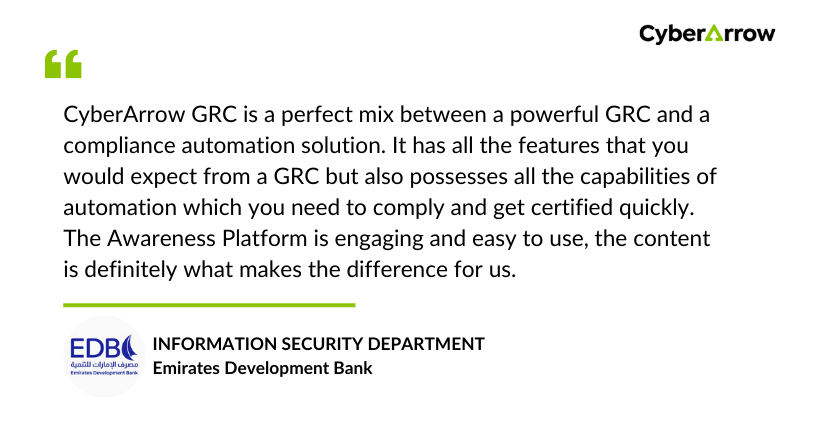
See what EDB has to say about CyberArrow GRC: