Why UAE IA matters for businesses in the UAE
The United Arab Emirates (UAE) is pioneering innovation while confronting significant security challenges. It has implemented the UAE IA regulation as its commitment to cyber security to address the imperative need for robust information security in the UAE.
Two-thirds (66%) of UAE respondents have reported one or more breaches within their organizations due to cyberattacks. These attacks stemmed primarily from Wi-Fi access points amidst the surge in remote work (41%), as well as third-party and supply chain providers (39%), IoT devices or networks (38%), and cloud infrastructure or applications (36%). They highlight the multifaceted challenges faced by businesses in securing sensitive information.
The UAE IA not only establishes minimum baseline requirements for in-scope entities but also mandates the adoption of comprehensive security controls, guiding government entities in establishing, implementing, maintaining, and continuously improving their information assurance.
This article explores why staying protected and compliant with UAE IA matters for businesses operating in this dynamic environment.
Regulatory landscape in the UAE
The United Arab Emirates (UAE) has strategically positioned itself at the forefront of cyber security through a comprehensive framework of Information Assurance (IA) regulations. These regulations serve as a foundation for ensuring the secure and resilient functioning of the nation’s critical information infrastructure.
Covering a spectrum of industries and sectors, the IA regulations outline the minimum baseline requirements that entities must adhere to in order to safeguard sensitive information from cyber threats.
Key government entities responsible for IA regulations
The implementation and enforcement of Information Assurance regulations in the UAE fall under the purview of key government entities, with the Telecommunications Regulatory Authority (TRA) playing an essential role.
As the central regulatory body, the TRA oversees and guides entities in their compliance efforts, ensuring that IA measures are consistently applied and updated to meet the evolving cyber security landscape. Collaborations with other relevant governmental bodies further enhance the efficacy of IA regulations, fostering a holistic approach to cyber security across the UAE.
Evolution of IA regulations in the UAE
The evolution of IA regulations in the UAE reflects the government’s proactive stance in addressing emerging cyber security challenges. Over the years, these regulations have undergone iterative refinements to keep pace with technological advancements and the dynamic nature of cyber threats.
The UAE’s commitment to continuous improvement is evident in the periodic updates and enhancements made to the UAE IA framework, ensuring that businesses remain resilient in the face of evolving cyber risks. This adaptive approach underscores the government’s dedication to creating a secure digital environment for businesses and citizens.
Read about NCEMA 7000.
The significance of UAE IA for businesses in UAE
UAE IA provides a proactive defense against the growing spectrum of cyber threats.
It enables businesses to anticipate, identify, and mitigate potential risks before they escalate.
Following are some benefits of complying with the UAE IA regulations for businesses.
- Comprehensive risk management: UAE IA involves regular risk assessments, security audits, and vulnerability management. It ensures a comprehensive approach to risk management by addressing potential weaknesses in systems and processes.
- Protection of sensitive data: UAE IA helps businesses safeguard sensitive data through access controls and secure communication protocols. It prevents unauthorized access, manipulation, or disclosure of critical information.
- Resilience to diverse cyber attacks: IA measures establish resilience to various cyber attacks, including ransomware, phishing, and data breaches. Combining managerial and technical controls enhances the organization’s ability to withstand and recover from attacks.
- Proactive adaptation to technological changes: The UAE IA framework evolves with technological advancements and changing cyber threats. Businesses benefit from a proactive approach, staying ahead of emerging risks and vulnerabilities.
Learn more about UAE IA with our UAE IA compliance hub.
Best practices for businesses for implementing UAE IA
To fortify their Information Assurance (IA) posture and navigate the intricate landscape of cyber security, businesses in the United Arab Emirates (UAE) can adopt the following best practices:
1. Conducting regular risk assessments
Conducting risk assessments provides the following benefits:
- Proactive identification of vulnerabilities: Regular risk assessments enable businesses to identify potential vulnerabilities in their systems and processes proactively.
- Prioritization of threats: By prioritizing identified risks, organizations can allocate resources effectively to address the most critical threats first.
- Adaptive risk management: Implementing an adaptive risk management approach allows businesses to adjust strategies based on evolving cyber threats and business operations.
2. Implementing robust cyber security policies
Businesses should implement the following policies for robust cyber security:
- Comprehensive policy development: Crafting comprehensive cyber security policies provides a foundational framework for secure operations.
- Access controls and data encryption: Policies should address access controls, data encryption, and secure communication protocols to protect sensitive information.
- Incident response planning: Establishing clear incident response policies prepares businesses to manage and recover from security incidents effectively.
3. Investing in employee training and awareness
Businesses should invest in employee training and awareness to create a security-conscious culture.
- Building a security-conscious culture: Employee training and awareness initiatives contribute to building a security-conscious organizational culture.
- Recognition of social engineering tactics: Educated employees are better equipped to recognize and thwart social engineering tactics, such as phishing attacks.
- Informed incident reporting: Training empowers employees to play an active role in IA by promoting informed incident reporting and creating a collaborative defense against cyber threats.
Streamlining compliance: How EAD became UAE IA compliant with CyberArrow
In a rapid transition to UAE IA compliance, the Environment Agency Abu Dhabi (EAD) utilized the CyberArrow Compliance Automation Tool, streamlining processes and achieving remarkable results. Overcoming manual compliance challenges, EAD automated checklist monitoring, evidence collection, and risk assessments, achieving 100% compliance without manual efforts.
This transformative approach not only accelerated UAE IA compliance sixfold but also unlocked readiness for other standards, marking a paradigm shift towards efficiency, reduced costs, and future scalability for the Middle East’s largest environmental regulator.
Ready to get UAE IA compliant as EAD got with CyberArrow? Schedule a free demo today!
Download your free UAE IA checklist.
FAQs
What is the UAE IA standard?
The IA Regulation in the UAE offers both management and technical information security controls, denoted as “security controls.” These controls empower entities to set up, execute, uphold, and consistently enhance information assurance measures.
What are the requirements for the UAE IA Regulation?
The UAE Information Assurance (IA) Regulation mandates a comprehensive strategy for achieving information assurance, employing a risk-based approach. It outlines clear roles and responsibilities for stakeholders, provides a catalog of standard and specialized controls, and endorses a phased implementation to counteract threats incrementally.
Who should comply with the UAE IA Regulation?
Complying with the UAE IA Regulation is essential for all government and TRA-identified vital entities, as it forms a crucial part of the National Cyber Security Strategy and establishes standards for seamless integration across Sector and National platforms.
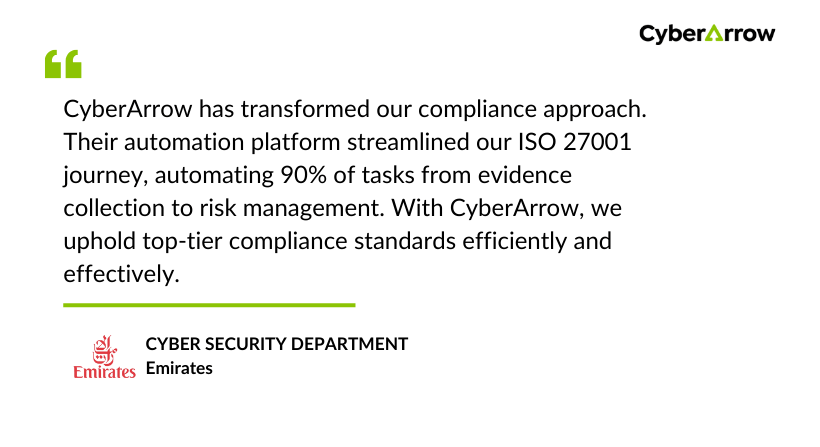
Read how Emirates enhanced Information Security by automating ISO 27001 with CyberArrow.
See what Emirates has to say about CyberArrow GRC: