


What is UAE Information Assurance Regulation? How to comply?
Cyber security is a growing concern worldwide, and the United Arab Emirates (UAE) has taken proactive steps to secure its digital landscape. One of the key regulations governing cyber security in the region is the UAE Information Assurance (IA) Regulation. This framework establishes a structured approach to information security management, helping organizations protect their systems and data from cyber threats.
Organizations operating in the UAE, particularly those in government and critical national infrastructure sectors, must comply with this regulation to ensure robust security measures. This guide provides an in-depth understanding of the UAE IA Regulation, including its key requirements, applicability, and steps to achieve compliance.
- What is the UAE Information Assurance Regulation?
- Key components of the UAE IA Regulation
- Who must comply with the UAE IA Regulation?
- Why is UAE IA compliance important?
- How to achieve compliance with the UAE IA Regulation?
- Automating UAE IA compliance with CyberArrow GRC
- Conclusion
- FAQs on UAE Information Assurance Regulation for financial institutions
What is the UAE Information Assurance Regulation?
The UAE IA Regulation is a national cyber security framework that defines a set of technical and management controls designed to enhance information security. It applies to organizations handling sensitive data and critical digital infrastructure, ensuring a uniform cyber security standard across industries.
This regulation aims to:
- Establish a comprehensive security framework for organizations handling sensitive data.
- Reduce cyber risks and vulnerabilities across industries.
- Strengthen national security and digital infrastructure resilience.
- Standardize risk management and compliance practices.
Key components of the UAE IA Regulation
The UAE IA Regulation consists of several core elements designed to help organizations develop a strong cyber security posture.
1. Security requirements
Organizations must implement security controls to protect their systems. These include:
- Access control: Ensuring that only authorized individuals can access critical systems.
- Data encryption: Securing sensitive information against unauthorized access.
- Network security: Implementing firewalls, intrusion detection systems, and anti-malware tools.
- Incident response: Preparing for and responding to security incidents effectively.
2. Risk management
A structured risk management approach is essential to identify and mitigate potential threats.
Organizations must:
- Conduct regular risk assessments to evaluate vulnerabilities.
- Implement mitigation strategies to address identified risks.
- Develop a risk management framework aligned with industry best practices.
3. Compliance framework
To ensure continuous compliance, organizations must:
- Perform compliance audits to assess adherence to UAE IA standards.
- Conduct regular security assessments to identify gaps in security controls.
- Maintain proper documentation of policies, risk assessments, and incident response plans.
Who must comply with the UAE IA Regulation?
The UAE IA Regulation applies to entities operating within critical national infrastructure and other sectors handling sensitive data.
Organizations required to comply include:
- Government agencies and public institutions.
- Private sector businesses in industries such as finance, telecommunications, and healthcare.
- Educational institutions handling large volumes of data.
- Critical infrastructure organizations in sectors like energy, utilities, transportation, and defense.
Failure to comply with UAE IA standards can result in financial penalties, reputational damage, and an increased risk of cyber incidents.
Why is UAE IA compliance important?
1. Strengthening cyber security resilience
The regulation ensures organizations implement effective security measures to protect sensitive data and digital assets.
2. Reducing cyber security threats
With cyber threats evolving, compliance with UAE IA standards helps organizations proactively defend against security breaches, ransomware, and data leaks.
3. Enhancing national security
By enforcing standardized cyber security controls, the regulation contributes to a secure and resilient digital ecosystem in the UAE.
4. Ensuring business continuity
A well-implemented security framework minimizes disruptions caused by cyber incidents, operational failures, and compliance violations.
How to achieve compliance with the UAE IA Regulation?
Organizations must follow a structured process to ensure compliance with UAE IA standards. The key steps include:
1. Conduct a risk assessment
- Identify critical assets and evaluate security risks.
- Assess the impact of potential cyber threats and vulnerabilities.
- Develop a risk management plan to address identified threats.
2. Implement security controls
- Apply technical security measures, including firewalls, access controls, and encryption.
- Develop cyber security policies and procedures for employees and third-party vendors.
- Implement continuous monitoring and threat detection tools.
3. Train employees on cyber security awareness
- Conduct regular cyber security training sessions.
- Educate employees on phishing attacks, password security, and social engineering threats.
- Establish a security-first culture to ensure compliance at all levels.
4. Conduct compliance audits
- Perform internal security assessments to identify potential gaps.
- Conduct annual compliance audits to ensure adherence to UAE IA standards.
- Keep records of policies, risk management reports, and audit findings.
5. Automate compliance management
Managing compliance manually can be time-consuming and complex. Organizations can simplify the process using automated compliance tools such as CyberArrow GRC.
Automating UAE IA compliance with CyberArrow GRC
Achieving and maintaining compliance with the UAE IA Regulation requires continuous monitoring, reporting, and risk assessment. Many organizations struggle with manual compliance processes, leading to inefficiencies and compliance gaps.
CyberArrow GRC is a specialized Governance, Risk, and Compliance (GRC) solution that automates the entire compliance lifecycle.
Key features of CyberArrow GRC for UAE IA compliance:
- Automated compliance monitoring: Real-time tracking of compliance status.
- Risk management tools: Identification and mitigation of cyber security risks.
- Audit & reporting automation: Generation of compliance reports for regulatory authorities.
- Cyber security awareness training: Employee training modules to reduce cyber risks.
- Efficient documentation management: Streamlining of compliance evidence collection.
With CyberArrow GRC, organizations can simplify the UAE IA compliance process, ensuring faster and more efficient implementation of security measures.
Conclusion
The UAE Information Assurance Regulation is a critical cyber security framework designed to protect sensitive data, reduce security risks, and enhance national resilience. Compliance with this regulation requires organizations to implement security controls, conduct risk assessments, provide cyber security training, and perform regular audits.
For organizations seeking an efficient and automated approach to UAE IA compliance, CyberArrow GRC offers a comprehensive solution. By leveraging automation, businesses can ensure continuous compliance, reduce cyber security risks, and enhance their overall security posture.
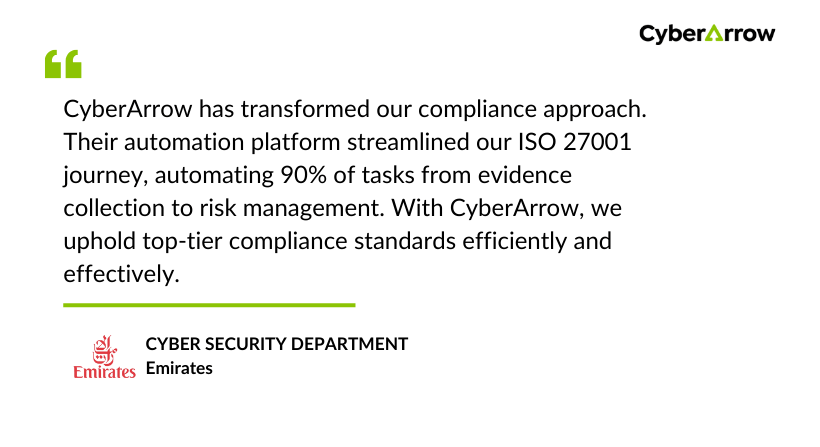
See what global clients has to say about CyberArrow GRC:
FAQs on UAE Information Assurance Regulation for financial institutions
1. Why is UAE IA compliance important for financial institutions?
Financial institutions handle sensitive customer data, financial transactions, and critical digital assets, making them prime targets for cyber threats. UAE IA compliance helps banks and financial organizations:
- Protect financial data from cyberattacks and fraud
- Ensure regulatory compliance to avoid penalties and reputational damage
- Strengthen risk management by implementing security controls
- Build customer trust by maintaining a secure banking environment
2. What are the key security requirements for financial institutions under UAE IA?
Financial institutions must implement strict cyber security measures to comply with UAE IA, including:
- Data encryption to protect customer and transaction information
- Access control to prevent unauthorized system access
- Fraud detection systems to monitor suspicious activities
- Incident response plans to quickly address security breaches
- Regular security audits to ensure continuous compliance
3. How can financial institutions automate UAE IA compliance?
Manual compliance management can be complex and time-consuming. Financial institutions can use CyberArrow GRC to:
- Automate compliance tracking and security audits
- Manage risk assessments with real-time monitoring
- Generate regulatory reports efficiently
- Train employees on cyber security awareness to prevent human errors
