What is security compliance? How CyberArrow GRC automates the process
In today’s digital world, cyber threats are everywhere, and organizations must work hard to protect sensitive data and maintain trust. Meeting industry standards and government regulations is essential for businesses to keep customer data safe, avoid penalties, and reduce risks. This is known as security compliance.
But achieving and maintaining security compliance can be tough, especially with constantly changing rules and complex systems. That’s where tools like CyberArrow GRC take the lead.
In this article, we’ll explain what security compliance is, why it matters, and how CyberArrow GRC can simplify the entire process.
What is security compliance?
Security compliance refers to following a set of rules, laws, and guidelines to keep data and systems secure. These rules can be set by government bodies, industry groups, or internal company policies. The goal of security compliance is to make sure organizations protect their sensitive data and minimize risks from data breaches and cyberattacks.
For example, an organization that handles health data must comply with regulations like HIPAA (Health Insurance Portability and Accountability Act) in the U.S. Similarly, companies dealing with customers in Europe must follow the GDPR (General Data Protection Regulation) to protect personal data.
Why is security compliance important?
Security compliance is crucial for several reasons:
1. Protects data and systems
Compliance ensures that your organization has security measures in place to protect sensitive information, such as customer data, financial details, and trade secrets.
2. Builds customer trust
When customers know their data is handled responsibly, they are more likely to trust your organization. Meeting compliance standards shows your commitment to protecting their privacy.
3. Avoids legal penalties
Failure to comply with industry regulations can lead to hefty fines, legal action, and reputational damage. Following the rules helps organizations avoid these costly consequences.
4. Reduces risk of cyber attacks
Compliance requires organizations to implement security measures that make it harder for cybercriminals to exploit vulnerabilities.
5. Boosts business reputation
Organizations that follow strict security standards gain a competitive edge, as clients, partners, and customers prefer working with companies that take data protection seriously.
Key security compliance standards
There are various security compliance standards that organizations may need to follow depending on their industry and location.
Here are a few well-known examples:
1. GDPR (General Data Protection Regulation)
A regulation that protects personal data of individuals within the European Union. It sets strict rules for data handling, storage, and transfer.
2. ISO 27001
An international standard for information security management systems (ISMS). It provides a framework for managing sensitive data and keeping it secure.
3. HIPAA (Health Insurance Portability and Accountability Act)
A U.S. regulation that ensures healthcare organizations protect patients’ health data.
4. PCI DSS (Payment Card Industry Data Security Standard)
A set of security standards designed to protect credit card data during transactions.
5. NIST (National Institute of Standards and Technology)
Provides guidelines for improving an organization’s cyber security posture and managing cyber risks.
6. SOC 2 (System and Organization Controls 2)
Focuses on managing customer data based on five trust service principles: security, availability, processing integrity, confidentiality, and privacy.
Challenges of achieving security compliance
While security compliance offers numerous benefits, it can be challenging for organizations to achieve and maintain it.
Some common challenges include:
- Complex regulations: Compliance standards can be complex and vary by industry, making it difficult for organizations to understand what is required.
- Constantly changing rules: Regulations and standards evolve over time, meaning organizations need to stay up to date with changes.
- High costs: Implementing and maintaining security measures to meet compliance standards can be expensive, especially for small businesses.
- Manual processes: Many organizations rely on manual processes for compliance tasks, which are time-consuming and prone to errors.
- Lack of expertise: Not all organizations have the expertise needed to understand and implement compliance requirements effectively.
How CyberArrow GRC simplifies security compliance
Achieving security compliance doesn’t have to be overwhelming. CyberArrow GRC (Governance, Risk, and Compliance) is a platform that automates and simplifies the entire process of meeting compliance standards.
Here’s how CyberArrow GRC can help:
1. Automated compliance management
CyberArrow GRC automates compliance-related tasks such as monitoring, reporting, and risk assessments. This reduces the need for manual effort, freeing up time and reducing human errors.
2. Centralized dashboard
All compliance activities can be managed from a single, user-friendly dashboard. This makes it easy to track progress, identify gaps, and stay on top of compliance requirements.
3. Continuous monitoring
CyberArrow GRC provides continuous monitoring to ensure organizations stay compliant even as regulations change. This means you don’t have to worry about missing updates to compliance standards.
4. Customizable templates and workflows
The platform offers customizable templates and workflows tailored to different compliance standards. Whether you’re working toward ISO 27001, GDPR, or another standard, CyberArrow GRC has you covered.
5. Risk assessment and mitigation
CyberArrow GRC helps organizations identify and assess risks that may impact their compliance efforts. It then provides recommendations for risk mitigation, helping you stay secure and compliant.
6. Compliance reporting
Generating reports for audits or internal use is quick and easy with CyberArrow GRC. The platform creates detailed, accurate reports to demonstrate compliance with various standards.
7. Integration capabilities
CyberArrow GRC integrates with other tools and systems, making it easy to gather data from different sources and ensure compliance across your entire organization.
Conclusion
Security compliance is a must for any organization that wants to protect its data, build customer trust, and avoid costly penalties. However, achieving and maintaining compliance can be challenging without the right tools.
CyberArrow GRC simplifies the process by automating compliance tasks, providing real-time monitoring, and offering customizable solutions for different standards. By using CyberArrow GRC, your organization can reduce risks, meet regulatory requirements, and improve its overall security posture.
Read how Emirates Development Bank ensures continuous cyber security compliance by using CyberArrow.
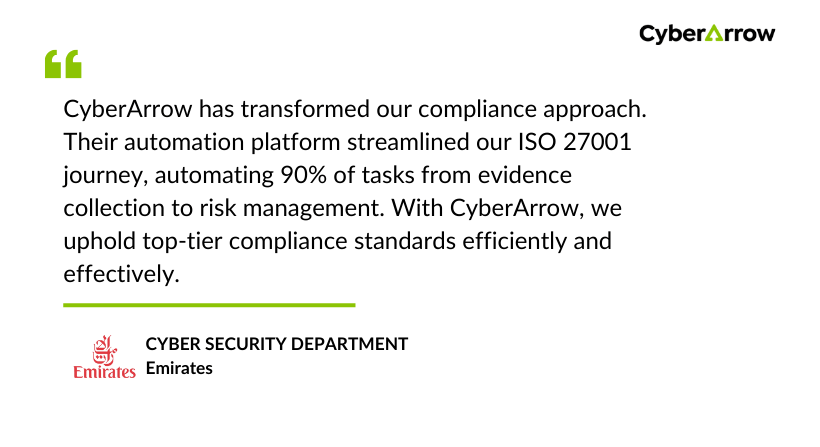
See what Emirates Development Bank has to say about CyberArrow GRC: