What is a security assessment? Types and steps to perform security assessments
When it comes to keeping sensitive data and systems safe, organizations can’t afford to be complacent. Cyberattacks are on the rise, and they keep getting more sophisticated. A security breach can lead to financial loss, reputational damage, and legal troubles. So, how do organizations ensure their systems are well-protected?
This is where a security assessment comes into play. In this blog, we’ll explore what a security assessment is, its different types, the steps to perform it, and how solutions like CyberArrow GRC can help automate and simplify the process.
What is a security assessment?
A security assessment is a comprehensive evaluation of an organization’s information systems and processes to identify security weaknesses, risks, and vulnerabilities. The primary goal is to determine if the existing security measures are adequate or need improvement. By conducting regular assessments, organizations can protect themselves against potential cyber threats, meet compliance requirements, and strengthen their overall security posture.
Security assessments help answer questions like:
- Are there any vulnerabilities in our network?
- How effective are our security measures?
- Are we complying with industry regulations?
Types of security assessments
Different types of security assessments are used depending on an organization’s needs.
Here are some of the most common types:
Vulnerability Assessment
This type of assessment scans systems, networks, and applications for known vulnerabilities. It provides a detailed report on security weaknesses but does not exploit them. The focus is on identifying and prioritizing risks based on their potential impact.
Penetration testing (Pen testing)
Pen testing simulates real-world attacks to evaluate how well an organization’s systems can withstand them. Ethical hackers use controlled attacks to exploit vulnerabilities. The goal is to uncover weaknesses before cybercriminals do.
Risk assessment
A risk assessment focuses on identifying potential risks that could harm the business, assessing their likelihood and potential impact, and providing recommendations for risk mitigation. This type of assessment often aligns with business goals and regulatory compliance.
Compliance assessment
This assessment checks whether the organization meets specific industry regulations and standards, such as GDPR, HIPAA, or ISO 27001. Compliance assessments help organizations stay aligned with legal and regulatory requirements.
Security posture assessment
This type of assessment evaluates the overall effectiveness of an organization’s security measures, policies, and procedures. It takes a broad view of the security landscape to ensure the organization is ready to handle different threats.
Application security assessment
This assessment focuses on identifying and mitigating security vulnerabilities in software applications, both during development and after deployment.
Steps to perform a security assessment
A successful security assessment requires a structured approach. Here are the key steps involved:
1. Define the scope
Before starting a security assessment, clearly define its scope. Identify which systems, networks, applications, and processes will be assessed. Having a well-defined scope ensures that the assessment focuses on the areas that matter most.
2. Gather information
Collect all relevant information about the systems and processes within the defined scope. This may include network diagrams, system configurations, security policies, and user roles. This phase helps assessors understand the environment they are evaluating.
3. Identify threats and vulnerabilities
Use various tools and techniques to identify potential security threats and vulnerabilities. This involves vulnerability scanning, manual testing, and threat modeling to identify exploitable weaknesses.
4. Assess risks
Not all vulnerabilities pose the same level of risk. In this step, evaluate the potential impact and likelihood of each identified threat or vulnerability. This risk assessment helps prioritize which security issues need immediate attention.
5. Perform testing
Depending on the type of security assessment, this step may involve ethical hacking, penetration testing, or compliance checks. Testing simulates attacks or evaluates the organization’s adherence to security standards.
6. Analyze findings
Once testing is complete, analyze the results to determine how existing security measures performed. Identify gaps, weaknesses, and potential areas for improvement.
7. Develop recommendations
Based on the findings, provide actionable recommendations to improve the organization’s security posture. Recommendations may include patching vulnerabilities, updating security policies, and implementing new security controls.
8. Create a report
Document the entire security assessment process, findings, and recommendations in a detailed report. This report should be clear, easy to understand, and actionable, helping stakeholders make informed decisions about their security strategy.
9. Implement improvements
Work with relevant teams to address the identified issues and implement recommended improvements. This may involve patching software, changing network configurations, or updating policies.
10. Monitor and review
Security is an ongoing process. Regularly monitor and review security measures to ensure they continue to protect the organization against evolving threats. Continuous assessments can help organizations stay one step ahead of cybercriminals.
CyberArrow GRC to automate security assessments
Performing regular security assessments can be time-consuming and complex, especially for organizations with large systems. This is where CyberArrow GRC can make a difference.
CyberArrow GRC is a comprehensive platform that automates security assessments, making it easier for organizations to evaluate their security posture and meet cyber security compliance standards.
Here’s how CyberArrow GRC can help:
- Automated assessments: Save time and reduce errors with automated security assessments. CyberArrow GRC performs regular scans and provides insights into vulnerabilities and risks without manual intervention.
- Compliance management: Stay aligned with industry standards and regulations effortlessly. CyberArrow GRC helps businesses meet compliance requirements such as ISO 27001, GDPR, and others by automating compliance checks and offering detailed reports.
- Centralized dashboard: Manage all aspects of your security assessment process from a single, user-friendly dashboard. Get real-time updates and actionable insights at your fingertips.
- Security posture analysis: CyberArrow GRC provides an in-depth analysis of your security posture, highlighting areas that need improvement and offering practical recommendations to address them.
- Continuous monitoring: Cyber threats are constantly evolving. CyberArrow GRC provides continuous monitoring to keep your organization protected at all times, not just during periodic assessments.
Conclusion
Regular security assessments are essential for any organization that wants to protect itself against cyber threats. By identifying vulnerabilities and risks, businesses can strengthen their defenses, meet compliance standards, and improve their security posture.
CyberArrow GRC simplifies the security assessment process through automation, making it easier to protect sensitive data, align with regulations, and stay ahead of evolving threats.
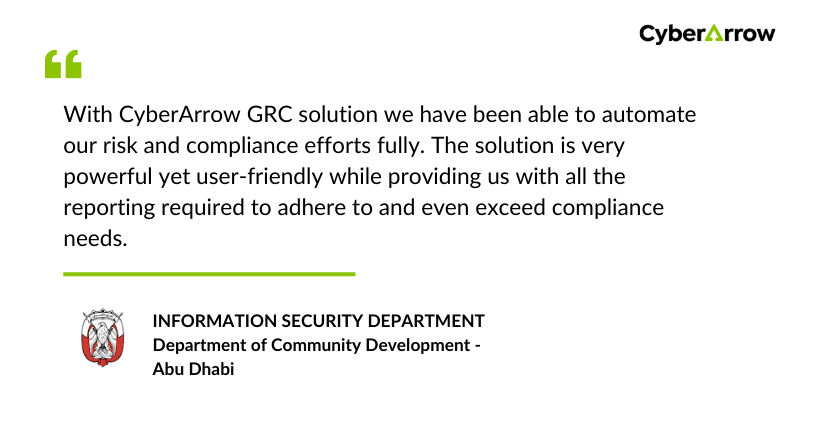
Read how CyberArrow improved risk assessments for DCD – Abu Dhabi.
See what DCD – Abu Dhabi has to say about CyberArrow GRC: