


What is medical compliance? How to achieve it?
Medical compliance is a critical part of today’s healthcare industry. It ensures that healthcare providers, insurance companies, and other related organizations follow the rules designed to protect patient safety, privacy, and data. These rules and regulations are not just legal obligations, they’re essential for building trust, avoiding costly mistakes, and delivering quality care.
From handling patient records to managing billing systems and using medical devices, every step in the healthcare process must meet strict standards. Failing to follow these standards can lead to serious consequences like lawsuits, financial penalties, and damage to reputation. That’s why understanding medical compliance and knowing how to achieve it is so important for any organization working in or around healthcare.
In this blog, we’ll explore what medical compliance really means, why it matters, which major standards apply (like HIPAA and HITECH), and how your organization can stay fully compliant. We’ll also show you how automation tools like CyberArrow GRC can make this process faster, easier, and more reliable.
- What is medical compliance?
- Why is medical compliance so important?
- Main medical compliance standards
- 1. HIPAA – Health Insurance Portability and Accountability Act
- 2. HITECH – Health Information Technology for Economic and Clinical Health Act
- 3. FDA Regulations for Medical Devices
- 4. CMS – Centers for Medicare & Medicaid Services
- 5. GDPR – General Data Protection Regulation (for EU healthcare providers)
- Who needs to follow medical compliance?
- How to achieve medical compliance (Step-by-step)
- Common medical compliance challenges
- How CyberArrow GRC can help you automate medical compliance
- Final thoughts
What is medical compliance?
Medical compliance means following all the rules, laws, and standards that protect patients’ health and personal information. These rules also guide how healthcare workers, systems, and data should be managed.
Compliance in healthcare covers:
- Protecting patient privacy and data.
- Following rules for billing and insurance.
- Keeping medical devices and systems secure.
- Training staff to do the right thing.
If a healthcare organization doesn’t follow these rules, it can face:
- Heavy fines.
- Legal trouble.
- Loss of reputation.
- Patient harm.
Why is medical compliance so important?
Healthcare is all about trust. Patients share private health details with doctors, nurses, and labs. If this data is lost or misused, it can cause serious problems.
Here’s why medical compliance matters:
- Protects patient safety and privacy.
- Prevents fraud, waste, and abuse.
- Improves care quality.
- Avoids costly penalties and lawsuits.
- Builds trust with patients, partners, and regulators.
In short, compliance isn’t just a checklist. It’s a must for safe and lawful medical care.
Main medical compliance standards
Now let’s look at the most important laws and standards that healthcare organizations must follow. These vary by country, but in this blog, we’ll focus mostly on U.S.-based regulations since they are widely followed around the world.
1. HIPAA – Health Insurance Portability and Accountability Act
HIPAA is one of the most well-known medical compliance standards. It was passed in the U.S. in 1996. It protects sensitive patient data, also called Protected Health Information (PHI).
HIPAA requires organizations to:
- Keep patient data private and secure.
- Give patients access to their own health records.
- Report breaches of PHI.
- Train employees on data handling.
- Use secure systems and technologies.
HIPAA applies to:
- Hospitals.
- Clinics.
- Labs.
- Insurance companies.
- Business associates (e.g. billing or IT vendors).
Quick link: Understanding the HIPAA Notice of Privacy Practices
2. HITECH – Health Information Technology for Economic and Clinical Health Act
HITECH works together with HIPAA. It promotes the use of electronic health records (EHRs) and increases penalties for data breaches. It also requires notification to affected individuals and the government when a breach occurs.
3. FDA Regulations for Medical Devices
The Food and Drug Administration (FDA) in the U.S. controls the safety and quality of medical devices. If you sell or use software or hardware used in patient care (like heart monitors, infusion pumps, or diagnostic tools), you must follow FDA rules for:
- Testing.
- Labeling.
- Reporting issues.
- Managing risks.
4. CMS – Centers for Medicare & Medicaid Services
CMS sets rules for how medical providers bill for care, especially if they serve Medicare or Medicaid patients. These rules help prevent fraud and overbilling.
5. GDPR – General Data Protection Regulation (for EU healthcare providers)
If your healthcare organization deals with patients in the European Union, you must follow GDPR rules. These laws protect personal data and privacy across Europe, and they’re stricter than many U.S. laws.
Who needs to follow medical compliance?
Medical compliance is not just for hospitals. Many businesses and professionals in the healthcare space must comply, including:
- Doctors and nurses.
- Pharmacies.
- Diagnostic labs.
- Health insurance companies.
- Telehealth providers.
- Medical billing companies.
- Healthcare IT service providers.
- Medical device manufacturers.
Even small clinics and solo practitioners need to meet compliance requirements.
How to achieve medical compliance (Step-by-step)
Following medical compliance rules doesn’t happen overnight. It’s a step-by-step process that needs proper planning, technology, and training.
Step 1: Understand what applies to you
Not every rule applies to every organization. A small clinic will have different requirements than a large hospital or insurance company. First, review:
- Your services.
- Your data systems.
- Who you share data with.
From there, list all the standards that apply HIPAA, HITECH, CMS, etc.
Step 2: Perform a risk assessment
You must identify where you are most vulnerable. A risk assessment looks at:
- Gaps in data security.
- Weak policies or missing documents.
- Untrained staff.
- Systems that don’t follow security best practices.
This helps you build a roadmap for fixing issues.
Step 3: Create and update policies
Every organization should have clear, written policies for:
- Patient privacy.
- Data storage and access.
- Breach response.
- Staff roles and responsibilities.
Make sure these are easy to understand, reviewed regularly, and shared with your team.
Step 4: Train employees
Most data breaches happen because of human error. Train your staff regularly on:
- How to handle patient data.
- What to do in case of a breach.
- How to avoid phishing and social engineering.
Training should be simple, repeatable, and updated often.
Step 5: Use secure technology
Use systems that offer:
- Data encryption.
- Role-based access control.
- Audit logs.
- Automatic backups.
- Breach detection.
This applies to both hardware and software used in patient care or record keeping.
Step 6: Monitor and improve
Compliance isn’t a one-time task. You need to:
- Monitor your systems.
- Track incidents.
- Update policies.
- Re-train your team.
- Stay updated on new laws.
Audits (internal or external) can help you stay on track and prove compliance.
Common medical compliance challenges
While the path to medical compliance is clear, many organizations struggle with:
- Keeping up with changing laws.
- Managing multiple standards at once (HIPAA, OSHA, CMS).
- Limited staff or budget.
- Manual tracking and outdated tools.
- Third-party risks from vendors or partners.
If you rely on paper records or spreadsheets, it’s easy to lose track of your compliance efforts. That’s why many teams turn to automation tools.
How CyberArrow GRC can help you automate medical compliance
CyberArrow GRC is a powerful platform built to simplify compliance across healthcare environments.
Instead of using multiple systems or tracking documents manually, CyberArrow brings everything into one place.
Here’s how CyberArrow supports medical compliance:
- Built-in frameworks: Automatically align with HIPAA, HITECH, CMS, GDPR, and more.
- Cross-framework mapping: Map one control to multiple standards (e.g., HIPAA + NIST + ISO), saving time and reducing repetition.
- Automated risk assessments: Easily identify and manage risks with built-in workflows.
- Policy & document management: Store, update, and distribute your policies in one place.
- Employee training modules: Educate your staff using engaging, easy-to-understand content.
- Incident response tools: Handle data breaches or policy violations in real time.
- Audit-ready reports: Create clear reports for regulators, leadership, or external auditors.
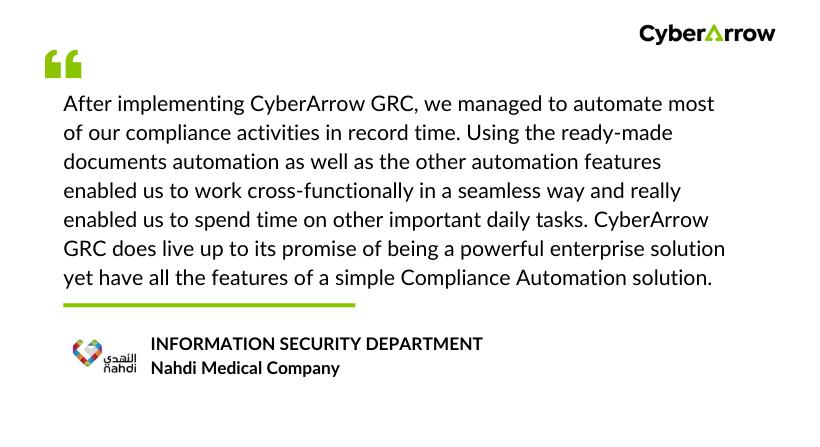
Read how CyberArrow GRC streamlined compliance for Nahdi Medical Company.
See what Nahdi Medical Company has to say about CyberArrow GRC:
Final thoughts
Medical compliance is not optional, it’s the backbone of safe, legal, and trustworthy healthcare. From protecting patient data to preventing billing fraud, every part of your organization has a role to play.
But staying compliant across all rules and frameworks can be overwhelming. That’s where CyberArrow GRC can help. With automation, built-in frameworks, and cross-mapping features, CyberArrow makes medical compliance faster, simpler, and more reliable no matter your size or specialty.
