


What is ISO 27017 compliance? How to get ISO 27017 certification?
As businesses move more of their operations to the cloud, security risks have also increased. Traditional cyber security measures do not fully cover cloud-specific threats, leading to data breaches, unauthorized access, and compliance failures. To address these challenges, the International Organization for Standardization (ISO) developed ISO 27017, a security standard that provides additional controls for cloud service providers and customers.
ISO 27017 compliance helps organizations strengthen their cloud security by offering guidelines for risk management, data protection, and shared responsibility between cloud providers and users. Achieving ISO 27017 compliance demonstrates that a company follows industry best practices for securing cloud environments. However, compliance can be complex, requiring businesses to implement strict security measures, conduct audits, and ensure ongoing monitoring.
This guide will explain what ISO 27017 compliance is, why it matters, and how organizations can achieve certification. It will also discuss how CyberArrow GRC simplifies the compliance process through automation, allowing businesses to achieve and maintain ISO 27017 compliance with minimal effort.
What is ISO 27017 compliance?
ISO 27017 is an extension of ISO 27001, the widely used standard for information security management. While ISO 27001 applies to general IT security, ISO 27017 focuses specifically on cloud security. It provides additional security controls that help organizations mitigate cloud-related risks and establish clear security responsibilities between cloud service providers and customers.
This standard applies to both cloud service providers (CSPs) and organizations that use cloud services. It ensures that data stored in the cloud remains protected, access controls are properly managed, and security policies are clearly defined. By following ISO 27017 guidelines, businesses can improve their cloud security posture and gain trust from customers, partners, and regulators.
Key aspects of ISO 27017 compliance
ISO 27017 introduces additional security controls beyond ISO 27001, addressing challenges unique to cloud environments. Some of the key aspects include:
- Shared security responsibility: ISO 27017 clearly defines the responsibilities of both cloud providers and customers, ensuring that security tasks are not overlooked.
- Cloud data protection: The standard requires encryption and strict access controls to prevent unauthorized data access.
- Incident management: Cloud providers and customers must have procedures in place to detect, respond to, and recover from security incidents.
- Cloud-specific risk assessments: Businesses must regularly assess their cloud security risks and implement appropriate mitigation strategies.
- Third-party risk management: Organizations must ensure that their cloud providers comply with security best practices and regulatory requirements.
By implementing these measures, businesses can reduce cloud security risks and meet compliance expectations.
Quick link: ISO 27001 vs ISO 20000
Why is ISO 27017 compliance important?
With more businesses relying on cloud services, cyber security threats have become more sophisticated. Many organizations assume that cloud providers are solely responsible for security, but ISO 27017 clarifies that security is a shared responsibility.
Achieving ISO 27017 compliance offers several key benefits:
- Stronger cloud security: Organizations can implement better security measures to protect sensitive data and prevent cyber threats.
- Regulatory compliance: Many industries require businesses to follow strict security regulations. ISO 27017 helps organizations meet these requirements.
- Increased customer trust: Customers and partners prefer working with businesses that follow security best practices. ISO 27017 compliance enhances credibility.
- Risk reduction: By identifying and addressing cloud security risks, businesses can prevent costly data breaches and downtime.
For companies that handle sensitive information in the cloud, ISO 27017 compliance is essential to maintain security and business continuity.
How to get ISO 27017 certification?
Unlike ISO 27001, which is a certifiable standard, ISO 27017 is not a standalone certifiable standard. Organizations cannot receive an official ISO 27017 certification, but they can adopt its best practices to enhance cloud security.
Instead of being a separate certification, ISO 27017 serves as an extension of ISO 27001. Businesses that implement ISO 27017 controls typically get certified under ISO 27001, with additional measures demonstrating their commitment to cloud security best practices.
To align with ISO 27017, organizations should follow these steps:
1. Achieve ISO 27001 certification first
Since ISO 27017 builds on ISO 27001, organizations should first work toward ISO 27001 certification. This includes:
- Implementing an Information Security Management System (ISMS).
- Defining security policies and risk management strategies.
- Conducting security audits and maintaining compliance documentation.
Once a business is ISO 27001 certified, it can apply ISO 27017 controls to enhance cloud security.
2. Implement ISO 27017 controls for cloud security
Organizations should integrate ISO 27017-specific controls into their ISO 27001 framework. These controls help address shared security responsibilities, cloud risk management, and data protection in cloud environments.
Key steps include:
- Defining security roles between cloud providers and customers.
- Implementing strong encryption and access control policies.
- Enhancing incident response strategies for cloud security threats.
- Conducting regular risk assessments to detect vulnerabilities.
3. Conduct internal audits to validate compliance
Even though there is no formal ISO 27017 certification, organizations should still conduct internal audits to ensure compliance with its security guidelines.
These audits help businesses:
- Identify security gaps in their cloud security posture.
- Improve risk mitigation strategies.
- Ensure that ISO 27017 controls are effectively implemented.
4. Get ISO 27001 certification with ISO 27017 best practices
Since ISO 27017 cannot be certified independently, organizations that want to demonstrate compliance should obtain ISO 27001 certification while highlighting their adherence to ISO 27017 controls.
During the ISO 27001 certification audit, organizations can show how they have incorporated ISO 27017 security measures into their cloud security framework. This helps businesses stand out as trusted cloud security leaders.
Quick link: What is employment identity theft
Challenges in ISO 27017 compliance
Achieving ISO 27017 compliance can be time-consuming and complex. Organizations often face challenges such as:
- Managing multiple security standards: Many businesses need to comply with multiple frameworks, including ISO 27001, ISO 20000, ISO 27035, and ISO 22301.
- Tracking compliance efforts: Keeping track of security measures, risk assessments, and audit reports manually can be difficult.
- Preparing for certification audits: Gathering documentation and ensuring compliance across cloud environments requires significant effort.
These challenges highlight the need for an automated compliance solution.
How CyberArrow GRC automates ISO 27017 compliance
CyberArrow GRC is a powerful compliance automation platform that simplifies the process of achieving and maintaining ISO 27017 compliance. It helps organizations reduce manual effort, improve security monitoring, and streamline compliance management.
Key features of CyberArrow GRC
- Automates compliance tasks, reducing time and effort required for certification.
- Cross-mapping feature aligns ISO 27017 with other standards, such as ISO 27001, ISO 27035, and ISO 22301, ensuring compliance across multiple frameworks.
- Provides real-time security monitoring to detect threats and vulnerabilities.
- Automates risk assessments to identify and mitigate cloud security risks.
- Generates audit-ready reports, making it easier to pass certification audits.
- Supports 80+ integrations, connecting with cloud security tools for seamless compliance management.
- Includes a native awareness module to educate employees on cloud security best practices.
By using CyberArrow GRC, organizations can accelerate their ISO 27017 compliance process and reduce the risks associated with cloud security.
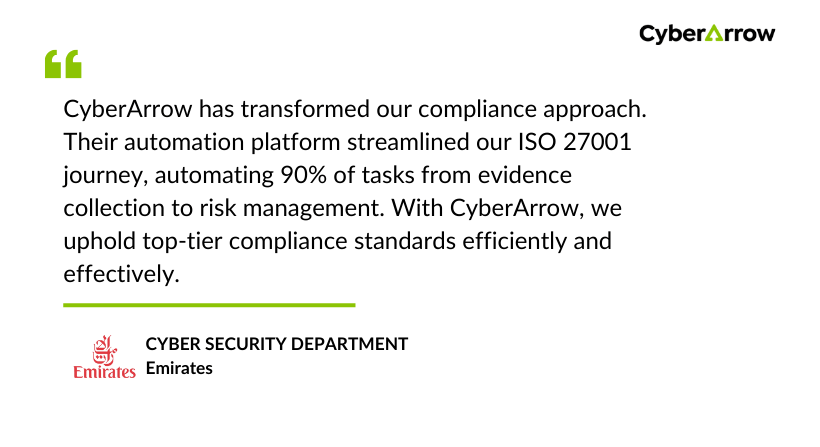
See how Emirates enhanced Information Security by automating ISO 27001 with CyberArrow GRC.
See what Emirates has to say about CyberArrow GRC:
Conclusion
ISO 27017 compliance is essential for businesses that operate in the cloud, providing security controls tailored to cloud environments. Achieving ISO 27017 compliance demonstrates a company’s commitment to protecting sensitive data and following security best practices. However, the compliance process can be challenging, requiring businesses to implement security measures, conduct audits, and maintain ongoing monitoring.
With CyberArrow GRC, organizations can automate their compliance efforts, reduce manual workload, and achieve ISO 27017 compliance faster. By streamlining risk assessments, monitoring security in real time, and ensuring cross-mapping against multiple compliance standards, CyberArrow GRC simplifies cloud security management.
FAQs
Is ISO 27017 certifiable?
No, ISO 27017 is not a certifiable standard. It is a guidance framework that provides additional security controls for cloud environments. Organizations cannot receive an ISO 27017 certification, but they can implement its best practices to strengthen cloud security. Instead, businesses should get ISO 27001 certification and apply ISO 27017 controls to enhance their cloud security posture.
How does ISO 27017 differ from ISO 27001?
ISO 27001 is a certifiable standard that establishes an Information Security Management System (ISMS), while ISO 27017 is a guidance framework focused on cloud security best practices. ISO 27017 extends ISO 27001 by providing additional security measures for cloud service providers and customers, helping them define shared security responsibilities, risk management, and access controls.
Why should businesses implement ISO 27017?
Businesses should implement ISO 27017 to strengthen cloud security, reduce cyber risks, and build customer trust. It provides clear guidelines for securing cloud environments, ensuring that organizations properly manage data security, compliance, and vendor relationships. Even though it is not a certifiable standard, following ISO 27017 best practices helps organizations improve their ISO 27001 compliance and enhance overall cyber security.
