

What is a DDoS booter / IP stresser?
Cyberattacks have become a growing threat to businesses, government organizations, and even individuals. One of the most common and dangerous cyberattacks is the Distributed Denial of Service (DDoS) attack. These attacks aim to overwhelm a network, website, or online service with an excessive amount of traffic, making it unavailable to legitimate users.
Many of these attacks use DDoS booters and IP stressers—powerful tools that allow attackers to launch large-scale cyber disruptions with minimal effort.
But what exactly are DDoS booters and IP stressers? Are they legal? How do they work, and how can organizations protect themselves?
In this guide, we will provide a comprehensive understanding of these cyber threats and offer best practices to defend against them.
What is an IP stresser?
An IP stresser is a tool designed to test the strength and reliability of a network or server by simulating high traffic loads. These tools were originally created for legitimate stress testing—helping businesses and IT professionals evaluate whether their infrastructure can handle sudden surges in web traffic.
However, IP stressers are often misused for illegal purposes, such as launching DDoS attacks against websites, businesses, and individuals. Cybercriminals use these tools to flood a target system with massive amounts of requests, causing it to slow down or crash entirely.
How does an IP stresser work?
IP stressers operate by sending a large number of connection requests or data packets to a target server or network. Here’s how they typically function:
- The attacker selects a target: A website, server, or online service.
- The attack configuration is set: The attacker chooses the type of attack, duration, and intensity.
- Traffic is generated: The tool bombards the target with excessive requests.
- Server overload occurs: The target system becomes unresponsive or crashes.
While some businesses use IP stressers legally for network testing, their misuse in cyberattacks has led to increased scrutiny and regulation.
What is a DDoS booter?
A DDoS booter (also known as a booter service) is an on-demand attack tool used to launch large-scale DDoS attacks. Unlike IP stressers, which are sometimes used for legal testing, booters are specifically designed for illegal activities.
How DDoS booters work
Booter services operate on a pay-per-use model, where attackers can purchase access to DDoS attack capabilities. These services are commonly advertised on the dark web, but some even operate openly under misleading names.
DDoS booters typically function by:
- Using botnets: A network of compromised devices (computers, IoT devices) controlled remotely.
- Generating high-volume traffic: Sending floods of data to the target.
- Crashing systems: Overwhelming the target until it becomes unusable.
Many cyber criminals use DDoS booters for:
- Taking down competitors’ websites
- Extorting businesses for ransom (Ransom DDoS or RDoS attacks)
- Disrupting online gaming servers
- Harassing individuals or organizations
Due to their illegal nature, law enforcement agencies worldwide actively work to shut down booter services and arrest operators.
Quick link: Spam vs phishing
Legal status of IP stressers and DDoS booters
Are IP stressers legal?
IP stressers are legal only when used for ethical testing with permission. Organizations can use them to check their own network security and infrastructure resilience.
However, using an IP stresser to attack someone else’s network without consent is illegal.
Are DDoS booters legal?
DDoS booters are completely illegal. Authorities consider them cybercrime tools, and operating or using them can lead to severe penalties.
Legal consequences
Many countries have strict anti-DDoS laws:
- United States: The Computer Fraud and Abuse Act (CFAA) criminalizes unauthorized attacks.
- European Union: The EU Cybercrime Directive treats DDoS attacks as a serious offense.
- United Kingdom: The Computer Misuse Act prohibits unauthorized cyberattacks.
- United Arab Emirates: The UAE Cybercrime Law imposes strict penalties on cybercriminals.
Cybercriminals convicted of using booters or Stressers for malicious purposes can face heavy fines and long-term imprisonment.
How to protect against IP stressers and DDoS booters
With DDoS attacks becoming more sophisticated and accessible, organizations must adopt proactive security measures. Here’s how to defend against these threats:
1. Use DDoS protection services
Many cyber security companies offer DDoS mitigation services that detect and block attacks before they cause harm.
2. Implement network traffic filtering
Firewalls, Intrusion Detection Systems (IDS), and Intrusion Prevention Systems (IPS) can analyze incoming traffic and block malicious requests.
3. Enable rate limiting
By restricting the number of requests a user can make within a certain time frame, DDoS attacks become less effective.
4. Deploy load balancing
Distributing traffic across multiple servers prevents a single system from becoming overloaded.
5. Conduct real-time traffic monitoring
Using Security Information and Event Management (SIEM) tools, organizations can detect unusual spikes in traffic and respond quickly.
6. Train employees on cyber security awareness
Human error is one of the biggest security risks. Employees should be trained to recognize potential threats and respond effectively.
Quick link: What is a Smurf attack?
CyberArrow Awareness Platform: Strengthening cyber security awareness
One of the most effective ways to protect against cyber threats like DDoS booters and IP stressers is continuous security awareness training.
Why choose CyberArrow Awareness Platform?
- Automated cyber security training to educate employees
- Simulated cyberattacks to test real-world security readiness
- Detailed reports to measure cyber security awareness levels
- Compliance support to meet regulatory requirements
By empowering employees with the right knowledge and skills, organizations can transform their workforce into a human firewall against cyber threats.
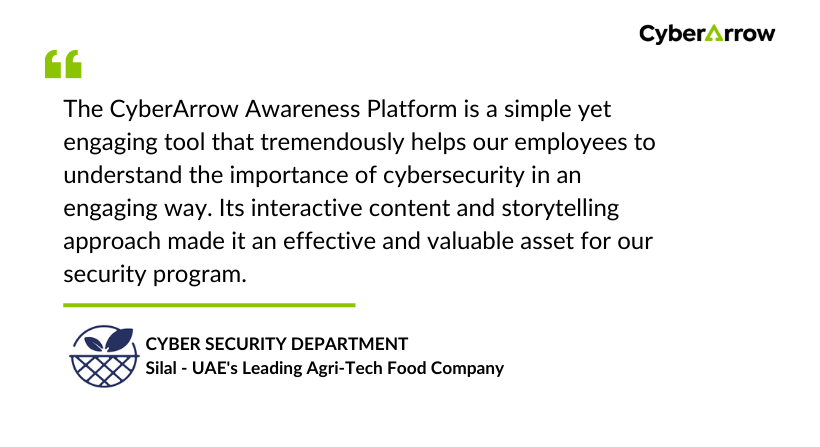
Read how CyberArrow Awareness Platform increased security awareness among Silal’s employees.
See what Silal has to say about CyberArrow Awareness Platform:
Conclusion
DDoS booters and IP stressers are dangerous tools that threaten businesses, governments, and individuals. While some IP stressers have legitimate uses, their misuse for launching cyberattacks is illegal and punishable by law.
Organizations must adopt strong cyber security measures such as DDoS protection, network filtering, and employee awareness training to safeguard against these threats.
Investing in CyberArrow Awareness Platform ensures that employees are well-equipped to recognize and prevent cyber threats, helping organizations build a strong defense against cyberattacks.
Cyber security is not an option, it’s a necessity. Stay protected!
